Mythos Preview Parameter Scale Analysis: 10 Trillion Parameters and the Validation of Scaling Law

Multi-dimensional analysis suggests Anthropic's Mythos Preview may be a ~10T parameter model validating Scaling Law.
Through three independent lines of evidence—pricing reverse-engineering, benchmark performance paradoxes, and compute estimation from Project Rainier—this analysis argues that Anthropic's Mythos Preview is likely a ~10 trillion parameter model. Combined with leadership statements emphasizing Scaling Law's continued validity, this convergence suggests pre-training scale-up still yields meaningful capability gains despite widespread industry skepticism about scaling limits.
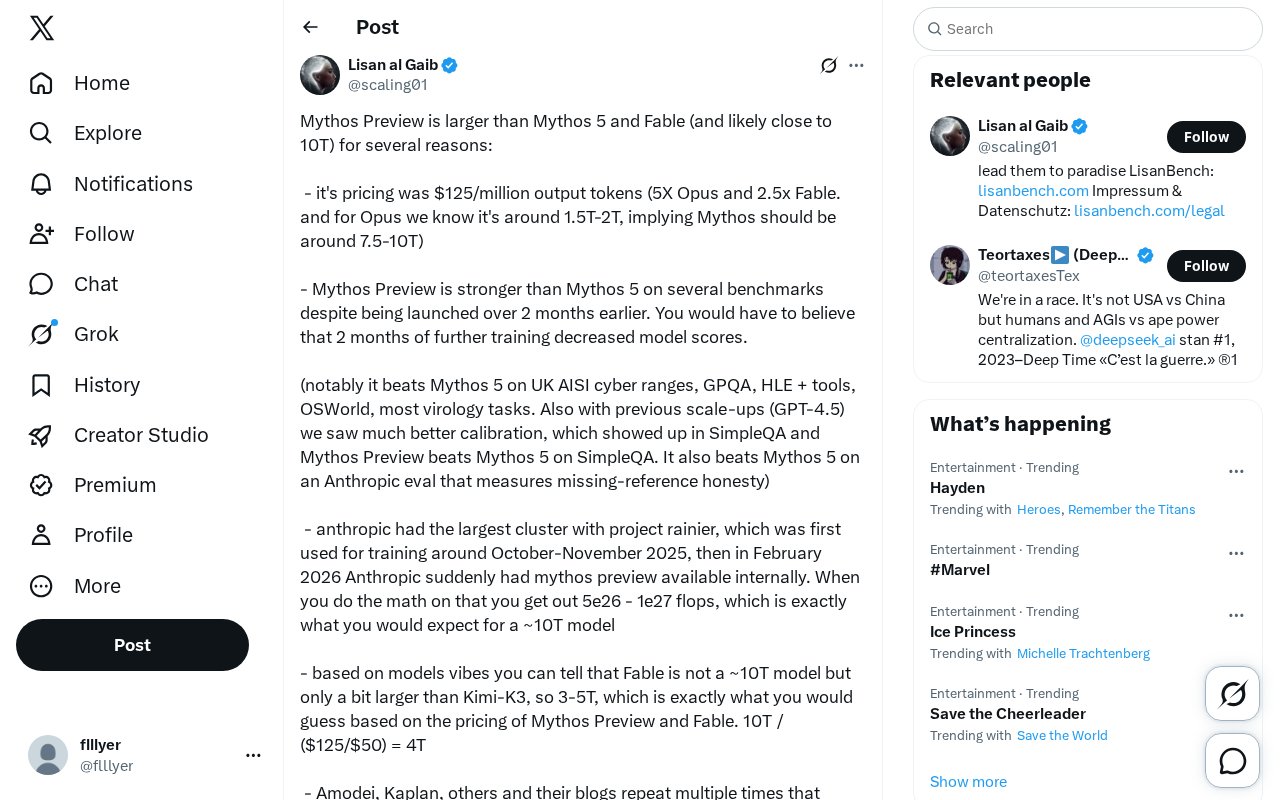
Recently, a tweet about Anthropic's next-generation model "Mythos Preview" sparked widespread discussion in the AI community. Through cross-referential analysis across multiple dimensions including pricing, benchmarks, and compute estimates, the author reached a striking conclusion: Mythos Preview is very likely a super-large-scale model approaching 10 trillion (10T) parameters, exceeding both Mythos 5 and Fable in scale.
This article walks through the complete logical chain of this analysis and explores its implications for the core question of whether "Scaling Law remains valid."
Reverse-Engineering Mythos Preview's Parameter Scale from Pricing
The first line of evidence comes from pricing. According to the tweet, Mythos Preview's output token pricing is as high as $125 per million tokens—5x that of Opus and 2.5x that of Fable.
The Relationship Between Pricing and Model Parameter Count
In the commercialization of large models, inference cost (which directly influences pricing) is typically approximately proportional to a model's active parameter count. The technical rationale is straightforward: in the Transformer architecture, generating each token requires a forward pass through all layers, and the computation scales roughly linearly with active parameters. For dense models, active parameters equal total parameters; for Mixture of Experts (MoE) models, only a subset of expert networks are activated per inference, so active parameters are far smaller than total parameters. Within a single vendor's product line, since inference optimizations (such as KV-Cache, speculative decoding, quantization, etc.) are typically applied uniformly, pricing ratios still roughly reflect model scale ratios.
The author uses Opus as an anchor point for estimation:
- Opus's parameter count is widely believed to be in the 1.5T–2T range;
- If Mythos Preview is priced at 5x Opus, then by linear extrapolation, its scale should fall in the 7.5T–10T range.
The same logic applies to Fable. The author estimates Fable's pricing at approximately $50 per million tokens, and through the calculation 10T / ($125/$50) = 4T, infers that Fable is in the 3T–5T range—"only slightly larger than Kimi-K3." This figure corroborates assessments derived from model "vibes."
It's worth noting that pricing doesn't perfectly equal cost—vendors also factor in market strategy, profit margins, and other considerations—so this estimation carries some margin of error. But as one of several independent lines of evidence, it provides valuable order-of-magnitude reference.
Benchmark Performance: Why an Earlier-Released Model Is Stronger
The second line of evidence comes from a temporal paradox in benchmark results.
The Anomaly of an Earlier Release Outperforming a Later One
Mythos Preview was released more than two months before Mythos 5, yet it outperforms Mythos 5 on multiple benchmarks, including:
- UK AISI cyber ranges (UK AI Safety Institute cybersecurity evaluation)—this institution was established by the UK government for frontier AI assessment; its cyber ranges simulate real-world cybersecurity attack and defense scenarios, testing models on vulnerability discovery, code auditing, and more
- GPQA (Graduate-level expert Q&A)—developed by NYU and other institutions, containing 448 questions requiring PhD-level expertise to answer, designed to test deep reasoning and specialized knowledge
- HLE + tools (Humanity's Last Exam with tool use)—an extremely difficult evaluation set jointly launched by Scale AI and multiple researchers, aggregating cutting-edge high-difficulty problems across disciplines
- OSWorld (operating system environment tasks)—evaluating a model's ability to execute complex tasks in real operating system environments, such as file operations and application usage
- Most virology tasks
These evaluations span multiple dimensions from knowledge depth to practical operations. When a model simultaneously outperforms another across all these metrics, it typically indicates a systematic improvement in foundational capabilities rather than single-dimension optimization.
The author's reasoning: if Mythos Preview and Mythos 5 were the same scale, then Mythos 5—released two months later with two additional months of training—should logically be stronger. "Unless you believe that two extra months of training actually lowered the model's scores"—which is clearly unreasonable. The more plausible explanation is that Mythos Preview is inherently a larger-scale model.
Calibration Improvements Corroborate Scale Increase
More subtle evidence lies in the model's calibration capability. In machine learning, calibration refers to the alignment between a model's output confidence and its actual accuracy—a well-calibrated model that expresses "90% certainty" is indeed correct approximately 90% of the time. Research shows a positive correlation between calibration ability and model scale: larger models possess richer internal representations, enabling more fine-grained distinction between "definitely knows," "vaguely remembers," and "completely doesn't know" knowledge states.
Historically, when model scale increases significantly (e.g., from GPT-4 to GPT-4.5), we observe more accurate self-assessment of knowledge boundaries, reflected in evaluations like SimpleQA. SimpleQA is a benchmark developed by OpenAI specifically testing whether models can accurately judge their own knowledge boundaries when facing factual questions—that is, whether to answer or admit ignorance.
Mythos Preview notably outperforms Mythos 5 on SimpleQA, and also surpasses it on an internal Anthropic evaluation measuring "missing-reference honesty"—which further tests whether a model will honestly inform users when it cannot find supporting evidence, rather than fabricating citations. Improvement in calibration is often a characteristic byproduct of scale increases, adding another layer of evidence for the "larger model" hypothesis.
Compute Estimation: The Project Rainier Cluster Training Timeline
The third—and most hardcore—line of evidence comes from FLOPs estimation.
From Cluster Scale to Training Compute
According to the tweet, Anthropic possesses what was then the largest compute cluster: "Project Rainier." This is an ultra-large-scale compute cluster built in partnership between Anthropic and Amazon AWS, reportedly using hundreds of thousands of high-end GPUs (possibly NVIDIA H100 or B200). The cluster was first used for training around October–November 2025. By February 2026, a usable Mythos Preview suddenly appeared within Anthropic.
The author estimates total training compute at approximately 5e26 – 1e27 FLOPs (i.e., 5×10^26 to 10^27 floating-point operations). For reference, GPT-4's training is estimated at roughly 2×10^25 FLOPs, and Llama 3 405B at approximately 4×10^25 FLOPs—meaning Mythos Preview's training compute is 25 to 50 times that of GPT-4.
According to Chinchilla and other compute-optimal training laws, this compute scale "corresponds precisely to a model of approximately 10T parameters." The Chinchilla optimal law, proposed by DeepMind in 2022, has a core formula of: total compute C ≈ 6ND (where N is parameter count and D is training tokens), with optimal training satisfying D ≈ 20N. Thus, if C = 1e27, the optimal configuration is approximately N ≈ 10T parameters and D ≈ 200T tokens. Of course, in practice vendors may adopt "over-training" strategies (training smaller models with more data) based on inference efficiency considerations, but 5e26–1e27 of compute is certainly sufficient to support training a 10T-scale model.
The value of this compute-based evidence is its relative independence from pricing and benchmarks—it starts from the physical constraints of hardware and time, yet arrives at conclusions consistent with the other two lines of evidence. This multi-dimensional cross-validation convergence is what makes the analysis most convincing.
Is Scaling Law Still Valid: Signals from Leadership
Finally, the author cites public statements from Anthropic leadership as "official hints."
Public Statements from Amodei and Kaplan
Anthropic CEO Dario Amodei, Chief Scientist Jared Kaplan, and others have repeatedly emphasized in blog posts that Mythos Preview is "proof that Scaling Law is alive and well."
Notably, Jared Kaplan is one of the core founders of Scaling Law—he co-authored the seminal 2020 paper "Scaling Laws for Neural Language Models" while at OpenAI, systematically articulating the power-law relationships between model performance and parameter count, data volume, and compute. This discovery provided theoretical support for the "bigger is better" approach and directly drove the development of GPT-4, Claude 3, and other large models. Kaplan later joined Anthropic as Chief Scientist, and his personal assertion that Scaling Law remains valid carries special authority.
The author astutely points out: if Mythos Preview were merely a modest 1.5–2x expansion over Opus, leadership would have no reason to repeatedly emphasize that "scaling law works." This repeated emphasis itself implies a genuinely massive scale-up.
Significance for the AI Industry and Necessary Caveats
If this inference is correct, it sends an important signal: at a time when the industry widely questions whether "pre-training scale-up has hit a ceiling," a ~10T parameter model delivering substantial capability improvements would serve as powerful evidence that the scaling route still has room to run.
This context requires further explanation. Starting in the second half of 2024, widespread discussion of a "Scaling Wall" emerged: high-quality training data approaching exhaustion, diminishing marginal returns on model performance, questionable effectiveness of synthetic data training—all leading some researchers to question whether pure scale expansion was nearing its limits. Simultaneously, alternative paths like test-time compute and reinforcement learning post-training gained attention, with OpenAI's o1/o3 series and DeepSeekAd-R1 improving performance by increasing inference-stage computation. Amid this divergence, if Anthropic has indeed achieved a systematic capability leap by expanding pre-training to 10T parameters, it would powerfully counter the "scaling is dead" narrative, suggesting that both paths may be complementary rather than substitutive.
Of course, we should remain cautious. All analysis in this article is based on the Twitter author's reasoning and industry rumors; Anthropic has not officially disclosed exact parameter counts for the Mythos series. Pricing may include non-cost factors, and compute estimates depend on assumptions about cluster configuration. These conclusions should be viewed as reasonable speculation based on public evidence, not confirmation.
Conclusion
Synthesizing four mutually independent lines of evidence—pricing, benchmarks, compute estimation, and official statements—the judgment that "Anthropic possesses a ~10T parameter model" carries considerable credibility. As the author states: "This is barely even a question anymore."
Whether the final number is 7.5T or 10T, this analysis reminds us that in the opaque competition over frontier models, multi-dimensional cross-validation still allows outsiders to sketch the broad contours of large model evolution. And its implications for the Scaling Law thesis will be further tested in model releases over the coming months.
Related articles

GPT-Next Leak, Gemini 4 Argon Imminent: AI News Roundup
GPT-Next leak suggests extreme efficiency; OpenAI's 28-day shipping pledge boosts speed 50%; Gemini 4 Argon nears release; Anthropic subscription value report sparks debate.

GPT-Next Leaked, Gemini 4 Argon Speeds Up, Fable 5.5 May Launch Today
OpenAI's GPT-Next model leaks, expected to be extremely low-cost and possibly part of the 28-day release plan; Gemini 4 Argon internal testing accelerates, NanoBanana 2.1 is live; Semi Analysis tests show Claude Max's equivalent API value is about 5 times that of ChatGPT Pro; Fable 5.5 may launch today.

Gemini 4 Argon Launches Globally: Key Highlights from the AI Daily Brief
Google opens Gemini 4 Argon globally across Pro and Ultra subscriptions and the API, and demonstrates robot control. This article rounds up open-source models, Agent infrastructure, cost transparency, and safety governance updates.