n8n Automation in Practice: The Essential Difference Between Automation and AI Agents

Automation follows fixed rules; AI agents understand intent and make decisions autonomously.
Based on an n8n automation course, this article clarifies the core difference between automation and AI agents: automation executes preset rules step by step with no reasoning, while AI agents use LLMs to understand context, make judgments, and call tools for complex tasks. Using a customer service refund email as an example, the article shows how pure automation mechanically triggers a refund, while an AI agent reads the user's conflicting emotions, offers a discount instead, updates the CRM, and follows up — forming a complete intelligent service chain powered by models like GPT, Claude, or Gemini.
AI Agents are becoming one of the hottest topics in the automation space. Many people who are new to workflow tools like n8n tend to conflate "automation" with "AI agents," but the two differ fundamentally at the logic level. This article, based on content from an n8n automation course, clarifies the capability boundaries of each and uses a real-world customer service scenario to explain why certain tasks genuinely require an AI agent.
The Core Difference Between Automation and AI Agents
To put it as simply as possible: automation "follows rules," while AI agents "make decisions."
Automation is essentially about executing pre-defined, fixed instructions. You define a workflow, and it carries out each step in order — no reasoning, no decision-making room. It can recognize keywords or structured fields in context, but it cannot understand implied meaning, let alone determine which path to take — unless that path was already written into the workflow.
AI agents are different. They have reasoning and decision-making capabilities, allowing them to autonomously determine what to do next based on the current situation. More importantly, AI agents can call tools, adapt to changing scenarios, and aren't locked into executing a rigid script. This flexibility is precisely what makes them so much more valuable than traditional automation.
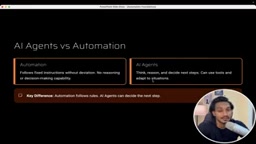
A quick summary of the dividing line:
- Automation: Follows rules, no reasoning or decision-making, relies on fixed instructions
- AI Agents: Understands context, makes decisions, calls tools, adapts to situations
A Customer Service Refund Scenario That Illustrates the Point
The theory can sound abstract, so the example given in the course is quite illuminating.
Imagine a customer who bought a product sends an email to the company saying: "I'd like a refund, but honestly I actually kind of like the product." This email contains contradictory emotions — it both requests a refund and expresses appreciation for the product.
What happens if you handle this email with pure automation? The automated system cannot understand the "I like the product" layer of emotion. It will only pick up on the "refund" signal. As long as the workflow has a refund process configured, it will mechanically trigger it — completely ignoring the recoverable sentiment in the customer's message. It processes explicit fields in the context, not the person's actual intent.
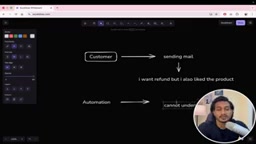
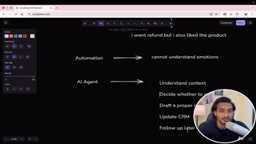
With an AI agent, the situation is entirely different. It can read the full context of the message — the customer wants a refund, but also likes the product. Based on this understanding, the agent can decide whether a refund is actually necessary and draft a more appropriate response: since you like the product, why not keep it? We can offer you a discount or some other form of compensation.
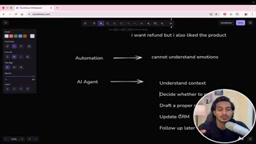
And it doesn't stop there. After handling the interaction, the AI agent can update the CRM system with the outcome, log the customer's feedback, and proactively follow up later: did the refund go through? Are there any issues with the product? The entire chain — understanding, deciding, replying, recording, and following up — is completed autonomously by the agent based on the actual situation.
This scenario actually touches on a classic challenge in natural language processing: separating sentiment from intent. Traditional keyword matching or rule engines can only handle surface-level signals (like "refund"), while real user messages often contain implied intent, contradictory emotions, or even sarcasm. Large language models, having been pre-trained on vast amounts of human text, have developed a holistic understanding of semantics and sentiment. As a result, they can treat "I want a refund" and "but I actually like the product" as two signals that need to be weighed together, rather than simply triggering a single workflow. In real business contexts, this capability can significantly reduce mishandling rates — preventing unnecessary refunds and recovering customers who might otherwise churn — directly impacting a company's refund costs and user retention.
Why AI Agents Are "Smarter"
AI agents can do all of this because they apply "intelligence" to understand what is actually happening. They're not matching keywords — they're comprehending intent, weighing options, and generating appropriate actions.
One of the most powerful aspects of building AI agents in tools like n8n is that almost any step can be connected to an AI model. Whether it's Gemini, GPT, Claude, or any number of other available AI models, all can be plugged into a workflow to power an agent. This brings tremendous flexibility and means you can choose the most suitable model for the task at hand.
From a technical standpoint, an AI agent's "intelligence" comes from the combination of a large language model's (LLM) reasoning capabilities and its tool-calling mechanism. The LLM handles understanding natural language input, generating a chain of reasoning, and deciding the next action. Tool calling (Function Calling / Tool Use) allows the model to proactively trigger external operations during its reasoning process — such as querying a database, calling an API, sending an email, or updating a CRM record. This "perceive → reason → act" loop is commonly referred to in the technical literature as the ReAct (Reasoning + Acting) paradigm. In n8n's implementation, each external capability the agent can invoke is encapsulated as a "tool node," and the agent decides on its own — based on the current conversation context — whether to call it, which one to call, and what parameters to pass. This is the fundamental difference from traditional automation, where every step is prescribed by a human in advance.
Bridging Theory and Practice
It's worth noting that everything covered above is still at the conceptual level. When you actually build a workflow like this, things get "serious" fast — you'll start constructing quite complex processes. To truly grasp the difference between automation and AI agents, you have to implement it yourself.
But before you get there, these foundational concepts are an unavoidable prerequisite. When you go to build it out, you need to have a clear mental model of what each step actually means: when is rule-based automation sufficient, and when do you need to bring in an AI agent capable of making decisions? Understanding this dividing line will keep you from getting lost when building more complex workflows later on.
This is a fundamental skill that must be mastered in any serious n8n learning path — and it's the watershed moment between "getting a simple flow to run" and "building a genuinely intelligent system."
Related articles

Free Unlimited Claude Code Solution: Agnes AI + CC Switch Setup Guide
No paid subscription needed — pair the free AI platform Agnes AI with the open-source tool CC Switch to provide a backend for Claude Code, enabling unlimited free calls to text, image, and video models. This guide covers the full setup, test results, and usage boundaries.

A Complete Zero-Cost Guide to Getting Started with Claude Code for Beginners in China
A beginner's guide to Claude Code for users in China: two installation methods (command line and IDE plugin), full configuration steps for replacing the official API with the free domestic LongCat model, and a hands-on demo of building a small tool with natural language, plus tips.

When the NSA Gets Involved: The AI Supply Chain Crisis Behind Open-Source CVEs and API Key Hijacking
Multiple open-source projects disclosed severe CVEs in one day, PHP flaws alarmed the FBI, and Railway and OpenCode were breached with API keys stolen. This article breaks down the vulnerability window, AI-accelerated exploitation, and the AI supply chain crisis behind the API key black market, with a developer defense checklist.