n8n Beginner's Guide: A Complete Guide to Building AI Automation Workflows

A complete beginner's guide to building AI automation workflows with n8n's low-code platform.
This guide introduces n8n as a low-code workflow automation platform, covering its 500+ node integrations, flexible process orchestration, and native AI capabilities. It details the three core AI modules—AI Agents, Chain nodes, and Tool nodes—for building intelligent workflows and RAG systems, while analyzing n8n's limitations for China's domestic ecosystem.
What Is n8n? Let's Start with Workflow Automation
Many people hear about n8n for the first time and immediately equate it with AI workflows, but this is actually a common misconception. At its core, n8n is a low-code workflow automation platform. It was originally designed to help users chain together various tasks, not specifically to serve AI purposes.
Low-Code platforms represent a major trend in software development in recent years. The core philosophy is to replace traditional coding with visual drag-and-drop configuration, lowering the technical barrier to entry. Workflow automation itself originates from the BPM (Business Process Management) domain, with early representatives including SaaS tools like Zapier and Make (formerly Integromat). What sets n8n apart is that it's open source (under a Fair-code license), allowing users to self-host their deployments with full control over their data—a critical advantage for organizations sensitive about data privacy. n8n was created in 2019 by Jan Oberhauser, built on Node.js, and uses a visual Directed Acyclic Graph (DAG) approach to orchestrate workflows.
Here are a few typical examples: you can use n8n to build a data cleansing workflow, set up an automated web scraping process, or even automate video publishing, comment collection, and analysis. None of these scenarios have anything to do with AI, yet they represent n8n's most fundamental and practical capabilities.
In other words, n8n is first and foremost a "workflow engine"—AI is just one of many directions it extends into. Understanding this is the right starting point for learning n8n.
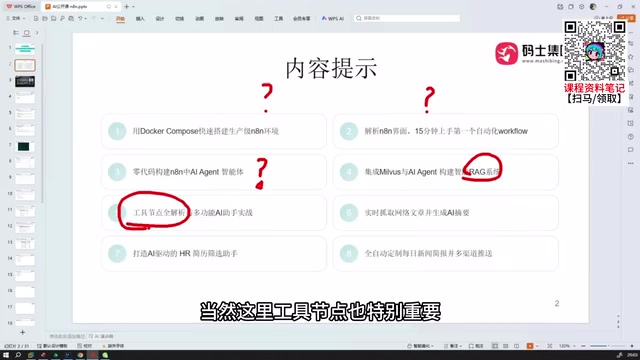
Three Core Features of n8n
Powerful Node Integration
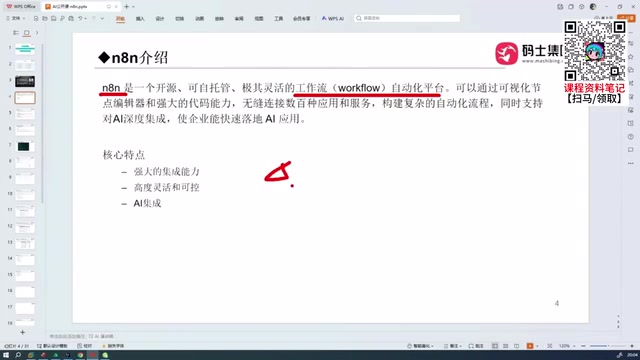
n8n's most prominent advantage lies in its vast node ecosystem. "Nodes" here share the same concept as those in platforms like Dify and Coze—each node handles a specific function. For example, one node publishes content on a video platform, another scrapes data from web pages, and yet another fetches news articles.
In n8n's architecture, each node is essentially an abstraction layer wrapping an external service's API. APIs (Application Programming Interfaces) are the standard way for different software systems to communicate, typically based on REST or GraphQL protocols. n8n's nodes encapsulate complex API authentication (OAuth2, API Keys, etc.), request construction, and response parsing into simple form configurations, so users don't need to understand the underlying HTTP protocol details. Unlike AI-native platforms such as Dify and Coze, n8n's node coverage extends far beyond AI, spanning CRM, ERP, databases, message queues, file storage, and virtually every aspect of enterprise IT infrastructure.
n8n officially supports at least 500+ nodes, with some counts suggesting over 1,000. In comparison, platforms like Dify and Coze typically offer far fewer native nodes. A rich node ecosystem means stronger out-of-the-box integration capabilities—many requirements can be addressed directly without writing code.
Highly Flexible Process Orchestration
n8n's second major feature is its flexibility in process orchestration. You can combine branching nodes, loop nodes, error handling nodes, data transformation nodes, and more to build business processes with considerable logical complexity.
This means a single workflow can handle multiple layers of business complexity: where data comes from, how it's transformed, how errors are handled, and where results are written—all controlled precisely within the same flow. This ability to compose logic "like building blocks" is what distinguishes n8n from many lightweight automation tools.
Native AI Integration
The third feature—and the focus of this article—is n8n's comprehensive AI integration capabilities. With n8n, you can build AI Agents, set up RAG systems, and embed large language model capabilities into your automation workflows. We'll dive deep into this in the sections below.
Deep Dive into n8n's Three Core AI Modules
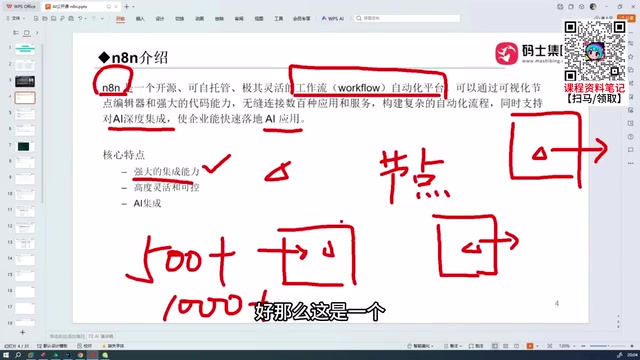
When using n8n for AI scenarios, the core can be broken down into three components. Understanding these three parts gives you the skeleton of n8n's AI capabilities.
AI Agent
This is the most critical component. You can build AI agents within n8n, using a large language model as the "brain" for reasoning and decision-making. The value of an Agent lies in its ability to autonomously determine when to invoke tools and how to organize information, enabling it to complete relatively complex tasks rather than simply engaging in basic question-and-answer exchanges.
AI Agents represent one of the core paradigms in current LLM applications, with their theoretical foundation rooted in the ReAct (Reasoning + Acting) framework. Unlike the traditional Prompt-Response model, Agents possess three core capabilities: Planning, Memory, and Tool Use. In n8n, Agent nodes are implemented based on frameworks like LangChain, with the LLM serving as the reasoning engine and using the Function Calling mechanism to decide when to invoke which tool. This architecture transforms AI from passively answering questions to actively decomposing tasks, executing multi-step processes, self-correcting, and forming complete task loops.
Chain Nodes
n8n provides a category of Chain nodes, divided into three types. These Chain nodes can also integrate with AI to handle different task scenarios. They essentially encapsulate LLM capabilities into reusable processing units, allowing you to select the appropriate chain processing approach based on specific needs.
n8n's Chain node design is heavily influenced by the LangChain framework. LangChain is currently the most popular framework for building LLM applications, and its core concept is the "Chain"—linking multiple processing steps into a pipeline. Common Chain types include: LLM Chain (basic prompt-model invocation chain), Sequential Chain (executing multiple sub-chains in sequence), and Router Chain (dynamically selecting different processing paths based on input). n8n visualizes these programming concepts, enabling non-developers to build complex AI processing pipelines through drag-and-drop node configuration.
Tool Nodes
The third component consists of tool nodes that work in conjunction with Agents. AI Agents are powerful precisely because they can invoke external tools. n8n includes a variety of built-in tool nodes that Agents can call, ensuring that the intelligent agent isn't limited to text generation but can actually "take action" and execute operations.
In summary, AI Agent + Chain Nodes + Tool Nodes—these three components form the entire core of n8n's deep integration with AI. Around them, you can build everything from simple agents to enterprise-grade RAG systems.
RAG (Retrieval-Augmented Generation) is the mainstream approach for addressing LLM knowledge freshness and hallucination issues. Here's how it works: enterprise private documents are first converted into vectors using an Embedding model and stored in a vector database (such as Pinecone, Weaviate, or Qdrant). When a user asks a question, the system first retrieves relevant document fragments from the vector store, then submits these fragments as context along with the user's question to the LLM for answer generation. Through built-in vector store nodes, document loader nodes, and text splitter nodes, n8n enables users to build complete RAG pipelines without writing any code.
Limitations of Using n8n in China
Given how powerful n8n is, why haven't more Chinese companies adopted it? There's a practical reason behind this: n8n is an international platform.
The vast majority of its 500 to 1,000+ supported nodes are oriented toward the overseas application ecosystem. For instance, it includes a YouTube node for direct video publishing, and Telegram and Instagram nodes for sending messages or pushing content.
But for China's domestic application ecosystem, the situation is entirely different. n8n doesn't have a native Weibo publishing node, nor does it have a node for sending messages directly through WeChat. This means Chinese users face significant limitations when using n8n to connect with local services.
China's domestic workflow automation space also has several corresponding solutions. Tencent's HiFlow (Tencent Cloud Connector), Alibaba's Logic Orchestration Service, and independent products like Jijanyun all attempt to solve the automation connectivity problem within China's application ecosystem. In the AI Agent domain, Dify and Coze (under ByteDance) represent the open-source and commercial paths respectively. n8n's strength lies in its versatility and open-source nature, but its weakness is the lack of native support for mainstream Chinese platforms like WeChat ecosystem, Feishu, DingTalk, and Douyin. However, n8n provides HTTP Request nodes and Webhook nodes, allowing technical teams to connect with any API-enabled service through these general-purpose nodes.
This also explains why n8n hasn't gained widespread adoption in China—its node ecosystem lacks out-of-the-box integration with major domestic platforms. Of course, this doesn't diminish n8n's powerful capabilities as an automation engine; it simply means that when evaluating tools, you need to assess them against your specific business scenarios.
Conclusion: How to Properly Choose and Use n8n
For developers and teams looking to build AI automation workflows, n8n offers a low-code platform that combines flexibility with extensibility. Its value lies not only in AI integration but also in its ability to seamlessly combine AI Agents, Chain nodes, and tool nodes with traditional automation processes.
If your business primarily targets the international ecosystem, n8n is practically a ready-to-use powerhouse. If you're targeting the Chinese market, you'll need to consider bridging the gap in local integrations through custom nodes or HTTP requests. Understanding n8n's positioning and boundaries is the key to truly getting value from this tool.
Key Takeaways
Related articles

FlexBudget: Fair Comparison of KV Cache Eviction Strategies Under a Unified Compute Budget
AMD engineer proposes FlexBudget at PyTorch Conference: a training-free fair comparison method for KV cache eviction rules using fixed kernels and memory budgets, all in core PyTorch.

Anthropic's $2 Trillion Valuation Deconstructed: Why the AI IPO Wave Keeps Faltering

Anthropic IPO Countdown: The Compute Cost Ledger Behind a $2 Trillion Valuation
Anthropic's IPO targets up to $2 trillion — double its Series H valuation. We break down the timeline, compute cost logic, and the key question investor day must answer.