N8N Deep Dive: From Zapier Clone to Open-Source Automation Platform with 200K Stars
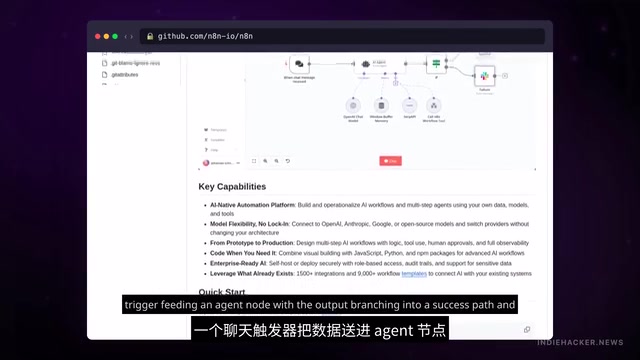
How N8N grew from a free Zapier clone to a 200K-Star open-source automation platform powering AI Agents.
N8N, a workflow automation platform, has exploded to 200K GitHub Stars—half gained in the past year alone—driven by the AI Agent boom. Built on readable JavaScript nodes with escape hatches to code, it features Agent Nodes wrapping LangChain, MCP protocol support, Queue Mode for horizontal scaling, and a pricing model where one execution counts as one regardless of workflow length. Its fair-code license sparks debate but offers a pragmatic middle ground between open source and SaaS.
It All Started with a Free Clone
Six years ago, a visual effects artist gave away a free clone of Zapier as a side project. No one expected this byproduct to grow into a behemoth—in 2024, Zapier, valued at $5.2 billion, turned around and invested in it. It's called N8N, a workflow automation tool that's quietly devouring the entire automation category.
Zapier was founded in 2011 and is one of the pioneers in the Workflow Automation space. Its core philosophy is enabling non-programmers to connect different SaaS applications using "if this, then that" trigger logic. Over the past decade, this market has grown from a niche need into foundational infrastructure for enterprise digital transformation—Gartner classifies it as iPaaS (Integration Platform as a Service). Zapier remained profitable for years without raising significant funding, only beginning to actively invest in its ecosystem when the AI wave arrived. Its investment in N8N was a landmark move in this strategic pivot.
The numbers speak for themselves: N8N has accumulated 202,000 Stars and 60,000 Forks on GitHub, with roughly 112,000 of those Stars gained in the past year alone. In other words, more than half of its total attention is a recent explosion. GitHub Stars are a social signal developers use to bookmark or endorse open-source projects—while they don't directly reflect actual usage or code quality, they're the most commonly used proxy metric for measuring an open-source project's visibility and community momentum. N8N's Star growth curve closely mirrors the AI Agent hype timeline, and that's no coincidence. This growth trajectory, combined with a funding pace that doubled its valuation within seven months, paints the picture of a classic open-source commercialization miracle.
N8N's core mechanic is remarkably intuitive: drag node blocks onto a canvas and connect them with lines. As long as the action you need exists among its 1,500+ supported applications, the workflow triggers automatically. You can even deploy it on a self-hosted server costing $12/month, with no one charging you per execution.
Readable Code Architecture Beneath the Drag-and-Drop Canvas
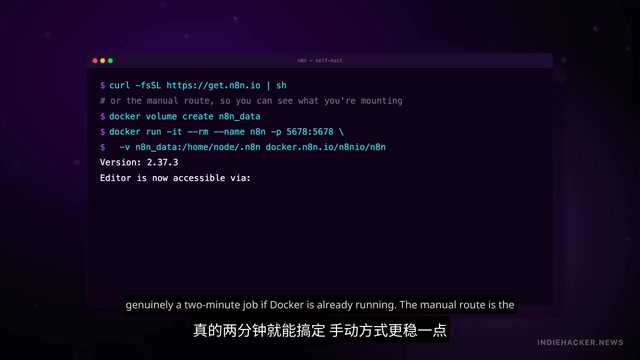
The most underestimated aspect of N8N is this: every node on the canvas is essentially a piece of JavaScript you can open and read. This was established in the early architectural design. This brings a critical benefit—when a node breaks, you can actually understand what went wrong, instead of staring helplessly at a black box.
When pre-built blocks aren't enough, N8N provides a Code Node that lets you write inline JavaScript or Python. Those awkward, non-standard logic patterns in your workflow no longer need to be routed to external services—they can be handled right there. This design philosophy stems from the "low floor, high ceiling" product concept—the entry barrier is low enough (just drag and drop), but the capability ceiling is high enough (write arbitrary code). In the tech community, this pattern is called an "escape hatch"—when visual abstractions fall short, developers can "escape" to the code layer for precise control. N8N supports both JavaScript and Python, covering the two major groups of frontend engineers and data/AI engineers.
Here's a security detail you might have missed: the expression language you type into node fields has its own independent parser package (called Tournament), because it needs a safer approach than feeding user input directly to eval. eval() is a notorious JavaScript function that executes arbitrary strings as code—meaning if user input is passed to eval unfiltered, attackers can inject malicious code to achieve Remote Code Execution (RCE) attacks. N8N developed the Tournament parser specifically for this purpose: it only parses N8N's custom expression syntax and refuses to execute any instructions beyond what's expected.
User code never touches the main process—instead, it runs in isolated Task Runner processes, one per language. This borrows from the browser sandbox approach—Chrome allocates a separate process for each tab so that one tab crashing doesn't affect others. N8N applies a similar isolation strategy to user code. This means a broken piece of code in one workflow won't bring down the entire N8N instance.
The Center of Gravity Shifts in the AI Agent Era
If N8N's earlier years were powered by the breadth of its SaaS integrations, the direction where engineering resources have been heavily invested over the past two years is the Agent Node—and this is N8N's core competitive advantage in the AI automation space.
The Agent Node encapsulates the entire LangChain capability set—a single block can hold a large language model, a memory module, and call other workflows as sub-tasks. LangChain is an open-source framework born in late 2022 that quickly became the de facto standard toolchain for building LLM applications, providing core abstractions like Chain, Memory, Tool Use, and RAG (Retrieval-Augmented Generation). N8N's Agent Node wraps these capabilities into visual nodes, enabling users unfamiliar with the LangChain API to build complex AI Agents. The addition of the memory module is particularly crucial—it allows Agents to maintain context across multiple conversation turns rather than starting from scratch each time, which is a prerequisite for upgrading from "single Q&A" to "continuous task execution." The entire node ecosystem comes with 308 node folders, 409 credential types, and over 11,000 community templates—you almost never need to start from a blank canvas.
At the architecture level, N8N supports Queue Mode: the main process hands tasks to Redis Workers for horizontal scaling, rather than forcing you to buy a bigger machine. In default mode, N8N's main process handles both receiving trigger events and executing workflow logic, easily becoming a bottleneck as concurrency increases. With Queue Mode enabled, the main process only pushes tasks into a Redis message queue (a high-performance in-memory database commonly used as message middleware), and multiple Worker processes pull tasks from the queue for parallel execution. The advantage of this architecture is "horizontal scaling"—you only need to increase the number of Worker instances to linearly boost throughput, without purchasing more expensive individual servers. For production environments handling large volumes of scheduled tasks or Webhook triggers, this is the key architectural choice for upgrading from "toy" to "infrastructure."
The repository also includes both an MCP Client and an MCP Server—meaning a workflow can serve as a tool called by an Agent, or turn around and orchestrate other Agents itself. MCP (Model Context Protocol) is an open protocol released by Anthropic in late 2024, designed to standardize interactions between AI models and external tools. It defines a unified interface specification so that any MCP-compatible Agent can discover and invoke any MCP-compatible tool, without writing custom integration code for each Agent-tool pair. N8N implements both ends of MCP, giving it exceptional flexibility in multi-Agent collaboration scenarios—for example, a data analysis Agent can call an N8N workflow to pull database data, while an N8N workflow can call a text summarization Agent to process results. This bidirectional orchestration capability is exactly what today's AI Agent workflows need most.
Version 2.37 has shipped, and the changelog clearly reveals the team's focus: Agent Sessions now display tool failures directly on the canvas timeline, distinguishing between severe and minor failures; Messages and Agent Workflows have added Streaming, so responses can return token by token; and the Anthropic Node has gained Prompt Caching, directly reducing costs for scenarios that repeatedly send the same lengthy System Prompt. The principle behind Prompt Caching is caching the unchanging prompt prefix on the server side—subsequent calls only need to send the changed portion, and cache-hit tokens are billed at one-tenth of the original price. For high-frequency Agent workflows, this can reduce API costs by 50%-90%. These are all features you'd only think to add after actually debugging Agents in production.

N8N's Pricing Logic: One Execution Counts as One
N8N's business model is frequently compared to competitors, and the pricing difference is a key reason many teams choose N8N.
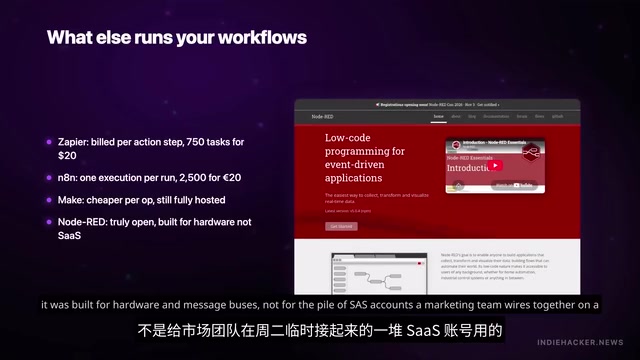
Zapier charges per action step—an eight-step workflow consumes eight Tasks per run, and the starter plan at $20/month only gives you 750 Tasks. Make sits in the middle ground, with cheaper per-operation costs, but you're still fundamentally running on someone else's servers.
N8N's key differentiator: no matter how long the workflow chain is, one execution only counts as one. The corresponding plan gives you 2,500 executions per month. For teams with long workflow steps but manageable execution counts, the math clearly works out better.
Enterprise-tier plans also offer custom Roles and Role Mapping Rules that can pull Group Membership directly from your Identity Provider (such as Okta, Azure AD, and other enterprise identity management systems)—exactly the question platform teams ask before making procurement decisions. Every run leaves behind an Execution History that you can expand step by step per node, and you can Replay with the exact same inputs.
The repository even includes a built-in CRDT package for supporting multi-user collaborative canvas editing. CRDT (Conflict-free Replicated Data Type) is a data structure from the distributed systems domain that allows multiple users to edit the same data simultaneously while guaranteeing all replicas eventually converge to a consistent state automatically, without a central server arbitrating conflicts. Google Docs' real-time collaborative editing and Figma's multi-user simultaneous design rely on similar technology. This means multiple team members can simultaneously drag nodes and modify configurations on the same workflow canvas without encountering operation conflicts.
The Core Controversy: Is N8N Actually Open Source?
The most persistent debate around N8N started the very week it first hit the GitHub front page—it's not open-source software in the strict sense. N8N officially positions itself as "a fair-code platform," with licensing terms displayed prominently on its page rather than buried in a file nobody opens.
Fair-Code is not a standard license type recognized by the OSI (Open Source Initiative), but rather a business model that has emerged in recent years where "source code is visible but usage is restricted." It arose from a long-standing debate in the open-source community: pure open-source licenses (like MIT, Apache 2.0) allow anyone to freely use and distribute software, but also mean cloud providers can offer it as a hosted service without giving back to the community—MongoDB, Elasticsearch, and Redis all changed their licenses for this reason. N8N's chosen Sustainable Use License takes a similar path: source code is fully open, personal and internal enterprise use is unrestricted, but reselling it as a competitive product is prohibited. Critics call this approach "false advertising," but supporters argue it strikes a better balance between developer experience and commercial sustainability. Notable projects like HashiCorp (Terraform) and Sentry have adopted similar non-traditional open-source licenses.
Before deciding to use it, two things must be clarified:
First, commercial restrictions. The terms allow you to run N8N internally within your own company around the clock; but once you want to package it as a product to sell to customers, you need a separate commercial agreement. This frequently catches agencies off guard.
Second, operational costs. Self-hosting means upgrades, maintenance, and 3 AM alerts are all your responsibility. So it's not truly "free"—it just converts the cost into your own time. However, if you're already paying four-figure annual bills to per-task-priced vendors, the time-cost math becomes much easier to justify.
Conclusion: An Underestimated Form of Automation
Putting all these numbers together, N8N's form factor is quite unusual: a contributor list large enough to fill a small conference, an integration directory at enterprise software scale, and behind both sits a growth story of doubling valuation in seven months. It's neither a product of pure open-source idealism nor a closed SaaS black box—instead, it walks the controversial yet remarkably vital middle path of "fair code."
For developers and automation enthusiasts, N8N offers a rare combination of quick drag-and-drop prototyping and deep code-level control—especially now that AI Agent orchestration has become a pressing need, its value is being repriced.
Related articles
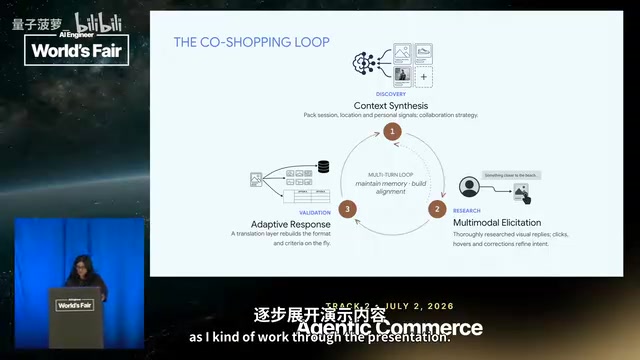
Multimodal Collaborative Agents: A Complete Methodology from Vague Intent to Precise Recommendations
Deep dive into Google DeepMind's multimodal collaborative agent methodology: three-stage framework (Discovery, Research, Response) solving user articulation gaps, with design principles and evaluation systems.
The Real Bottleneck for Coding Agents: Human-AI Collaboration, Not Benchmark Scores
AI coding agents over-pursue benchmark scores while ignoring human-AI collaboration—the real bottleneck. This article explores steering, verification, and adaptation challenges, and why Human-in-the-loop matters more than SWE-bench rankings.
Plug-in Solar: A New Wave of DIY Photovoltaics Is Rising in America
Plug-in solar is spreading from Europe to America. Learn how balcony PV works, the regulatory hurdles in the U.S., and how rising electricity costs and DIY culture are driving this distributed energy revolution.