n8n in Practice: Breaking Down an AI Automation System That Replies to Leads at 2 AM

Two n8n AI systems automate sales lead follow-up and federal contract monitoring for CEOs and CFOs.
This article breaks down an n8n-based AI automation solution built for time-strapped CEOs and CFOs. The first system covers the full sales lead lifecycle: sending personalized emails within a minute of lead intake, following up in the same thread, stopping automatically once a meeting is booked, and syncing all events to the CRM. The second scans federal contract awards every five minutes and alerts the CFO with pre-packaged research whenever a mid-cap company wins a contract over $25 million — an alternative data strategy for stock signals. The stack includes Outlook, Calendly, Fireflies, Google Sheets, OpenAI, and n8n.
A Lead Comes In at 2 AM — Who Responds First?
Imagine this: a new lead lands in your inbox at 2 in the morning. Your sales team clocked out hours ago, and so did your competitor's. Whoever responds first has the better shot at winning that client.
This is exactly the core problem that this AI automation system — built on n8n — is designed to solve. It targets time-strapped CEOs and CFOs: people who can't afford to manually chase every lead, but also can't afford to lose business to slow response times. The logic isn't complicated, but its strength lies in a complete end-to-end loop: from lead intake, email follow-up, and meeting scheduling, to call summaries and CRM sync — all automated, running around the clock, never taking a day off.
System One: A Fully Automated Lead Lifecycle
The first part of this system centers on sales leads, covering the entire journey from first contact to close.
Whenever a new lead comes in, the AI drafts a personalized introduction email within about one minute — not a mass template, but a tailored message sent instantly, day or night. This solves the response speed problem: even a lead that comes in at 2 AM gets a reply within minutes.
In reality, most leads won't book a call after just one email. So the system follows up the way a real person would — continuing in the same email thread rather than firing off awkward, disconnected new messages. This "same-thread follow-up" design detail goes a long way toward making the communication feel natural.
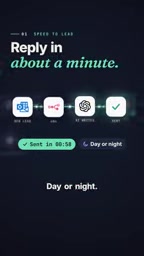
The key is timing control: once a prospect successfully books a call, automated follow-ups stop immediately — avoiding the embarrassing situation where a client who's already scheduled a meeting keeps receiving reminder emails. Every booking and cancellation is synced directly to the correct tab and status in the CRM, with no manual data entry required.
Pre-Meeting Research and Post-Meeting Notes, Automatically Connected
When a new contact appears on the calendar, the AI proactively researches who that person is — and only fills in missing information fields rather than blindly overwriting existing data.

After each call, the AI writes a meeting summary, saves the full transcript, and advances the lead to the next stage. This frees salespeople from the heavy lifting of note-taking and organizing, letting them focus their energy on the actual conversations and decisions that matter.
System Two: A Market-Watching Bot That Uses Government Contracts as Stock Price Signals
If the first system serves the sales process, the second is a market monitoring tool built specifically for CFOs.
Its logic rests on a valuable market insight: large government contracts often have a significant impact on the stock prices of the winning companies. This system checks for new federal contract awards every five minutes. Whenever a mid-cap company wins a contract worth $25 million or more, it immediately sends the CFO an alert.
But it doesn't stop at sending a notification. Whether or not the contract ultimately proves to be a major catalyst, relevant background research is already prepared and delivered alongside the alert — so the CFO can quickly assess its significance the moment they receive it. This "information + research" bundled delivery eliminates the need to manually look up details after receiving an alert.

This approach is known in investment practice as an "Alternative Data" strategy. Government contract awards are publicly disclosed by agencies like the Federal Procurement Data System (FPDS), but tracking and interpreting them has traditionally required manual effort or specialized data vendors. For mid-cap companies (typically defined as publicly traded companies with a market cap between $2 billion and $10 billion), a government contract worth more than $25 million can represent a meaningful share of annual revenue — making its marginal impact on market valuation far greater than it would be for a large-cap firm. The value of these signals lies in being verifiable, traceable, and earlier than analyst reports. Before high-frequency monitoring tools existed, only institutional investors typically had the capacity to catch them in time.
Tech Stack and Reliability Design
The toolchain for this solution is fairly representative of how n8n functions as an automation orchestration hub:
- Outlook: Email sending and receiving
- Calendly: Meeting scheduling
- Fireflies: Call transcription
- Google Sheets: Data storage and CRM backbone
- OpenAI: Content generation and research
- n8n: The automation engine that ties all of the above together
Worth noting is the emphasis on reliability. The creator mentions that any process failure can be detected within seconds, and every change is tested with real data before going live. For automation systems, this kind of robustness often matters more than the features themselves — a workflow that silently breaks while no one is watching can cause more damage than having no automation at all.
n8n is an open-source workflow automation tool, positioned similarly to Zapier or Make (formerly Integromat), but with support for self-hosted deployment. Data never passes through third-party servers, making it more privacy-compliance-friendly for enterprise users. Its core concept is the "Node": each node represents an action or service integration, and nodes are connected by data flows to form a visual workflow. Compared to pure-code solutions, n8n lowers the barrier to integrating multiple SaaS tools; compared to pure no-code tools, it retains the flexibility to write custom logic in JavaScript, enabling complex conditional logic and data transformation. This is precisely what makes fine-grained behaviors like "same-thread follow-up" and "only fill in missing fields" possible in the systems described here.
The Value and Limits of This Approach
In terms of outcomes, the pitch is clear: reduce administrative overhead, speed up response times, and never miss a lead. Two "always-on" systems, each covering a high-value scenario — sales acquisition and market monitoring.
That said, a grounded perspective is warranted. The source material is essentially a service showcase, focused more on demonstrating "what's possible" than providing a detailed build tutorial. Key specifics — like how personalized email quality is maintained, how the AI avoids errors when researching contacts, and how the $25 million threshold was determined — are left unexplored. For anyone looking to replicate this themselves, those are exactly the hard parts.
But setting aside the marketing angle, it does offer a genuinely useful template for thinking about automation: embedding LLM-powered content generation directly into real business process nodes, rather than using AI in isolation to "just write some stuff." For teams considering building business automation with n8n, the workflow design of these two systems is worth studying.
Related articles

Apple HomeView Hands-On Review: Is the $300 Smart Home Hub Worth It?
Apple HomeView hands-on: a $300 smart home hub with facial recognition for quick account switching, but no App Store or voice recognition. Is the wall-mounted version worth it? Should you buy the first generation?

Meta Muse Wonder Launch: What It Means for Meta's Return to the Frontier AI Race
Meta releases Muse Wonder and WonderFull, benchmarks reach the frontier, community feedback is polarized. An in-depth look at Meta's return to the frontier AI race, its personal agent strategy, and Zuckerberg's different path.

Apple Home Smart Home Lineup Leaked: LG and Schneider Team Up, UWB Door Lock on Board
Apple Home ecosystem gains new LG and Schneider devices: UWB smart lock with proximity unlock, 2.5K dual-camera doorbell, privacy indoor camera, and AirPods-like seamless pairing.