Nanosaur 2 Released: A Lightweight Open-Source Image Model with 670M Parameters

Nanosaur 2 is a 670M-parameter open-source DiT image model that compresses down to 388MB and rivals SDXL.
Nanosaur 2 is a lightweight open-source image generation model with just 670M parameters, built on a DiT (Diffusion Transformer) architecture with a new VAE and 270M-parameter text encoder. Trained on ~14 million images from e6 and danbooru datasets, it specializes in anime-style art and supports both natural language and tag-based prompts. Despite being far smaller than SDXL, it reportedly outperforms it in many scenarios. The full model runs at ~2GB, with quantized options down to ~388MB for low-spec local deployment.
A new contender has entered the open-source image generation space. A model called Nanosaur 2 was recently announced on Reddit, and it takes a notably different approach from today's billion-parameter giants. With just 670 million (670M) parameters, it delivers impressive results for its size class — and according to its introducer, can even go toe-to-toe with the much larger SDXL in many scenarios.
It's worth noting that the Reddit poster clarified they are not the model's creator, but as someone who knows the author well, they spoke highly of its capabilities: "For any model smaller than anima, this is the best one out there."
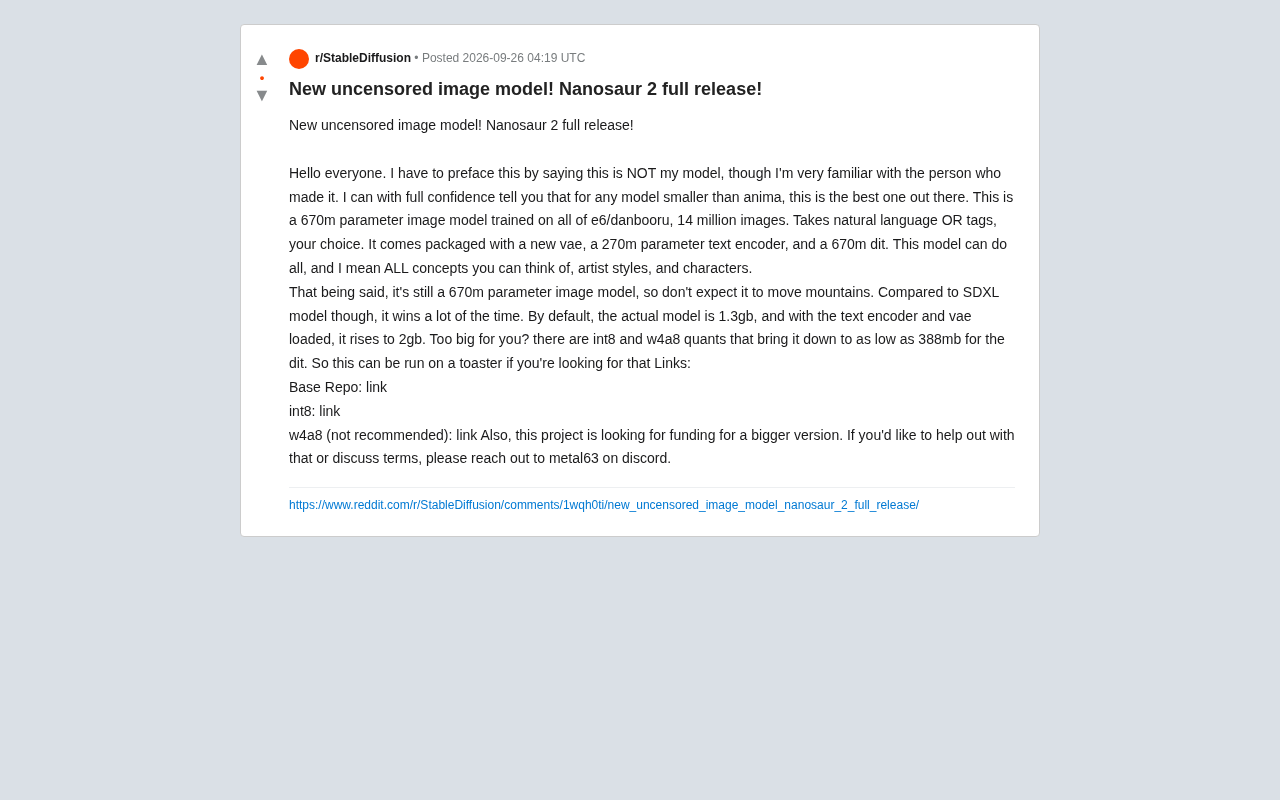
Model Specs: Small Footprint, Full Pipeline
At its core, Nanosaur 2 is a 670M-parameter DiT (Diffusion Transformer) architecture, bundled with a brand-new VAE and a 270M-parameter text encoder. This three-component setup gives the model a complete image generation pipeline while remaining remarkably compact.
For training data, the model was trained on the full e6 and danbooru datasets, totaling approximately 14 million images. This data source gives it a strong foundation in anime-style art, character accuracy, and artist style reproduction. According to the poster, the model covers "every concept you can think of" — including a wide range of artist styles and character designs.
On the interaction side, Nanosaur 2 supports both natural language descriptions and tag-based inputs, letting users choose whichever workflow suits them. This flexibility lowers the barrier for users accustomed to traditional tag-based workflows as well as those who prefer natural language prompts.
A quick primer on DiT and VAE: DiT (Diffusion Transformer) is a design paradigm that brings the Transformer architecture into diffusion models, first proposed by Peebles and Xie in 2022. Traditional diffusion models (like Stable Diffusion 1.x/2.x) use a U-Net as the denoising backbone; DiT replaces it with a Transformer-based structure that processes latent image patches via attention mechanisms. This swap yields better scalability — research shows that DiT's generation quality improves more consistently as parameter count grows. The VAE (Variational Autoencoder) compresses pixel-space images into a lower-dimensional latent space and decodes diffusion outputs back to pixels, making it a critical component for color fidelity and detail reproduction. The fact that Nanosaur 2 ships with a new VAE rather than reusing an older one suggests the developers invested specifically in improving decode quality.
Performance: Going Head-to-Head with SDXL
The poster is refreshingly candid about the model's positioning: "It's still just a 670M image model — don't expect it to move mountains." This honestly acknowledges the natural ceiling of lightweight models in handling complex compositions and fine-grained details.
That said, its performance-per-parameter ratio is where things get interesting. According to the post, Nanosaur 2 "wins more often than not" in direct comparisons against SDXL — a model with significantly more parameters. That level of competition suggests meaningful optimization in both training data quality and architectural design. For users focused on local deployment with limited hardware, this is a compelling option.
Deployment: Quantization Options from 2GB Down to 388MB
Nanosaur 2 has been built with deployment accessibility in mind. Out of the box, the model itself is approximately 1.3GB, with the text encoder and VAE bringing the total to around 2GB.
For more hardware-constrained setups, the project offers multiple quantization tiers:
- int8 quantized version: Significantly reduced size with a good quality-efficiency balance
- w4a8 quantized version: Compresses the DiT component down to approximately 388MB (marked as not recommended by the poster due to likely noticeable quality degradation)
The poster colorfully notes that the quantized model can "run on a toaster" — a testament to how far the deployment requirements have been pushed down. This flexible range from 2GB to 388MB means users with varying hardware specs can find a version that works for them.
A note on quantization: Model quantization refers to compressing neural network weights from high-precision floating-point formats (e.g., float32, bfloat16) to lower-bit integer representations, reducing storage size and VRAM requirements during inference. int8 quantization compresses weights to 8-bit integers, typically cutting model size roughly in half with minimal quality loss. w4a8 is a more aggressive approach — "w4" means weights are stored as 4-bit integers, while "a8" means activations (intermediate inference values) retain 8-bit precision. While this drastically reduces model size, 4-bit weights leave only 16 discrete values per parameter, which can cause noticeable quality degradation in tasks like diffusion modeling that rely on fine-grained gradient information — hence the "not recommended" label on the w4a8 version.
A Note on the "Uncensored" Label
The "uncensored" tag in the model's title reflects the absence of built-in content filtering. This is not unusual in the open-source community — such models offer greater creative freedom, but that comes with the expectation that users take responsibility for content compliance and ethical use. The e6/danbooru training data background further confirms that this model is aimed at anime art and creative communities.
Roadmap and Community Support
The project is currently seeking funding to develop a larger-scale version. Users interested in investing or discussing collaboration terms can reach the developer via Discord under the username metal63.
In terms of product direction, Nanosaur 2 is pursuing a deliberate "small but excellent" differentiation strategy — focused on squeezing maximum efficiency out of a limited parameter budget, rather than competing in the arms race of ever-larger models. If future, larger versions can maintain deployment accessibility while pushing generation quality further, this series has real potential to carve out a lasting niche in the lightweight open-source image generation space.
Summary
Nanosaur 2 represents a pragmatic philosophy in open-source image modeling: rather than chasing parameter counts, it combines high-quality training data, flexible input methods, and tiered quantization options to make capable image generation accessible on modest hardware. Its 670M parameters punch well above their weight class, and the sub-400MB quantized option makes it one of the more seriously deployable local options available. As with any lightweight model, expectations for complex scenes should remain realistic — but for its target use case, it's a genuinely interesting release worth watching.
This article is based on information shared in a Reddit community post. Actual model capabilities should be verified through your own testing.
Related articles

How Does Claude Call Tools It Has Never Seen? MCP and AI Agent Principles Explained
How does Claude call tools it was never trained on? This article breaks down the AI Agent tool-calling loop, Anthropic's three-layer MCP architecture, context bloat and context rot, and production-grade Agent safety design principles including timeout retries, prompt injection, and idempotency keys.

OpenAI Cracks Math Problems, Why Are Mathematicians Losing Sleep?
OpenAI claims to solve math problems — why are mathematicians anxious? Vergecast reveals the Eye of Sauron dilemma and the tension between AI answers and human understanding.

CSS Conditional Border-Radius Trick: Auto-Square Corners When Elements Touch the Edge
Pure CSS conditional border-radius: auto-square corners when elements touch the edge, rounded while floating. Use calc(100vw-100%) with clamp() to kill the transition band, and container query units cqi for non-fullscreen containers, plus a scrollbar offset workaround.