NarraSpace: How Multimodal Scene Evidence Improves Interpretability of Dementia Classification

NarraSpace links picture description transcripts to scene events, enabling traceable Alzheimer's classification.
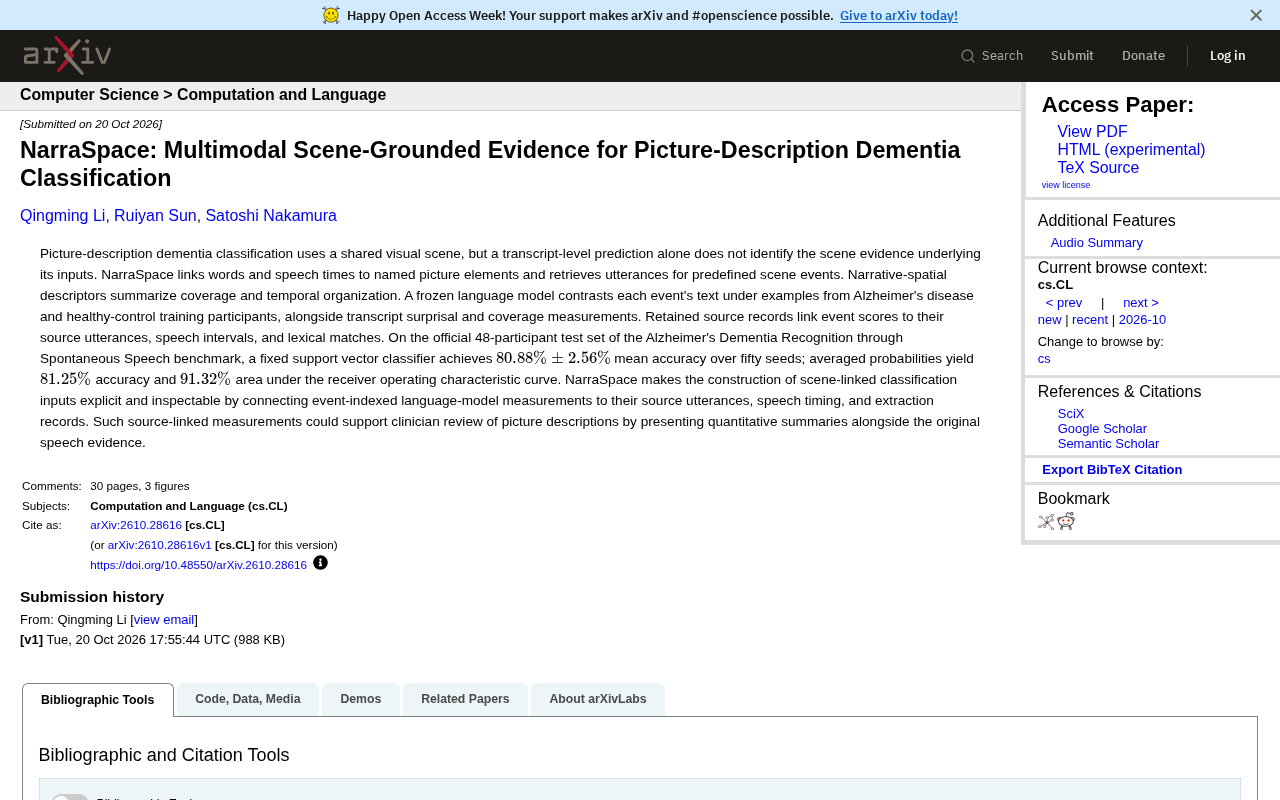
The NarraSpace framework addresses the picture description task in early Alzheimer's screening by decomposing the "black-box" predictions of traditional transcript classification into inspectable scene evidence. The system links transcript words and speech timestamps to named elements in the image and retrieves utterances related to predefined scene events, combining narrative-spatial descriptors (scene coverage, temporal organization), frozen language model comparison measurements, and transcript surprisal, with a fixed SVM classifier making the final prediction. On the 48-subject ADReSS test set, average accuracy across 50 random seeds was 80.88%±2.56%, reaching 81.25% after probability averaging with an AUC of 91.32%. Every event score can be traced back to source utterances, speech intervals, and lexical matching records, enabling clinicians to review raw speech evidence while improving interpretability without sacrificing classification accuracy.
In the early screening of Alzheimer's disease (AD), the picture description task is a common neuropsychological assessment method: subjects are asked to describe a complex scene image, and clinicians judge cognitive status based on the linguistic content. However, traditional transcript text classification models only output a "dementia" or "healthy" prediction label, without being able to explain which elements in the image and which utterances from the subject support this judgment. This "black-box" nature limits the credibility of models in clinical review. The recently proposed NarraSpace framework attempts to address this issue—it links words in the transcript to named elements in the image and retrieves utterances related to predefined scene events, thereby constructing traceable, inspectable classification evidence.
From Transcript Classification to Scene Evidence Linking
The core idea of NarraSpace is to use the "shared visual scene" in the picture description task as an anchor, decomposing transcript-level predictions into scene-event-level evidence. Specifically, the system links words and speech timestamps in the transcript to named elements in the image (such as "boy," "dog," "swing"), and retrieves subject utterances corresponding to predefined scene events. These scene events are typical activities or relationships occurring in the image, such as "boy falling from a tree" or "woman washing dishes." In this way, the model no longer merely outputs a label but can indicate which scene events' utterance evidence influenced the classification result.
According to the original paper, NarraSpace also introduces narrative-spatial descriptors to summarize scene coverage and temporal organization features. Coverage reflects how many predefined scene elements the subject mentioned, while temporal organization captures the distribution pattern of utterances along the timeline. These descriptors are combined with utterance-level language model measurements to form multi-dimensional classification input.
The picture description task (such as the Cookie Theft picture) is a classic paradigm in AD screening. Its rationale is that describing a complex scene requires multiple cognitive abilities including vocabulary retrieval, syntactic organization, semantic integration, and working memory—abilities that can be impaired in early AD. Commonly used clinical assessments such as the Boston Naming Test or semantic fluency tests focus on the word level, whereas picture description simultaneously assesses coherent narrative ability, giving it higher predictive value for the conversion from mild cognitive impairment (MCI) to AD. Traditional scoring relies on clinicians manually counting idea units and grammatical errors, which is time-consuming and has limited inter-rater agreement—precisely the step that automated transcript analysis attempts to replace.
A Combination of Frozen Language Model and Support Vector Machine
In the classification stage, NarraSpace uses a frozen language model to compare the text of each scene event—contrasting it with training sample examples from the Alzheimer's group and healthy control group—while incorporating transcript surprisal and coverage measurements. Finally, a fixed support vector machine (SVM) classifier makes predictions based on these features.
On the official 48-subject test set of the Alzheimer's Dementia Recognition through Spontaneous Speech (ADReSS) benchmark, the system achieved an average accuracy of 80.88%±2.56% across 50 random seeds; after averaging probabilities, accuracy reached 81.25% with an area under the ROC curve (AUC) of 91.32%. This performance demonstrates that scene-linked evidence not only improves interpretability but does not sacrifice classification accuracy.
The ADReSS benchmark (Alzheimer's Dementia Recognition through Spontaneous Speech) is a public challenge dataset launched at INTERSPEECH 2020, containing Cookie Theft picture description recordings and manual transcripts from 78 AD patients and 78 healthy controls, with official training/test splits of equal size—the test set being the 48 subjects mentioned above. The benchmark's evaluation metrics are accuracy and F1, and in recent years most systems' accuracy has clustered in the 75%–85% range, so 80.88% represents an above-average level on this benchmark. Note that the ADReSS test set is small in size and homogeneous in population composition, so improvements on this benchmark may not directly generalize to real clinical populations—which is the background reason the paper emphasizes sample size limitations.
Support vector machine (SVM) is a supervised classifier based on the maximum margin principle, finding the decision hyperplane that separates the two classes with the largest margin, and handling nonlinear boundaries through kernel functions. In small-sample, high-dimensional feature settings, SVM is typically more robust than deep networks and less prone to overfitting, which aligns well with the ADReSS test set of only 48 subjects and limited feature dimensionality. The term "frozen" language model means parameters are not updated during inference, using its outputs only as a fixed feature extractor; the benefits are low training cost, reproducible results, and easy attribution to specific utterances, while the cost is the inability to adapt to the task distribution—which is why the authors mention end-to-end fine-tuning in their outlook.
Inspectability: Connecting Measurements to Raw Speech Evidence
A key design of NarraSpace is preserving source records: every event score can be linked back to its source utterance, speech interval, and lexical matching record. This means that when clinicians review the picture description, they can not only see quantitative summaries but also jump directly to the raw speech evidence. The paper states that such source-linked measurements "can make the construction of scene-linked classification inputs explicit and inspectable," opening possibilities for clinical review.
From an application perspective, this feature is particularly important for the practical deployment of dementia screening tools. Clinicians need to understand why a model makes a certain judgment in order to incorporate it into assisted diagnostic workflows. NarraSpace takes a step in this direction by connecting event-indexed language model measurements to source utterances, speech times, and extraction records.
Limitations and Outlook
The current evaluation of NarraSpace is based on the 48-subject test set of the ADReSS benchmark, which is relatively limited in sample size. The coverage of predefined scene events may also be constrained by the design of the image itself. Additionally, the choice of frozen language model and the fixed configuration of the SVM classifier mean the system has not yet explored the possibility of end-to-end fine-tuning. Nevertheless, the "scene evidence linking" approach proposed by this framework provides an interpretability-first paradigm for multimodal dementia classification, which may in the future be extended to more picture description tasks and clinical scenarios.
Transcript surprisal originates from information theory and refers to the negative log probability that a language model assigns to actually occurring words; higher values indicate the word is more unexpected by the model. In dementia speech analysis, the mean and variance of surprisal can serve as proxy indicators of language predictability: AD patients often exhibit abnormal word choices, syntactic deviations, and topic drift, leading to elevated or more variable local surprisal. The advantage of this metric is that it can be computed without manual annotation and correlates with clinical observations such as semantic fluency and naming difficulties; however, its values depend heavily on the training corpus of the language model used, and caution is needed when comparing across models and languages.
Related articles

Free Unlimited Claude Code Solution: Agnes AI + CC Switch Setup Guide
No paid subscription needed — pair the free AI platform Agnes AI with the open-source tool CC Switch to provide a backend for Claude Code, enabling unlimited free calls to text, image, and video models. This guide covers the full setup, test results, and usage boundaries.

A Complete Zero-Cost Guide to Getting Started with Claude Code for Beginners in China
A beginner's guide to Claude Code for users in China: two installation methods (command line and IDE plugin), full configuration steps for replacing the official API with the free domestic LongCat model, and a hands-on demo of building a small tool with natural language, plus tips.

When the NSA Gets Involved: The AI Supply Chain Crisis Behind Open-Source CVEs and API Key Hijacking
Multiple open-source projects disclosed severe CVEs in one day, PHP flaws alarmed the FBI, and Railway and OpenCode were breached with API keys stolen. This article breaks down the vulnerability window, AI-accelerated exploitation, and the AI supply chain crisis behind the API key black market, with a developer defense checklist.