Native Windows ROS 2 IDE Rovant Launches with Only 8 Downloads on Day One
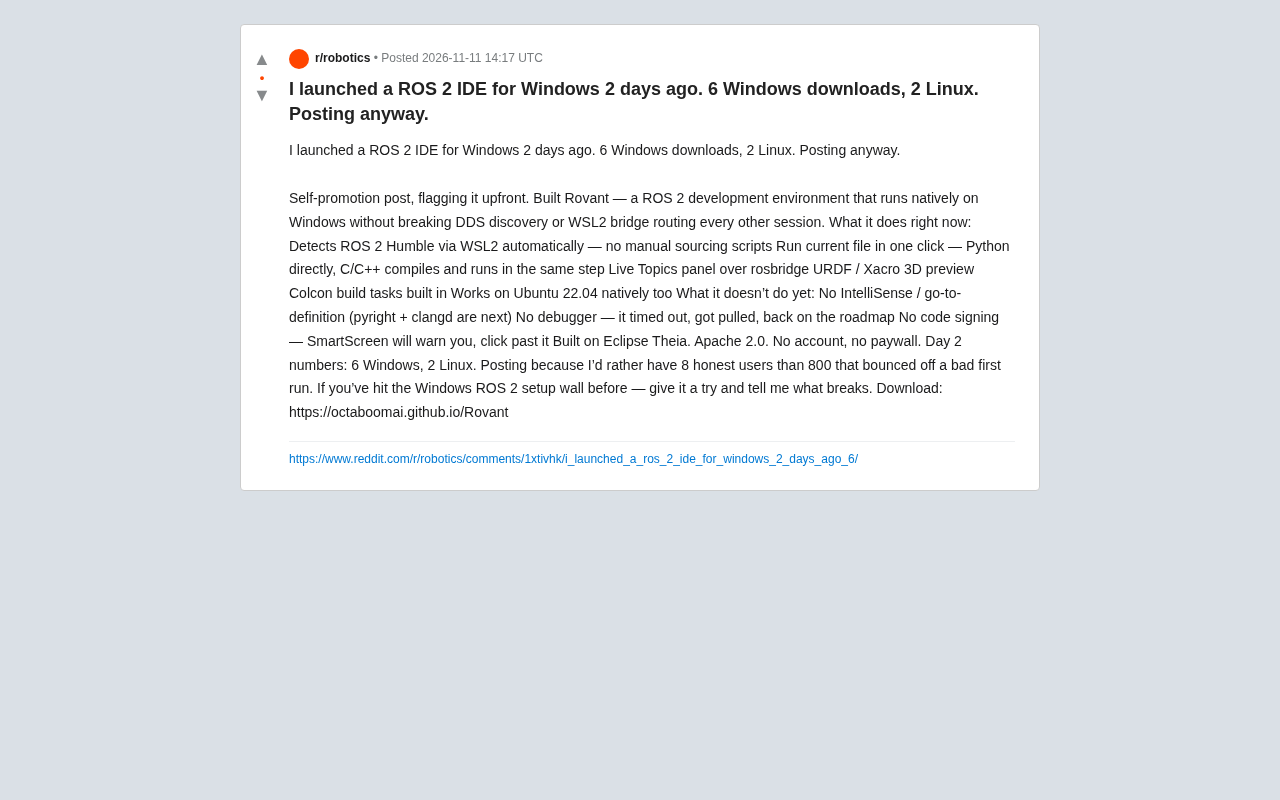
Developer releases native Windows ROS 2 IDE Rovant, with only 8 downloads in two days, focused on reducing configuration friction.
The article introduces Rovant, a ROS 2 development environment released by a developer on Reddit. Built on Eclipse Theia, it focuses on running natively on Windows and avoiding repeated failures of WSL2 bridged routing and DDS discovery. Current features include automatic detection of ROS 2 Humble in WSL2, one-click running of Python/C++ files, a Live Topics panel via rosbridge, URDF/Xacro 3D preview, and Colcon build tasks, with support for Ubuntu 22.04 as well. The author admits it still lacks IntelliSense, a debugger, and code signing, and SmartScreen will show a warning. Two days after launch, it has only 6 Windows and 2 Linux downloads, but the author values early real feedback more and discloses shortcomings to validate whether the pain point truly exists.
Why Is ROS 2 Development on Windows So Hard?
If you've done ROS 2 development on Windows, you've likely been through this loop: install WSL2, configure DDS discovery, bridge network routing, and then redo it every few sessions. A developer has released Rovant on Reddit, a ROS 2 development environment that claims to run natively on Windows without breaking DDS discovery or WSL2 bridged routing. Two days after launch, it has 6 Windows downloads and 2 Linux downloads.
The author admits upfront that this is self-promotion, but is direct about it: "I'd rather have 8 honest users than 800 who churn because the first-run experience was terrible."
The DDS discovery mechanism is key to understanding the pain points of ROS 2 on Windows. DDS (Data Distribution Service) is the underlying communication middleware of ROS 2, where nodes automatically discover each other via multicast or unicast. On Linux, discovery within the same host is usually smooth; but Windows and WSL2 belong to different network namespaces, and WSL2 uses NAT mode by default, so multicast packets often cannot penetrate between the host and the subsystem, causing nodes to be "invisible" to each other. In addition, the WSL2 virtual NIC address may change after each restart, invalidating previously configured environment variables such as ROS_DOMAIN_ID, CYCLONEDDS_URI, or FASTRTPS_DEFAULT_PROFILES_FILE. This is exactly why you have to "redo it every few sessions."
WSL2 bridged routing refers to the network configuration required for tools on the Windows host to communicate with ROS 2 nodes inside WSL2. Because WSL2 is behind NAT, host access to the subsystem requires port forwarding, and subsystem access to the host relies on the virtual gateway address. ROS 2's DDS discovery depends on bidirectionally reachable endpoint information; once routing or firewall rules change, discovery breaks. The so-called "bridging" is usually done through netsh interface portproxy, mirrored networking mode, or manually specifying DDS peer addresses to connect this link—cumbersome and fragile to configure.
What Rovant Can Do Now
According to the author, Rovant's current core capabilities revolve around "reducing configuration friction":
- Automatically detects ROS 2 Humble in WSL2, no need to manually write sourcing scripts
- One-click run of the current file: Python runs directly; C/C++ compiles and runs in the same flow
- Live Topics panel: view topics in real time via rosbridge
- URDF / Xacro 3D preview
- Built-in Colcon build tasks
- Also runs natively on Ubuntu 22.04
These features target the areas where ROS 2 beginners and cross-platform developers most often get stuck. In particular, WSL2 auto-detection and automation of sourcing scripts eliminate the repetitive mechanical operations of every terminal session. Live Topics and URDF preview bring debugging and model inspection into the IDE, reducing the cost of switching between multiple tools.
What's Still Missing: An Honest Feature List
The author doesn't shy away from shortcomings and clearly lists what the current version cannot do:
- No IntelliSense / go-to-definition—pyright and clangd support are planned for the next step
- No debugger—integration was attempted but timed out, removed from the current version, and returned to the roadmap
- No code signing—Windows SmartScreen will show a warning, requiring a manual click to bypass
For a tool released only two days ago, this list actually increases credibility. The lack of code signing means the author hasn't gone through the full release process, but it also shows the project is still in early validation. The absence of IntelliSense and a debugger means it's currently more of a "run and preview" tool than a full development environment.
Technical Foundation and Positioning
Rovant is built on Eclipse Theia, uses the Apache 2.0 license, requires no account, and has no paywall. Theia is a mature cloud and desktop IDE framework, and many of VS Code's interaction patterns can be reproduced on it, which explains how Rovant was able to build a usable interface and task system in a relatively short time.
Choosing Theia instead of building from scratch means the author focuses energy on the ROS 2-specific integration layer—WSL2 detection, DDS routing, rosbridge connections, Colcon task wrapping—rather than the editor's general capabilities. This trade-off is reasonable at an early stage.
Eclipse Theia is an open-source IDE framework with a modular architecture that allows developers to contribute editors, views, commands, and task systems through extensions. It shares many design philosophies with VS Code (such as Language Server Protocol-based language support and Monaco-based editing components) but is completely independently implemented and can run in both desktop (Electron) and browser forms. For Rovant, Theia provides a mature file tree, terminal, task runner, and plugin mechanism, so the author only needs to focus on the ROS 2 integration layer. Note that Theia itself does not include IntelliSense; language intelligence depends on connecting language servers such as pyright and clangd, which also explains why that feature is still on the roadmap.
rosbridge is a WebSocket bridge component in the ROS 2 ecosystem that exposes ROS 2 topics, services, and actions as JSON messages, enabling non-ROS-native programs (such as browser frontends or IDE plugins) to subscribe to and publish topics. Rovant's Live Topics panel displays topic data in real time by connecting to rosbridge, without directly linking DDS libraries within the IDE process, which reduces the complexity of cross-platform integration.
The Real Question Behind 8 Downloads
6 Windows downloads and 2 Linux downloads—this number itself doesn't warrant overinterpretation. More noteworthy is the author's motive for disclosing it: he is validating whether the pain point of "ROS 2 development experience on Windows" truly exists, and whether early users will leave immediately due to first-run issues.
From community reactions, ROS 2 configuration on Windows has long been a frequent complaint. WSL2's networking and DDS discovery mechanisms often need reconfiguration across sessions, and official toolchains have always had limited support for native Windows development. Rovant is targeting a real gap, but whether it can retain users depends on whether IntelliSense and the debugger can land according to the roadmap.
At the end of the post, the author directly invites feedback: "If you've hit the Windows ROS 2 configuration wall before, give it a try and tell me what breaks." For a second-day project, this attitude is more informative than the download numbers.
One-line Summary
Developer releases native Windows ROS 2 IDE Rovant, with only 8 downloads in two days, focused on reducing configuration friction.
Paragraph Summary
The article introduces Rovant, a ROS 2 development environment released by a developer on Reddit. Built on Eclipse Theia, it focuses on running natively on Windows and avoiding repeated failures of WSL2 bridged routing and DDS discovery. Current features include automatic detection of ROS 2 Humble in WSL2, one-click running of Python/C++ files, a Live Topics panel via rosbridge, URDF/Xacro 3D preview, and Colcon build tasks, with support for Ubuntu 22.04 as well. The author admits it still lacks IntelliSense, a debugger, and code signing, and SmartScreen will show a warning. Two days after launch, it has only 6 Windows and 2 Linux downloads, but the author values early real feedback more and discloses shortcomings to validate whether the pain point truly exists.
Related articles

Gemini 4 Neon Review: Benchmark Scores Rival Carbon, API Pricing and Quota Breakdown
Google Gemini 4 Neon is now live, benchmark scores closely tracking Carbon, API pricing 3/15 at twice Hydrogen's rate. This article compiles Bilibili creator testing: Neon can replace 90% of Carbon scenarios, AntiGravity quota consumption is only one-third of Carbon, plus subscription channel restrictions and 2API ban risks.

Gemini 4 Helium Coming Soon? Signals of Google Loosening Subscription Restrictions
Google team member hints releases will continue; community speculates Gemini 4 Helium (Flash Lite) may be next. Subscription ban controversy gets a response as product lead says "Soon," suggesting restrictions may be lifted. This article covers Gemini developments, OpenAI Coding Agent and risk management, Doubao real-time audio-video API, and compute business dynamics.

AI-Assisted React Development in Practice: Optimizing a Video App and Handling Errors
A 14-year veteran developer demonstrates AI-assisted React video app optimization: compressing video from 80MB to 5MB (~94%) via ImageKit, plus reliable error handling and retry mechanisms. Includes planning, code understanding, and verification methods for working with AI.