Navige: Using Sufficiency Intelligence to Control Runaway AI Agent Costs

Navige uses Sufficiency Intelligence to dynamically optimize Agent costs at runtime, plus budget and governance features.
Navige is an Agent cost control tool ranked second on Product Hunt. Its core mechanism, Sufficiency Intelligence, dynamically assesses request complexity during Agent runtime, routing suitable requests to smaller models while reducing token consumption through caching repeated reads and trimming tool return results. Unlike after-the-fact billing, it's a runtime intervention that keeps the user's original model when uncertain, favoring a conservative strategy. It also offers budget caps, runaway loop capture, and human approval for sensitive operations, with costs and savings shown by job dimension and estimates labeled. Watchtower is free forever and supports previewing changes before enabling controls. It received 121 votes and 39 comments, signaling that Agent cost control is becoming an independent tool category.
AI Agents are moving from demos to production, but a neglected problem is starting to surface: when Agents autonomously call models, tools, and loops, costs can spiral out of control without anyone noticing. Navige, a new product ranked second on Product Hunt, aims to solve this with a mechanism called "Sufficiency Intelligence."
Runaway Costs: A New Operational Challenge in the Agent Era
The cost model for traditional LLM applications is relatively simple — one request equals one bill, and developers can estimate expenses based on prompt length and call frequency. But the way Agents work changes all of this. A single Agent task may trigger dozens of model calls, tool executions, and intermediate result reads, and many of these requests don't actually need the most powerful model to handle.
Navige targets exactly this gap. Its core proposition is: dynamically assess the "sufficiency" of each request while work is running — if a small model can get the job done, there's no need to call an expensive large model. This differs from the approach of tallying up bills after the fact; it's runtime intervention.
Navige officially lists three methods: routing appropriate requests to smaller models, caching repeated read operations, and trimming bloated tool return results. When the system isn't confident about its judgment on a particular request, it keeps the model the user originally selected, avoiding sacrificing output quality just to save money.
The cost structure of LLM applications is typically billed by token, including input tokens (prompts, context, tool return results) and output tokens (model-generated content), with unit price differences between models reaching dozens of times. Under the traditional single-request model, developers only need to estimate prompt length multiplied by call count to roughly predict expenses. But the autonomous loop nature of Agents breaks this model: a single task may trigger planning, tool calls, result reflection, re-planning, and other multi-round steps, each accompanied by independent model calls and context inflation, causing costs to grow non-linearly with task complexity. More problematic is that Agents can fall into ineffective loops, repeatedly calling tools without advancing the task, continuously consuming budget while unattended. Therefore, cost control must shift from static estimation to runtime dynamic intervention — this is precisely the core scenario Navige targets.
What Sufficiency Intelligence Actually Does
Based on the product description, Navige's Sufficiency Intelligence is not a single technology but a combination of runtime optimization strategies.
Model routing is the first layer. The system evaluates the complexity of each request to decide whether to hand it off to a smaller model or maintain the original model. The difference from some static routing solutions on the market is that Navige claims to make judgments "while work is running," rather than using preset rules.
Caching and trimming are the second layer. Agents often repeatedly read the same files, web pages, or database records, and caching these reads can significantly reduce token consumption. Tool return results often contain large amounts of irrelevant content, and trimming them before feeding into the model context can also lower per-call costs.
Uncertainty handling is the third layer, and the one that best reflects the product's philosophy. Navige explicitly states "if unsure, keep the model you selected." This statement implies its optimization strategy is conservative — better to save a little less than to cause task failure or quality degradation due to misjudgment.
Model Routing is a common technique in LLM cost optimization, with the core idea of distributing requests to models of different sizes or prices based on request complexity, task type, or historical performance. Static routing is based on preset rules, such as assignment by keywords or task tags; dynamic routing evaluates request characteristics at runtime, such as context length, reasoning depth requirements, and more. The challenge of dynamic routing lies in accurately judging "whether a small model is sufficient" — misjudgment can lead to output quality degradation or task failure, triggering retries that actually increase total costs. Navige claims to make judgments "while work is running" and adopts a conservative strategy — keeping the user's original model when unsure — which in effect seeks a balance between savings and reliability, with effectiveness highly dependent on the accuracy of the judgment mechanism.
Budgets, Runaway Loops, and Sensitive Operation Approval
Beyond cost optimization, Navige also provides a set of governance features targeting more challenging scenarios in Agent operations.
Users can set budget caps, and the system will issue alerts when approaching or exceeding the budget. Agents falling into infinite loops is another common risk — repeatedly calling tools without advancing the task, wasting both time and money. Navige claims to be able to capture such runaway loops.
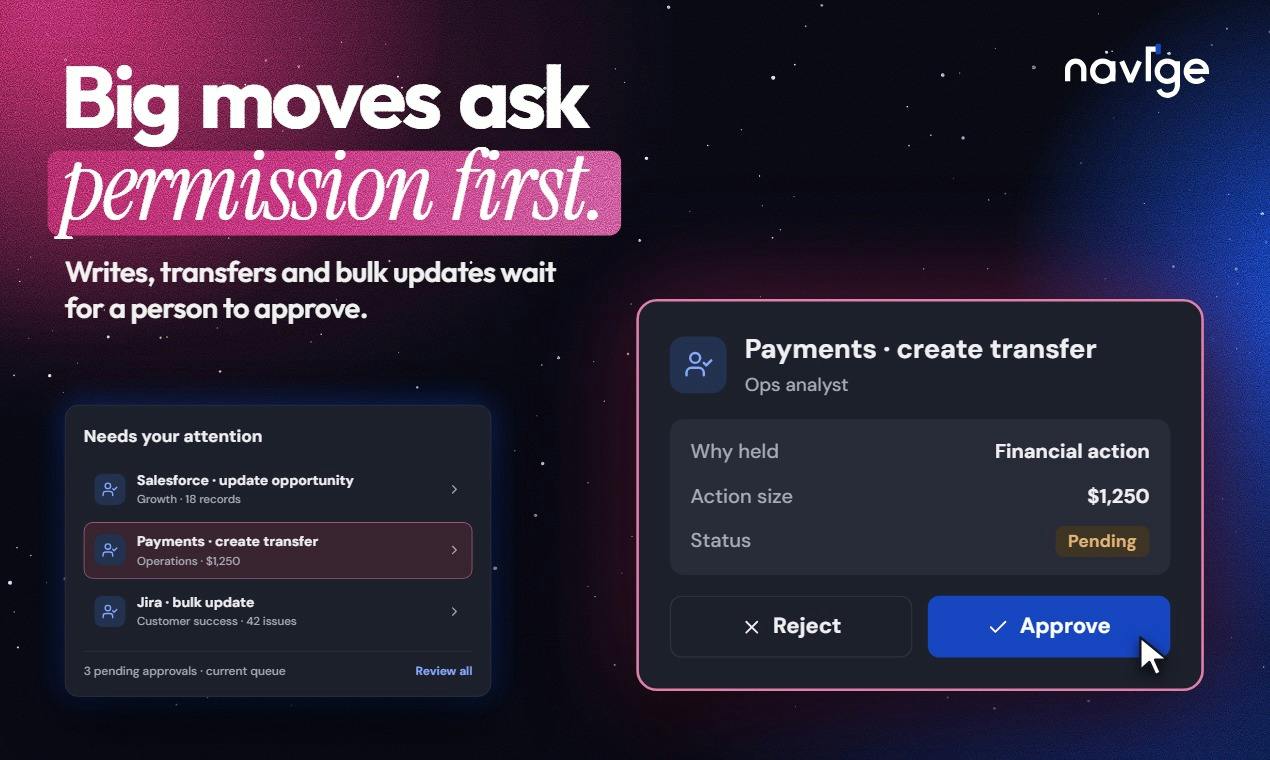
For sensitive operations, Navige requires human approval before execution. This continues the human-in-the-loop approach widely emphasized by current Agent products: automation can handle routine processes, but human confirmation is needed for critical actions.
Costs and savings are displayed by job dimension, and estimated data is clearly labeled, not confused with actual billing. This transparency is important for users who need to account for expenses to their teams or clients.
Human-in-the-loop (HITL) is a key pattern in Agent governance, referring to setting up human approval or confirmation nodes in automated workflows, especially for sensitive operations (such as deleting data, sending emails, executing payments). HITL can both prevent Agents from executing dangerous actions due to misunderstood instructions and introduce human judgment at critical decision points. In cost control scenarios, HITL can also be used for approval when budgets are exceeded — pausing and requesting human confirmation when an Agent is expected to break through a threshold. Navige places sensitive operation approval alongside budget alerts and runaway loop capture, essentially unifying cost governance and security governance into the same runtime intervention framework, reflecting how Agent operations tools are evolving from single-purpose monitoring to comprehensive control.
Watchtower Free Tier and Change Preview
Navige's pricing strategy has a clear hook: Watchtower is free forever. Watchtower most likely handles monitoring and alerting, letting users first see the full picture of Agent costs before deciding whether to pay for intervention features.
The product also supports previewing the effects of changes before enabling controls. This design lowers the cost of trial and error — users can simulate how Navige's optimization strategies would affect existing workflows, and officially enable them after confirming everything is fine.
Judging from its Product Hunt performance, Navige received 121 votes and 39 comments, ranking second for the day, indicating that the pain point of "controlling Agent costs" has indeed resonated with developers and teams.
Opportunities and Questions in This Direction
Agent cost optimization is becoming an independent tool category. Teams have previously attempted to address similar problems through gateways, proxy layers, or observability platforms. Navige's differentiation lies in packaging optimization and governance together and intervening at runtime.
Several questions worth watching: How accurate is Sufficiency Intelligence? Will hidden costs from misjudgments (such as task retries) offset the savings? How demanding are caching strategies on data consistency? Where are the functional boundaries of the free Watchtower tier?
The answers to these questions determine whether Navige can advance from a "useful monitoring tool" to a "standard component of Agent infrastructure." For teams putting Agents into production, it at least offers an option worth evaluating.
One-line Summary
Navige uses Sufficiency Intelligence to dynamically optimize costs at Agent runtime, with budget and governance features.
Paragraph Summary
Navige is an Agent cost control tool ranked second on Product Hunt. Its core mechanism, Sufficiency Intelligence, dynamically assesses the complexity of each request during Agent runtime, routing appropriate requests to smaller models while reducing token consumption through caching repeated reads and trimming tool return results. Unlike after-the-fact bill tallying, it's a runtime intervention, and it keeps the user's original model when uncertain, favoring a conservative strategy. Additionally, Navige offers governance features such as budget caps, runaway loop capture, and human approval for sensitive operations, with costs and savings displayed by job dimension and estimates labeled. Watchtower is free forever and supports previewing change effects before enabling controls. The product received 121 votes and 39 comments, showing that Agent cost control is becoming an independent tool category.
Related articles

Free Unlimited Claude Code Solution: Agnes AI + CC Switch Setup Guide
No paid subscription needed — pair the free AI platform Agnes AI with the open-source tool CC Switch to provide a backend for Claude Code, enabling unlimited free calls to text, image, and video models. This guide covers the full setup, test results, and usage boundaries.

A Complete Zero-Cost Guide to Getting Started with Claude Code for Beginners in China
A beginner's guide to Claude Code for users in China: two installation methods (command line and IDE plugin), full configuration steps for replacing the official API with the free domestic LongCat model, and a hands-on demo of building a small tool with natural language, plus tips.

When the NSA Gets Involved: The AI Supply Chain Crisis Behind Open-Source CVEs and API Key Hijacking
Multiple open-source projects disclosed severe CVEs in one day, PHP flaws alarmed the FBI, and Railway and OpenCode were breached with API keys stolen. This article breaks down the vulnerability window, AI-accelerated exploitation, and the AI supply chain crisis behind the API key black market, with a developer defense checklist.