Nepotism Network: Find Your 'Warm Introduction' Path Using a Relationship Graph
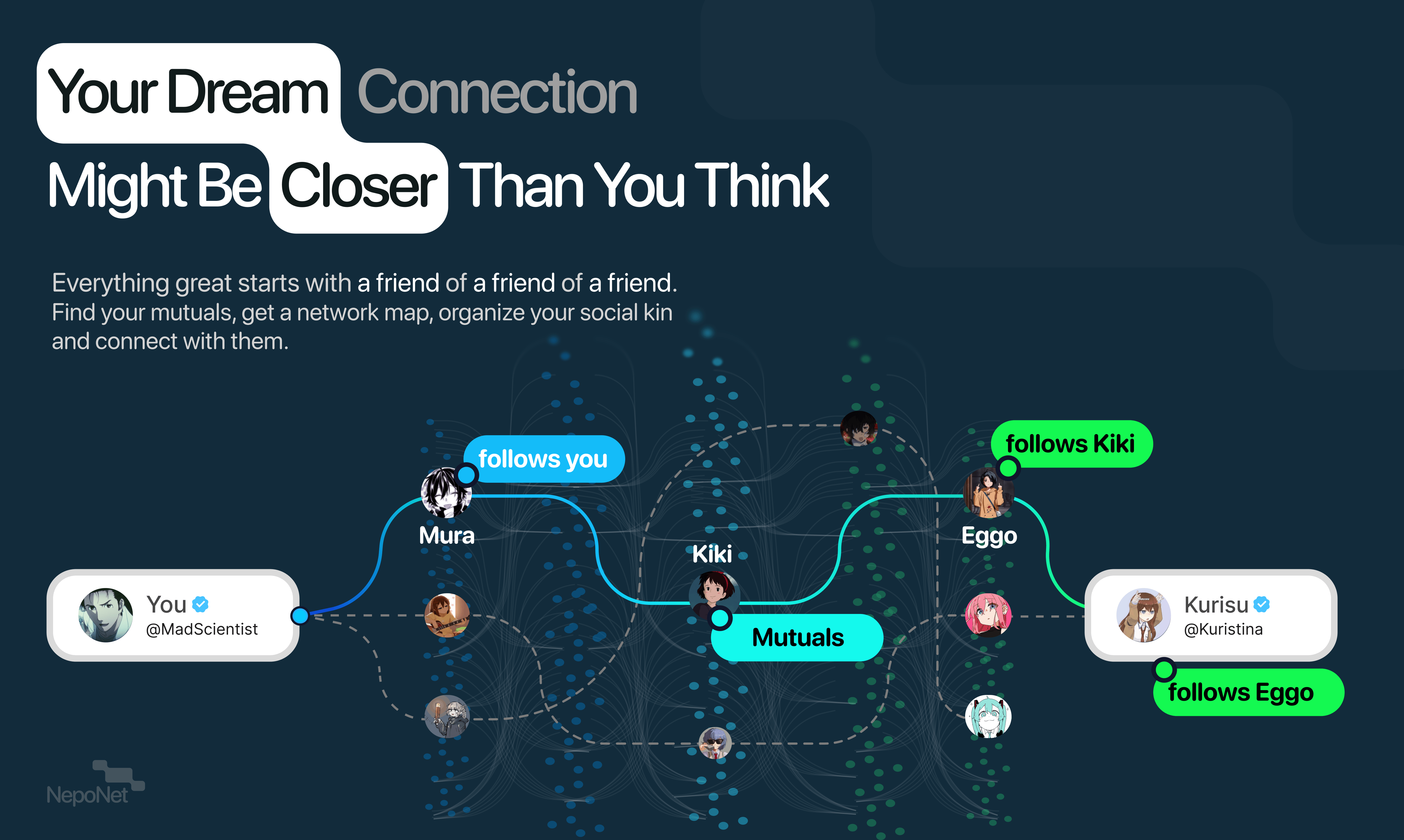
Nepo Network turns your X social graph into actionable warm introduction paths to anyone you want to reach.
Nepotism Network (Nepo Network) is a relationship-mapping tool built on X (Twitter) that calculates and ranks introduction paths between you and a target person, making second- and third-degree connections visible and actionable. The product breaks the referral process into four steps: ranked path discovery, intermediary identification, ask drafting, and outreach tracking. It launched on Product Hunt with 112 upvotes, ranking #8 for the day under the OpenAI Day category. Key risks include X's tightening API policies, data privacy concerns, and the ethical debate around systematizing human relationships.
A Product Built to Help You Work Your Connections
The value of a network often hides in plain sight — someone you know might know exactly the person you've been trying to reach. Nepotism Network (or Nepo Network) is built around this insight: it maps the connections between you and a target person on X (formerly Twitter), helping you find a viable warm intro path.
The product launched on Product Hunt with 112 upvotes and 10 comments, landing at #8 on the daily leaderboard. It's listed under Social Media, Social Networking, and OpenAI Day categories. The name itself carries a self-deprecating humor — "nepotism" bluntly acknowledges the real-world truth the product is built to address: many opportunities begin with "a friend of a friend of a friend."
What Problem Does It Actually Solve?
Cold outreach has notoriously low success rates — a frustration felt by nearly every founder, job seeker, and salesperson. By contrast, warm introductions convert at a much higher rate because they carry an inherent layer of trust.
The challenge is that most people have no visibility into how far their network actually extends. You might be just two or three degrees away from a key investor or potential customer, yet never attempt the reach because the path is invisible. Nepo Network's core value proposition is making that hidden relationship graph visible — turning "who knows who" into something you can actually see and act on.
As the product puts it: "Your network contains a surprisingly useful extended family."
Academic research has long validated the power of weak ties. Sociologist Mark Granovetter's landmark 1973 paper showed that people who find new jobs and opportunities tend to do so through weak connections — acquaintances they rarely contact — rather than close friends. The reason: your inner circle largely overlaps with your own knowledge and resources, while weak ties can bridge you to information silos entirely outside your world. Nepo Network is systematically trying to surface exactly this kind of latent value buried within weak-tie networks.
Four Steps Through the Introduction Flow
According to the product's description, Nepo Network breaks the entire referral process into several clear stages:
Explore Ranked Routes
The product calculates multiple possible connection paths between you and your target, then ranks them. Rather than giving you a single option, it surfaces multiple routes so you can judge which is most reliable, shortest, or most likely to succeed.
See Who Connects Each Step
Every intermediate node along each path is identified — you can see exactly which mutual connection bridges the two ends. This matters because the viability of any introduction depends heavily on the relationship strength between the intermediary and both parties.
Draft Your Ask
The product also includes a feature to help you draft your introduction request, turning the awkward "could you introduce me?" into something more polished and persuasive.
Track Your Outreach
Finally, it lets you track the entire outreach process — so you always know which requests have been sent, which are awaiting a response, and which opportunities might otherwise slip through the cracks of a chaotic inbox.
Why It's Worth Watching
The product's placement in the "OpenAI Day" category suggests AI capabilities are likely at work — whether for parsing social graphs, calculating path weights, or generating introduction scripts. As X increasingly becomes a central social hub for the tech world, building a network intelligence layer on top of the platform's public relationship data addresses a genuine market need.
From a product logic standpoint, Nepo Network is tackling the most commercially valuable — and hardest to automate — aspect of social networks: trust transfer. LinkedIn's referral features exist, but they lack intelligent path ranking or outreach management. By productizing this workflow, Nepo Network could meaningfully lower the barrier to building high-quality connections.
X (formerly Twitter) dramatically restricted API access in 2023, cutting free-tier call limits to near-unusable levels while raising paid tiers from $100/month to thousands of dollars. This policy shift caused a wave of third-party Twitter-dependent apps to shut down or pivot. For Nepo Network to map users' social graphs in real time on X, it would need API access to follower relationships, interaction history, and more — making data acquisition costs and sustainability one of the most critical uncertainties in its business model. This likely explains why the product is relatively guarded about technical implementation details in its public materials.
Potential Controversies and Challenges
Naming your product "nepotism" is both candid and provocative. It inevitably raises a question: when "who knows whom" becomes a tooled, scalable system, does opportunity distribution become more equitable — or more entrenched?
Beyond the philosophical, the product is heavily dependent on X's social data availability. Changes to platform API policies, along with user privacy concerns, could meaningfully threaten its long-term viability. The public-facing materials don't disclose how data privacy and user authorization are handled — something prospective users should investigate before diving in.
Summary
Nepotism Network zeroes in on a real, high-value problem: making second- and third-degree connections visible and actionable. For founders, investors, and salespeople who constantly need to build new relationships, it transforms the "hope someone introduces me" approach into a systematic process with mapped paths, drafted asks, and tracked follow-ups. Whether it can sustain itself long-term ultimately comes down to social data accessibility — and how comfortable users are with the idea of turning human relationships into a structured workflow.
Related articles
Free Open-Source Tool Rejected: The Community Controversy Sparked by r/DnD's AI Ban
A free open-source DnD campaign tool was rejected by r/DnD's AI ban — yet the same tool was approved a year ago. The case highlights the blurry line between AI tools and AI-generated content.
What LLMs Can You Run with 1.9TB of RAM? Exploring the Ceiling of Local AI Deployment
A Reddit user with 1.9TB of RAM sparked debate about local LLM deployment. We break down what massive RAM enables, where CPU inference falls short, and the real bottlenecks.
Researchers Use Claude to Hack OpenAI Systems: A New Wake-Up Call for AI Security
Security researchers used Anthropic's Claude to breach OpenAI systems, taking over employee accounts and accessing internal repos. What this means for AI security.