.NET 11 Performance Gains, Azure Elastic Automation, and the Multi-Cloud Database SDK Explained

Microsoft systematically raises developer platform defaults through .NET 11 performance compounding, declarative Azure elasticity, and a unified multi-cloud database SDK.
This article covers four key Microsoft developer ecosystem updates pointing to a shared trend: foundational capabilities shifting from manual tuning to declarative policy. .NET 11 delivers hundreds of runtime improvements across JIT, PGO, and SIMD with no code changes required. Azure VM Scale Sets gains automatic zone placement in public preview, turning elastic scheduling into a declarative strategy. A multi-cloud Java database SDK unifies access to Cosmos DB, DynamoDB, and Cloud Spanner — with cross-provider semantic consistency as the core challenge. Together, these updates trace a clear path of abstraction-level advancement in the Microsoft platform.
Microsoft's developer ecosystem has seen a wave of updates worth paying close attention to. From runtime performance to cloud-based elastic scheduling and cross-cloud database abstraction, several threads converge on a single trend: foundational capabilities are shifting from "manual tuning" toward "declarative policy." This article draws on episode 6 of The Upload on YouTube, summarizing four key developments and the technical reasoning behind them.
.NET 11: Performance Through Compounding, Not Magic Tricks
Microsoft has published its annual in-depth .NET performance report, this time covering hundreds of improvements in .NET 11. The work spans the JIT compiler, class libraries, memory allocation, locking mechanisms, system calls, SIMD instructions, and Profile-Guided Optimization (PGO) — including expanded opportunities for de-virtualization and inlining of hot code paths.
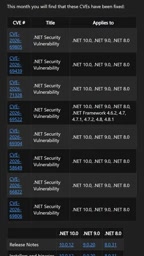
A key characteristic of these runtime-level improvements is that they accelerate existing applications without requiring any code changes. For already-deployed services, simply upgrading the runtime yields measurable performance gains. Microsoft also provides reproducible benchmarking methodology, allowing performance engineers to compare .NET 10 and .NET 11 on their own hardware and real workloads.
This reflects Microsoft's runtime strategy philosophy: performance rarely comes from a single dramatic optimization. Instead, it compounds — accumulating small wins across the entire stack until ordinary application code becomes noticeably faster. This approach is especially friendly to enterprise users, as it lowers the upgrade barrier and turns the gains into something that feels nearly "free."
Profile-Guided Optimization (PGO) is a technique that guides compiler optimizations using data collected from the program's actual runtime behavior. Traditional static compilers can only make optimization decisions based on code structure. PGO first runs the program under real or representative load, recording which code paths are executed most frequently and which branch predictions are most often correct, then uses these "hot profiles" to recompile — giving hot paths more aggressive inlining and register allocation. .NET's Dynamic PGO samples continuously at runtime, requiring no offline training phase, which makes it especially effective for long-running services: the longer the application runs, the more data the JIT accumulates, and the closer the optimization quality gets to offline static PGO. De-virtualization is an important downstream benefit of PGO: when runtime data shows that a virtual method call site always dispatches to the same concrete type, the JIT can replace it with a direct call or even inline it directly, eliminating virtual dispatch overhead and opening the door to further constant folding.
Azure Automatic Zone Placement: Elasticity Moves from Topology to Policy
Automatic zone placement for Azure Virtual Machine Scale Sets has entered public preview. Azure can now automatically select availability zones based on SKU availability, current capacity, scale set distribution, and developer-defined constraints.
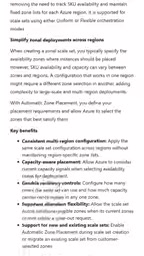
The feature supports both uniform and flexible orchestration modes and can partially fulfill scale-out requests rather than failing an entire request when capacity is insufficient. This means developers can use a unified regional deployment model without hard-coding specific availability zone lists for each region. Capacity-aware placement and automatic rebalancing also reduce the operational overhead behind elastic autoscaling.

The deeper shift is a paradigm change: cloud elasticity is moving from static topology to policy-driven. Previously, developers had to carefully plan the distribution across each availability zone. Now they declare the availability outcomes they want, and Azure continuously makes placement decisions as capacity changes in real time. Control moves from "configuring details" to "expressing intent" — a continuation of the same abstraction-level leap that came after infrastructure-as-code.
Availability Zones are groups of physically isolated data centers within the same cloud region, each with independent power, cooling, and networking, ensuring that a failure in one zone does not affect workloads in others. Traditional high-availability architectures required developers to manually distribute virtual machines or replicas evenly across multiple zones, specifying exact instance counts in each zone in advance — which could cause entire deployment requests to fail when a cloud provider's capacity in a given zone was tight. Virtual Machine Scale Sets (VMSS) are Azure's managed instance group service, supporting automatic scaling of virtual machine counts on demand. "Uniform mode" manages instances in bulk using the same image, suited for stateless horizontal scaling; "flexible mode" allows mixing instances with different configurations for more complex topologies. Automatic zone placement shifts capacity-aware decision-making from the developer to the platform, enabling scale sets to dynamically optimize across zones and prioritize fulfilling the satisfiable portion of a request rather than rejecting it entirely when capacity is insufficient.
Multi-Cloud Database SDK: The Hard Part Isn't the Adapter — It's Semantic Consistency
Microsoft's multi-cloud database SDK for Java has also entered public preview. It provides a unified CRUD and query API that works across Azure Cosmos DB, Amazon DynamoDB, and Google Cloud Spanner. The choice of database provider is pushed down to the configuration layer, while adapters handle query translation, error normalization, diagnostics, compatibility checks, and cross-provider consistency testing.
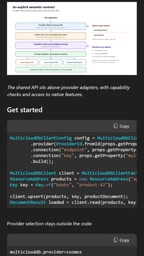
Portability is far harder than simply "wrapping three clients behind a single interface." Pagination, throttling, partial failures, and query semantics must all behave consistently — otherwise the abstraction collapses at the edges. This shared contract lets teams validate behavioral correctness once, while retaining an escape hatch for calling native capabilities directly.
The show's host Cameron offered a particularly insightful observation: as code generation becomes increasingly cheap, well-tested abstractions become more valuable. The difficulty is no longer producing the adapter itself — it's proving that every adapter expresses consistent meaning. This explains why Microsoft emphasizes cross-provider consistency testing: it's the true moat of this kind of multi-cloud abstraction.
Azure Cosmos DB, Amazon DynamoDB, and Google Cloud Spanner have fundamental differences in data models and consistency guarantees — which is exactly what makes a unified abstraction difficult. Cosmos DB is a document-oriented multi-model database with tunable consistency levels (from eventual to strong), where partition keys govern data distribution. DynamoDB is a hybrid key-value/document model whose core resource unit is provisioned or on-demand throughput; its conditional writes and transaction semantics differ significantly from the other two. Cloud Spanner is a distributed relational database offering external strong consistency and full SQL support, but with a sharding approach and scaling model fundamentally different from NoSQL systems. The three differ in pagination cursor formats, throttling error codes, handling of partial transaction failures, and query filtering capabilities. A unified SDK must establish a predictable behavioral contract on top of these differences — otherwise, developers will encounter hard-to-reproduce edge cases when switching providers, and the abstraction layer becomes an obstacle to debugging rather than an aid.
Microsoft Foundry Moves Toward Production-Grade Architecture
The episode also mentioned that Microsoft Foundry is beginning to take production environment architecture design seriously. While this segment received limited coverage in the episode, taken together with the other developments, it's clear that Microsoft is pushing AI application development from the experimental stage toward reliable, operable production deployments — reinforcing the same "infrastructure maturity" indicators as runtime performance, cloud elasticity, and data portability.
A Single Thread Running Through It All
Looking at these four developments together, a common signal emerges: Microsoft's developer platform is systematically raising the level of "default capability." The runtime makes code faster for free; Azure turns elasticity into a declarative policy; the database SDK gives multi-cloud portability a verifiable contract. Developers are freed from a large volume of repetitive low-level decisions, allowing them to focus their energy on business logic and architectural intent. For teams evaluating the direction of their tech stack, these seemingly scattered updates actually trace a clear path of abstraction-level advancement.
Related articles

Qwen 4 First Test Leaks: Performance Rivals Opus 5.5, DeepSeek V4 Series Surfaces
Early Qwen 4 test outputs leak, with front-end generation said to rival Opus 5.5; DeepSeek V4 Mini, Flash, and Pro names appear in a code repo; Ant Group's Ling-3.1-flash surfaces too. Here's the latest on model tiering and on-device lightweight models.

OpenCode Makes DeepSeek V4.1 Flash Free, AI Daily Roundup
AI daily roundup: OpenCode makes DeepSeek V4.1 Flash free, StepFun Step5 Preview and Ling 3.1 Flash open-sourced, Grok Voice 3.0 tops speech leaderboard, Matrix Game 4.0 open-sourced, and the EU opens its first AI Act enforcement probe into OpenAI and Anthropic.

DeepSeek V4.1 Flash 1017 Released: Reasoning and Coding Upgrades, Search and Fetch API Now Available
DeepSeek releases V4.1 Flash 1017 with major gains in reasoning, coding, and agentic tasks, plus web search and fetch APIs at 5 yuan per 1,000 requests. Tencent Hunyuan open-sources High Memory 2.0, Perplexity open-sources multimodal decision models, and MOFCOM seeks comments on AI export catalog.