Neural Network Provides Warm Start for JGLP, Tightening MAP Inference Upper Bounds by Orders of Magnitude
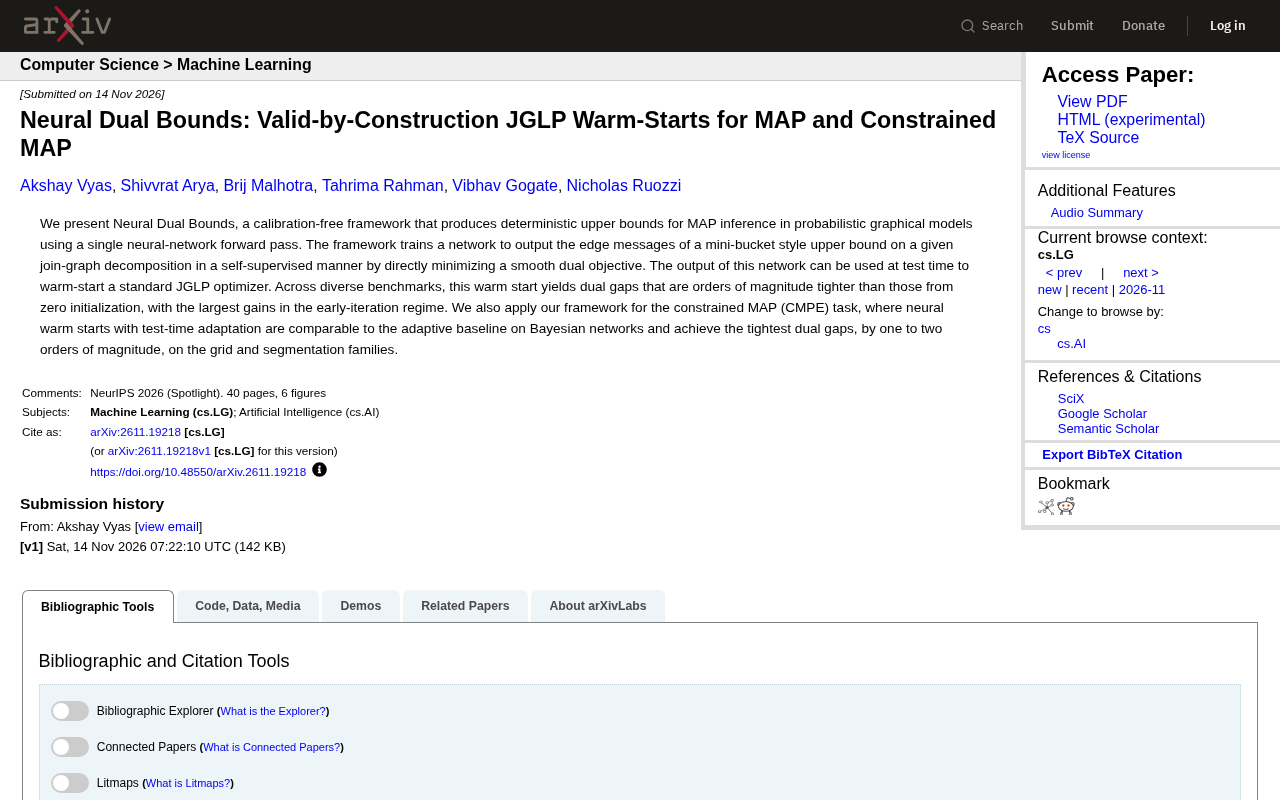
Neural Dual Bounds uses a single neural network forward pass to generate an effective warm start for JGLP, significantly tightening the dual gap.
This article proposes the Neural Dual Bounds framework, which uses a single neural network to generate an effective warm start for the dual-decomposition-based JGLP optimizer. The network outputs edge messages as dual variables and is trained self-supervised by minimizing a smoothed dual objective, guaranteeing a valid-by-construction upper bound. On multiple benchmarks, compared with zero initialization, neural warm start tightens the dual gap by several orders of magnitude, with the largest benefit in early iterations. In constrained MAP (CMPE) tasks, combined with test-time adaptation, the method achieves the tightest gaps on grid and segmentation families, leading by one to two orders of magnitude. This work combines learning-based methods with classical combinatorial optimizers while preserving theoretical guarantees, providing a pragmatic acceleration approach for MAP inference.
From Zero Initialization to Neural Warm Start: A New Approach to MAP Inference Upper Bounds
MAP inference in probabilistic graphical models is central to many AI applications, but exact solutions are often infeasible, so approximate algorithms are commonly used in practice. Among them, the JGLP (Join-Graph Linear Programming) optimizer based on dual decomposition can provide deterministic upper bounds, but the quality of the initial solution greatly affects convergence speed and the final gap. A recent work proposes the Neural Dual Bounds framework, which uses a single neural network's forward pass to generate an effective warm start for JGLP, significantly tightening the compat dual gap on multiple benchmarks.
The core idea of this framework is not complicated: train a network so that its output edge messages directly correspond to the dual variables in a mini-bucket style upper bound, and the training process is self-supervised—optimizing network parameters by minimizing a smoothed dual objective, without real labels or calibration steps. Since the messages output by the network themselves satisfy dual feasibility constraints, the constructed upper bound is "valid-by-construction" and can be safely used as the initial point for JGLP.
MAP inference (Maximum A Posteriori inference) refers to finding the variable configuration with the highest posterior probability in a probabilistic graphical model given observed data, which is equivalent to minimizing an energy function. Exactly solving MAP is NP-hard, and common approximate methods include dual decomposition based on LP relaxation. JGLP (Join-Graph Linear Programming) is an optimizer based on dual decomposition that decomposes the original problem into multiple subproblems and coordinates dual variables, thereby providing deterministic upper bounds. Mini-bucket is a classic approximate inference method that constructs upper bounds by decomposing large factors into products of smaller factors. The duality gap refers to the difference between the dual upper bound and the true optimal solution; the smaller the gap, the tighter the upper bound. Warm start refers to providing a high-quality initial solution to an optimization algorithm to accelerate convergence. These concepts form the basis for understanding the method in this article.
Self-Supervised Training and Valid-by-Construction Upper Bounds
Traditionally, finding good initial dual variables for JGLP relies on heuristics or trial and error, whereas Neural Dual Bounds parameterizes this process: the network input is the structural information of the join-graph decomposition, and the output is the message on each edge. During training, the dual objective function is directly minimized, so that the network learns to produce tight and feasible upper bounds under a given decomposition.
The advantage of this self-supervised design is that it does not require solving exact MAP as a supervision signal, avoiding expensive labeling of training data. At the same time, because dual feasibility is guaranteed by the network structure, the generated upper bound is always valid at test time regardless of the network output, and will not break the theoretical guarantees of JGLP.
Dual feasibility means that the dual variables satisfy the constraints, thereby ensuring that the constructed upper bound is valid. In JGLP, the dual variables correspond to messages on edges and must satisfy certain equality or inequality constraints. Valid-by-construction means that as long as the messages output by the network satisfy these constraints, the generated upper bound is automatically valid without additional verification. Self-supervised learning refers to automatically generating supervision signals from the data itself without manual labeling. In this article, the network is trained by minimizing a smoothed dual objective function that directly measures the tightness of the upper bound, so the messages output by the network gradually approach the optimal dual variables while maintaining feasibility. This design avoids the expensive labeling process of requiring exact MAP solutions as labels.
Benchmark Tests: Gaps Tightened by Orders of Magnitude, Largest Gains in Early Iterations
The authors evaluated this warm-start strategy on diverse benchmarks. The results show that compared with zero initialization, the dual gap obtained by neural warm start is orders of magnitude tighter, and the benefit is most pronounced in the early iterations. This means that in practical deployment, JGLP can reach acceptable upper-bound quality within fewer iterations, thereby saving computation time.
This property is especially important for scenarios that require repeatedly calling a MAP solver, such as when used as a submodule in learning-based systems, where quickly obtaining tight upper bounds can significantly reduce overall overhead.
Tightening the duality gap by orders of magnitude means that the difference between the upper bound obtained by neural warm start and the true optimal solution is several orders of magnitude smaller than with zero initialization, for example from 10^2 to 10^0. Early-iteration benefit means that in the first several iterations of the optimization process, the objective function value decreases fastest, and the advantage of warm start is most obvious at this time. This is because warm start already provides a feasible solution close to optimal, enabling the optimizer to quickly converge to a high-quality upper bound. For learning-based systems that need to repeatedly call a MAP solver, quickly obtaining tight upper bounds can significantly reduce computation time and improve overall efficiency.
Extension to Constrained MAP: Performance on CMPE Tasks
In addition to standard MAP, the paper also applies the framework to constrained MAP (CMPE) tasks. On Bayesian networks, the neural warm start combined with test-time adaptation performs comparably to the adaptive baseline; on grid and segmentation families, the method achieves the tightest dual gaps, leading by one to two orders of magnitude.
This shows that neural warm start is not only suitable for unconstrained scenarios, but can also provide high-quality initial solutions in complex structures with constraints. Test-time adaptation further improves generalization ability, enabling the network to fine-tune its output for specific instances.
Constrained MAP (CMPE) refers to adding constraints among variables in MAP inference, for example that certain variables must take specific values or satisfy logical relations. Test-time adaptation refers to fine-tuning the model at test time according to a specific instance to improve generalization ability. In this article, the neural warm-start network performs a small number of gradient updates for each instance at test time, making its output messages better adapt to the structure of that instance and thereby obtaining tighter upper bounds. On grid and segmentation families, the method achieves the tightest gaps, leading by one to two orders of magnitude, indicating that it is suitable for complex constrained structures.
Significance and Outlook
The value of Neural Dual Bounds lies in combining learning-based methods with classical combinatorial optimizers while preserving theoretical guarantees. It does not require calibration and outputs deterministic valid upper bounds, making it more reliable than purely end-to-end neural approximate inference. Possible future directions include extending to more types of graphical model decompositions and integration with other dual optimizers.
For researchers working in probabilistic inference and combinatorial optimization, this work provides a pragmatic acceleration idea: instead of replacing the original solver, use a neural network to provide it with a high-quality starting point.
One-line Summary
Neural Dual Bounds uses a single neural network forward pass to generate an effective warm start for JGLP, significantly tightening the dual gap.
Paragraph Summary
This article proposes the Neural Dual Bounds framework, which uses a single neural network to generate an effective warm start for the dual-decomposition-based JGLP optimizer. The network outputs edge messages as dual variables and is trained self-supervised by minimizing a smoothed dual objective, guaranteeing a valid-by-construction upper bound. On multiple benchmarks, compared with zero initialization, neural warm start tightens the dual gap by several orders of magnitude, with the largest benefit in early iterations. In constrained MAP (CMPE) tasks, combined with test-time adaptation, the method achieves the tightest gaps on grid and segmentation families, leading by one to two orders of magnitude. This work combines learning-based methods with classical combinatorial optimizers while preserving theoretical guarantees, providing a pragmatic acceleration approach for MAP inference.
Related articles
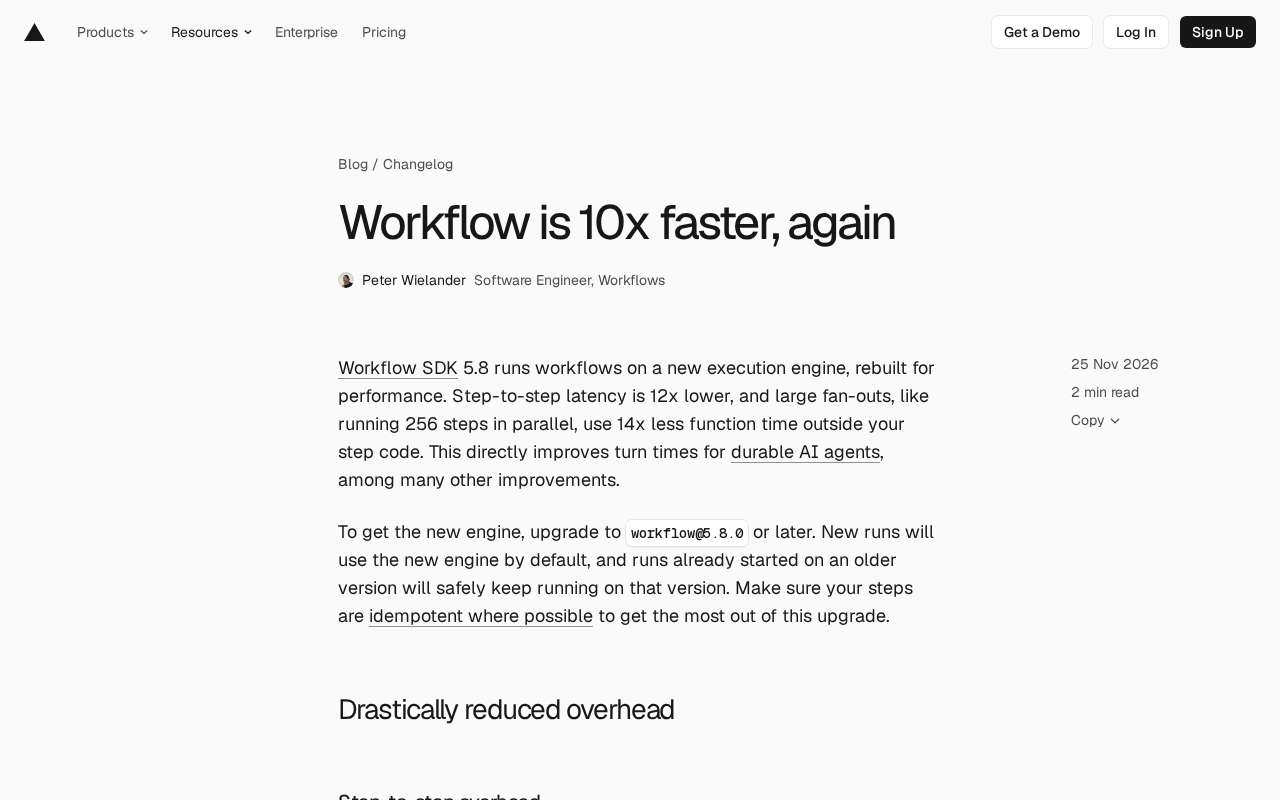
Workflow SDK 5.8 Performance Benchmark: Step Latency Reduced 12x
Workflow SDK 5.8 rebuilds its execution engine, cutting p75 inter-step latency from 85ms to 7ms and 256-way parallel fan-out overhead by 14x, improving durable AI agent turnaround.

David Fincher's New Film Accused of Being AI-Generated? The Truth Behind the Controversy
David Fincher's new film *The Further Misadventures of Cliff Booth* is accused of using AI, with a carriage shot in the trailer sparking controversy. Netflix's acquisition of Ben Affleck's AI company and Fincher's own openness to AI keep suspicions alive. This article sorts out the controversy and the views of all sides.

FCC Clears SpaceX's Space-Based AI Data Centers: A Debate Over Regulatory Boundaries
The FCC approved SpaceX's plan to deploy AI data centers in space but dismissed opponents' key concerns about scientific research impacts as beyond its regulatory authority. This article analyzes the regulatory boundary issues behind the decision, the deeper tensions of space-based AI infrastructure, and its implications for the industry.