NeurIPS Sydney Satellite Sells Out in Minutes: The Industry Power Struggle Behind AI Conference Scarcity
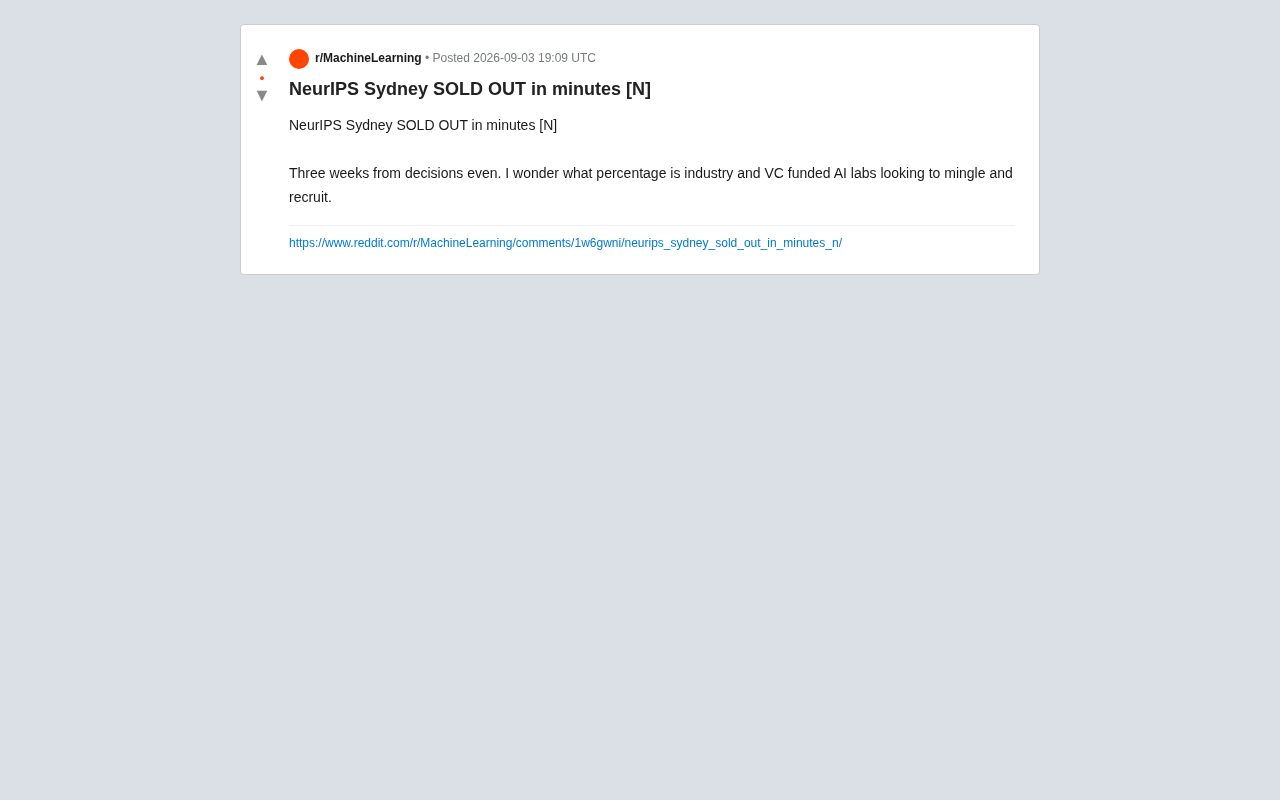
NeurIPS Sydney sold out in minutes—a signal of AI's talent war and conference commercialization.
Registration for NeurIPS Sydney satellite sold out within minutes, reflecting explosive demand for AI conferences and deep industry involvement. The article examines causes including capacity constraints, generative AI hype, and aggressive recruiting by tech giants and VCs, while raising concerns about fair access for academic researchers and potential overheating in the AI sector.
A Top-Tier AI Conference That Sold Out in Minutes
As one of the most prestigious academic conferences in machine learning, NeurIPS (Conference on Neural Information Processing Systems) has long been an annual pilgrimage for AI researchers worldwide. Recently, registration slots for the NeurIPS Sydney satellite venue sold out within minutes of opening, sparking widespread discussion across the Reddit community.
According to Reddit user feedback, the timing of this sellout was particularly noteworthy—just three weeks before paper acceptance notifications were released. In other words, many attendees rushed to secure their spots before even knowing whether their submissions would be accepted. This "grab first, ask later" registration frenzy reflects the unprecedented demand for participation in AI conferences today.
Why Did the NeurIPS Satellite Sell Out in Minutes?
Capacity Bottlenecks from the Satellite Model
In recent years, NeurIPS has adopted a multi-location satellite venue model, with Sydney being one such location. Compared to the main conference, satellite venues often have significantly more limited capacity, which objectively intensifies the scarcity of registration slots. When supply is fixed and demand surges, a rapid sellout becomes almost inevitable.
For researchers in the Asia-Pacific region—especially those in Australia and New Zealand—the Sydney satellite offers a rare opportunity to participate in top-tier academic exchange without the burden of long-haul travel. This geographic convenience further amplifies local and regional participation enthusiasm.
Generative AI Boom Drives Explosive Registration Demand
Over the past few years, the explosive growth of generative AI has brought unprecedented attention to the entire machine learning field. More and more practitioners, students, and even professionals from adjacent fields are eager to attend conferences like NeurIPS to stay abreast of cutting-edge developments and expand their professional networks. The base demand for conference attendance is expanding rapidly, making ticket scarcity the new normal.
Deep Industry and VC Involvement in AI Conferences
Who's Grabbing These Slots?
The original Reddit post raised a thought-provoking question: among those who secured registration slots, what proportion comes from industry and VC-funded AI labs, and are their real motivations networking and recruitment?
This question highlights an undeniable trend in today's AI conferences. NeurIPS, once primarily focused on pure academic exchange, is increasingly taking on commercial dimensions. For companies and investment firms, NeurIPS is no longer just an academic forum—it's an ideal talent recruitment venue and industry networking platform.
From Academic Temple to AI Talent Battleground
In an era of extreme AI talent scarcity, top academic conferences have become critical battlegrounds where tech giants and startups compete for elite researchers. Companies like Google, Meta, OpenAI, and Anthropic often dispatch large teams to conferences, set up booths, host receptions, and even conduct on-site recruiting.
VC firms are equally active. For investors, NeurIPS is an invaluable window for discovering the next star startup team and capturing technological trends. They attend to identify promising research and entrepreneurs, positioning themselves ahead of the investment curve.
This large-scale influx of industry forces brings funding, compute resources, and commercialization opportunities to academic research on one hand, while quietly transforming the conference ecosystem on the other—the boundary between academic sharing and business networking grows increasingly blurred, and pure academic attendees may find themselves squeezed out in the competition for slots.
Concerns and Reflections Behind the AI Conference Boom
Fair Access to Academic Conferences Under Challenge
When registration slots sell out in minutes, a practical question emerges: can students and early-career researchers without corporate backing—those relying on personal funds or limited research grants—still fairly access these opportunities? If conferences become increasingly dominated by well-funded industry players, the openness and diversity of academic exchange will inevitably suffer.
Is the AI Field Showing Signs of Overheating?
From a broader perspective, the rapid sellout of NeurIPS satellite venues can also be interpreted as a microcosm of overall overheating in the AI field. Massive capital inflows, fierce talent competition, impossible-to-get conference tickets—these phenomena collectively paint a picture of prosperity tinged with frenzy.
Historical experience teaches us that excessive hype in any field often accompanies bubble risk. When commercial motives increasingly drive enthusiasm for academic conference participation, we may need to maintain a degree of calm and scrutinize the sustainability of this prosperity.
Conclusion
The minutes-long sellout of NeurIPS Sydney satellite slots may seem like a minor news item about conference ticketing, but it actually reflects many deeper currents in today's AI industry: the scarcity of top-tier academic conferences, deep involvement of industry and capital, fierce competition for AI talent, and the ecosystem transformation at the intersection of academia and commerce.
For researchers, practitioners, and investors navigating this wave, maintaining rational judgment while seizing opportunities may be more important than securing a conference ticket.
Related articles

GitHub Daily · October 23: Agent Runtimes and Skill Libraries Surge on the Same Day
NVIDIA open-sources OpenShell, a Rust security runtime for autonomous agents; Claude-Red turns security methodology into SKILL.md skills; VoxCPM2 drops the tokenizer.

Build an AI Super Employee System at Zero Cost: A Full Breakdown of Automated Agent Workflows
A deep breakdown of the AI super employee system demoed on Bilibili: agent orchestration, digital human voiceovers, map and enterprise lead generation, 24/7 customer service, and legal modules. We analyze the business logic and compliance risks behind zero-cost signup to help entrepreneurs judge the real ROI of this AI digital employee system.

The Essential Difference Between Chatbots and AI Agents: Crossing from Conversation to Execution
What's the difference between a chatbot and an AI agent? Based on the MCP series on the Learn Tech channel, this article uses examples like booking flights and summarizing notes to explain: a chatbot only gives answers, while an agent actually completes tasks through a think-act-observe loop. It breaks down the four core components—model, tools, memory, and goal—as well as MCP's role as a bridge, and discusses agents' applicable boundaries and permission risks.