Neuro-Symbolic Framework Cracks Arabic Syntactic Ambiguity: 96.88% Accuracy Achieved

A neuro-symbolic framework injects formal grammar into AraBERT to resolve Arabic DP syntactic ambiguity at 96.88% accuracy.
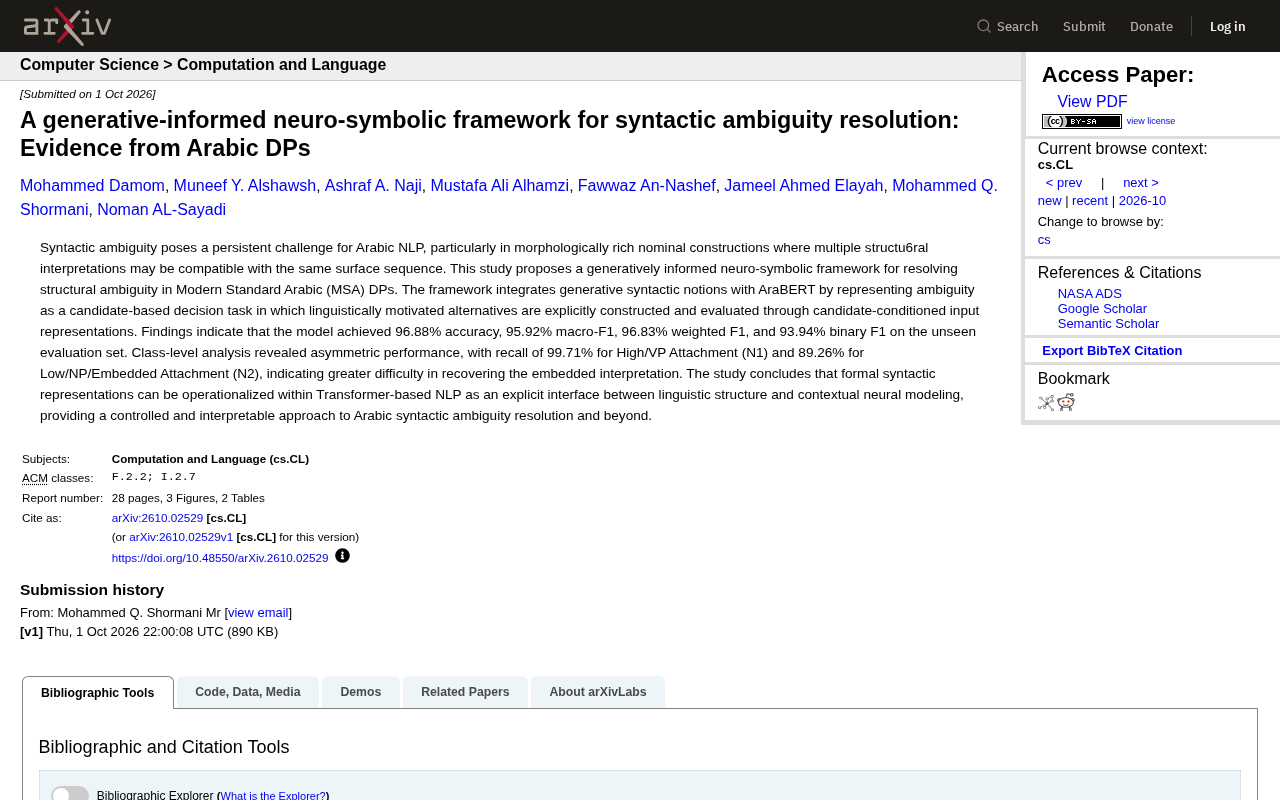
This study addresses pervasive syntactic ambiguity in Modern Standard Arabic Determiner Phrase (DP) structures through a generatively informed neuro-symbolic framework. Its core innovation recasts disambiguation as a candidate-conditioned decision task: generative grammar theory first constrains a set of linguistically valid syntactic candidates, then AraBERT provides contextual modeling to select among them. Results show 96.88% overall accuracy, though a notable recall gap between High/VP Attachment (N1: 99.71%) and Low/NP Embedded Attachment (N2: 89.26%) reveals that deep nested structures remain a key challenge. The framework shows strong potential for transfer to other morphologically rich languages.
The Long-Standing Problem in Arabic NLP: Syntactic Ambiguity
Arabic is a morphologically rich language where the same surface word order can often correspond to multiple structural interpretations. This structural ambiguity is particularly pronounced in nominal structures (DPs, or Determiner Phrases) — an identical literal sequence may imply entirely different syntactic hierarchies. For years, this has been one of the hardest obstacles to overcome in Arabic natural language processing (NLP).
A study published on arXiv proposes a "generatively informed neuro-symbolic framework" for Determiner Phrase (DP) structures in Modern Standard Arabic (MSA), aiming to build an interpretable bridge between deep learning and formal grammar.
Arabic's morphological richness manifests at multiple levels: nouns inflect for gender, number, and case; verbs must mark person, gender, tense, and voice; and the writing system typically omits short vowels (harakat), meaning a single written form can correspond to multiple lexical entries. In DP structures specifically, the Arabic Iḍāfa (genitive construct) allows multi-level nesting — chains like "the student of the teacher of the desk's notebook" can have multiple valid interpretations of modifier scope when written without punctuation or vowel markers. This ambiguity is not merely a theoretical linguistic concern: in practical applications like machine translation, information extraction, and question answering, incorrect syntactic parsing leads to completely skewed semantics. Meanwhile, annotated Arabic corpora are far smaller than those available for English, which limits the ceiling of purely data-driven approaches — and provides strong motivation for incorporating linguistic prior knowledge.
Core Idea: Reframing Ambiguity as a Candidate-Based Decision Task
The most valuable contribution of this research lies in how it redefines the problem of disambiguation. Traditional approaches often treat syntactic parsing as an end-to-end black-box prediction, whereas this framework explicitly models structural ambiguity as a candidate-based decision task.
Concretely, the researchers generate multiple "linguistically motivated" alternative interpretations for each ambiguous structure, then evaluate these candidates using candidate-conditioned input representations. This means the model does not generate answers from scratch — instead, it selects from a set of plausible options constrained by generative grammar theory.
Stitching AraBERT and Formal Grammar Together
The technical backbone of the framework is AraBERT — a Transformer model pre-trained on Arabic. The clever insight is that it doesn't discard deep learning's contextual modeling capabilities; rather, it embeds structural concepts from generative grammar as an explicit "interface layer." The neural network handles contextual information capture, while symbolic syntactic representations provide controlled, interpretable structural constraints. This neuro-symbolic combination is one of the key approaches the research community has been exploring to address the "interpretability" problem of deep models.
AraBERT is a language model pre-trained on Arabic by the AUBMIND Lab using the BERT architecture. Training data includes Arabic Wikipedia, news corpora, and other sources totaling approximately 24GB of Modern Standard Arabic text. Compared to using multilingual BERT (mBERT) directly, AraBERT offers significant improvements in morphological segmentation and semantic representation for Arabic — especially in lemmatization and root analysis. It's worth noting that while pre-trained Transformer models can implicitly learn certain syntactic patterns from large-scale corpora, this learning is statistical and lacks explicit constraints on linguistic structure — the model does not "know" that a given attachment decision violates a principle of generative grammar. This limitation is precisely what motivates the researchers to inject formal syntactic representations as an external structural interface, rather than hoping the neural network will spontaneously "emerge" with correct syntactic intuitions.
Experimental Results: Strong Accuracy with Asymmetric Performance
On the held-out evaluation set, the model delivers impressive results:
- Accuracy: 96.88%
- Macro-F1: 95.92%
- Weighted F1: 96.83%
- Binary F1: 93.94%
These numbers indicate that the framework can reliably distinguish between different syntactic interpretations overall.
Embedded Readings Are Harder to Recover
However, class-level analysis reveals a noteworthy asymmetry. The model's recall for High/VP Attachment (labeled N1) reaches 99.71%, while recall for Low/NP/Embedded Attachment (labeled N2) is only 89.26%.
In other words, when the correct answer involves a deeper, more embedded syntactic interpretation, the model struggles noticeably more. This aligns with the general intuition in language processing — embedded structures are inherently harder to parse, for both humans and machines. This gap also points the way toward future improvements: how to help models better recover deep nested structural relationships.
The distinction between High/VP Attachment and Low/NP Embedded Attachment stems from the classic discussion of attachment ambiguity in generative syntax. In English, "I saw the man with a telescope" illustrates how "with a telescope" can attach high to the VP (seeing via telescope) or low to the NP (the man who has a telescope). In Arabic DP structures, analogous hierarchical ambiguities determine which noun in the chain a modifier actually qualifies. Research shows that low embedded readings typically require more cognitive processing resources in human reading experiments, as they demand readers simultaneously track deeper dependency relations. For the model, N2 class training samples also tend to be less frequent — this data imbalance amplifies the model's tendency to favor the majority class (N1) and is a significant contributor to the recall asymmetry.
Significance: Formal Grammar Can Be "Operationalized"
The conclusions of this research extend beyond Arabic itself. The authors argue that formal syntactic representations can be operationalized within Transformer-based NLP pipelines, serving as an explicit interface between linguistic structure and contextual neural modeling.
This view echoes the core claim of neuro-symbolic approaches: purely data-driven models are powerful but lack controllability and interpretability; explicitly injecting the structural knowledge of linguistic theory can both boost performance and make model decision processes more transparent. For morphologically rich, structurally complex languages, this "controlled and interpretable" path is particularly attractive.
Implications for Low-Resource and Morphologically Rich Languages
The Arabic case is representative. Many morphologically rich or relatively low-resource languages face similar structural ambiguity problems. The framework's approach — using linguistic theory to constrain the candidate space, then applying a pre-trained model for contextual disambiguation — has the potential to transfer to a wider range of languages and syntactic phenomena, not just MSA DP structures.
Summary
This work demonstrates a clear technical pathway: rather than letting a Transformer struggle alone with syntactic ambiguity, generative grammar is used to transform the problem into an interpretable candidate decision task, with AraBERT's contextual modeling capabilities making the final call. The 96.88% accuracy validates the approach's effectiveness, while the recall gap between N1 and N2 honestly reminds us that parsing deeply embedded structures remains an open challenge. For researchers interested in neuro-symbolic AI and multilingual NLP, this is a framework worth referencing.
Related articles

Free Unlimited Claude Code Solution: Agnes AI + CC Switch Setup Guide
No paid subscription needed — pair the free AI platform Agnes AI with the open-source tool CC Switch to provide a backend for Claude Code, enabling unlimited free calls to text, image, and video models. This guide covers the full setup, test results, and usage boundaries.

A Complete Zero-Cost Guide to Getting Started with Claude Code for Beginners in China
A beginner's guide to Claude Code for users in China: two installation methods (command line and IDE plugin), full configuration steps for replacing the official API with the free domestic LongCat model, and a hands-on demo of building a small tool with natural language, plus tips.

When the NSA Gets Involved: The AI Supply Chain Crisis Behind Open-Source CVEs and API Key Hijacking
Multiple open-source projects disclosed severe CVEs in one day, PHP flaws alarmed the FBI, and Railway and OpenCode were breached with API keys stolen. This article breaks down the vulnerability window, AI-accelerated exploitation, and the AI supply chain crisis behind the API key black market, with a developer defense checklist.