New Advances in Stringological Sequence Prediction: The Efficiency Trade-off Between ARC and Layered Zipline Programs

Kosoy proposes a weaker complexity measure, trading layered zipline programs for sequence prediction algorithms with quasilinear time and polylog space.
The paper "Stringological sequence prediction III" continues the stringological sequence prediction series, introducing a measure weaker than Arithmetic Repetition Complexity (ARC), defined through layered zipline programs. The new algorithm can run in quasilinear time for highly structured sequences while requiring only polylog space, achieving a qualitative change in space compared to the polynomial-time algorithm corresponding to ARC. The author points out that this demonstrates an efficiency vs. expressive power trade-off: a weaker measure yields a more efficient algorithm. However, whether this trade-off is a fundamental limitation or a technical limitation remains an open question. This work is part of a new approach to compositional learning theory, formalizing the correspondence between algorithm efficiency and sequence structure, and providing new perspectives for understanding the limits of learning algorithms.
The field of sequence prediction has seen a noteworthy theoretical advance. In his latest paper (Stringological sequence prediction III), author Kosoy continues his previous two works, delving deeper into sequence prediction algorithms based on "stringological" word complexity measures. The core contribution of this research is revealing a classic theoretical trade-off: weaker complexity measures can actually yield more efficient prediction algorithms.
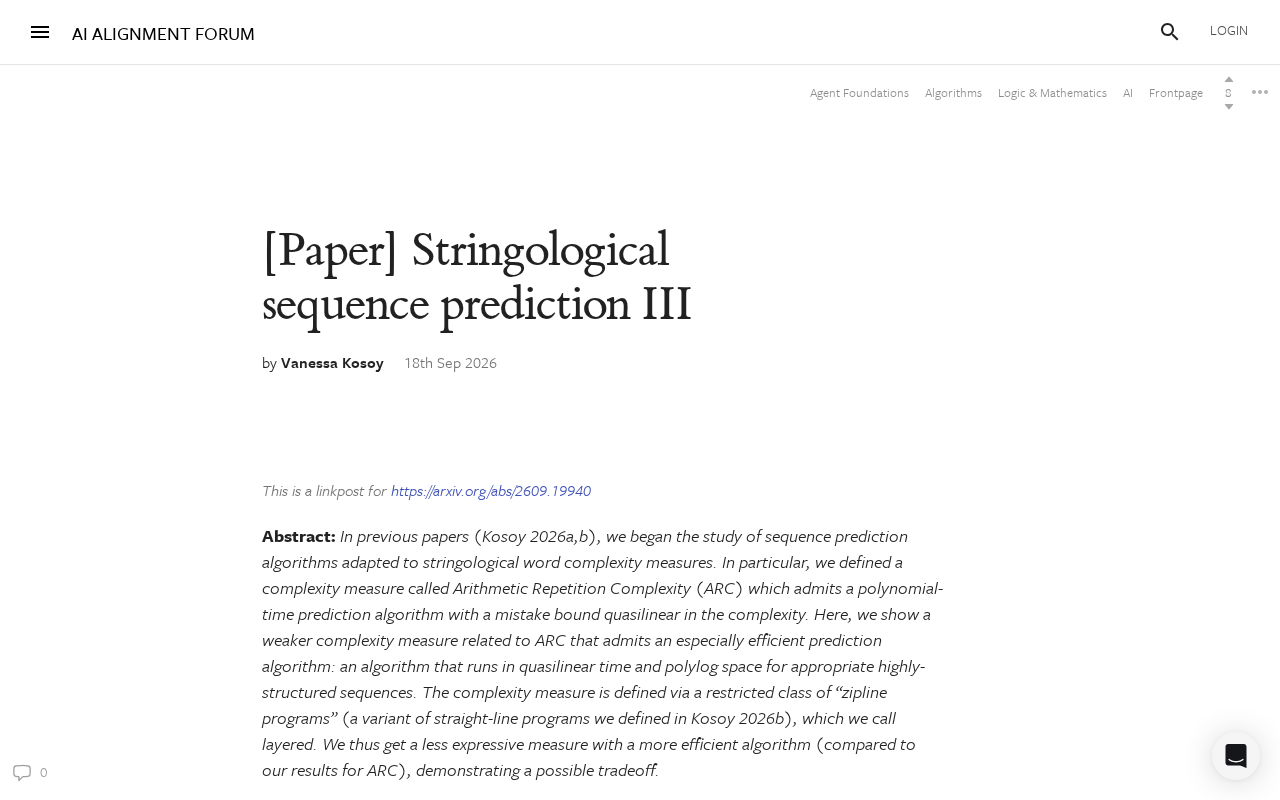
From ARC to Layered Zipline Programs
In the first two papers (Kosoy 2026a, 2026b), the author defined a measure called "Arithmetic Repetition Complexity" (ARC). ARC has a striking theoretical property: it allows a polynomial-time prediction algorithm whose error bound scales quasilinearly with complexity. In other words, for highly structured sequences characterized by ARC, the algorithm can complete prediction within feasible time, with a strict upper bound on the number of errors.
However, ARC's expressive power also means there is a ceiling on algorithm efficiency. This paper introduces a complexity measure related to but weaker than ARC, defined through a restricted class of "zipline programs." Zipline programs are a variant of straight-line programs proposed by the author in Kosoy 2026b, and here they are further restricted to a "layered" form. This restriction reduces the measure's expressive power but yields a significant improvement in algorithm efficiency.
Straight-line program (SLP) is a fundamental computational model in theoretical computer science, referring to a sequence of instructions with no branching or loops, where each instruction is executed only once and subsequent instructions can reference the results of earlier ones. It is essentially a linearized representation of a directed acyclic graph (DAG), commonly found in areas such as circuit complexity, string compression (e.g., LZ77, grammar-based compression), and program equivalence verification. The size of a straight-line program (number of instructions) is often used to measure the complexity of objects (such as strings or sequences). Kosoy defined zipline programs as a variant of straight-line programs to characterize the generation process of sequences; the "layered" restriction requires instructions to be organized in layers, where each layer can only reference results from the previous layer, further constraining the generation structure and reducing expressive power. This restriction is not arbitrary: the layered structure makes programs naturally suited for parallel and staged processing, providing a structural foundation for subsequent polylog-space algorithms.
Quasilinear Time and Polylog Space
The new algorithm's efficiency improvement is reflected in two dimensions. For appropriately highly structured sequences, the algorithm runs in quasilinear time while requiring only polylog space. This space complexity is particularly noteworthy—it means the algorithm can handle large-scale sequence prediction tasks under extremely limited memory conditions.
Compared to the polynomial-time algorithm corresponding to ARC, the improvement in time is not an exponential leap, but the compression in space is a qualitative change. Polylog space is typically closely associated with parallel computing and streaming processing scenarios, which provides theoretical possibilities for deploying sequence prediction in resource-constrained environments.
Quasilinear time refers to time complexity of O(n·polylog(n)), i.e., n multiplied by some power of log n, slightly slower than strictly linear O(n) but far better than polynomial time O(n^k) (k>1). When processing large-scale sequences, quasilinear is generally considered a "near-optimal" feasible efficiency. Polylog space refers to space complexity of O(polylog(n)), i.e., using only memory at the level of a power of log n. In standard computational complexity theory, the class corresponding to polylog space, such as L, is closely related to NC: NC is the class of problems solvable in parallel polynomial time, and polylog-space algorithms can typically be efficiently parallelized. In contrast, polynomial-time algorithms may use polynomial space, which is infeasible under memory constraints. Therefore, polylog space means the algorithm can stream or process ultra-long sequences in shards, even when total memory is far smaller than the input size. This space compression is the qualitative change point emphasized in the paper.
Efficiency vs. Expressive Power Trade-off: Essential or Technical Limitation?
The paper explicitly points out that this result demonstrates a possible trade-off relationship: a weaker expressive measure paired with a more efficient algorithm. But the author also admits that whether this trade-off is fundamental or merely a limitation of current techniques remains an interesting open question.
The significance of this open question extends beyond the purely technical level. If the trade-off between efficiency and expressive power is inevitable, then the design of sequence prediction algorithms requires a fundamental choice between the two; if it is merely a technical limitation, it means that in the future it may be possible to find algorithms with both strong expressive power and high efficiency. Either way, the answer will profoundly influence the development direction of compositional learning theory.
Expressive power here refers to how many different structures or complexities of sequences a complexity measure (such as ARC or layered zipline programs) can characterize. The stronger the expressive power, the more types of sequences can be covered, but this typically makes the corresponding prediction problem harder to solve efficiently. The efficiency vs. expressive power trade-off is one of the core themes in computational complexity theory: for example, regular expressions are weaker in expressive power than context-free grammars but more efficient to match; propositional logic is weaker than first-order logic but decidable and efficient. If this trade-off is fundamental, it means there is no sequence prediction algorithm that simultaneously possesses strong expressive power and polylog space/quasilinear time, akin to conjectures about complexity class separations; if it is merely a technical limitation, then in the future it may be possible to break the current trade-off through more clever algorithms or stronger lower-bound techniques. The resolution of this open question will directly affect whether compositional learning theory can construct a unified efficient learning framework.
A New Perspective on Compositional Learning Theory
This work is part of the author's new approach to compositional learning theory. The stringological sequence prediction series attempts to re-examine the sequence prediction problem from the perspective of word complexity, rather than following traditional statistical learning or information-theoretic frameworks. Layered zipline programs, as a restricted variant of straight-line programs, provide an intermediate layer between full generality and oversimplification for characterizing sequence structure.
From a broader perspective, this paradigm of "defining complexity using restricted program classes and then designing prediction algorithms accordingly" may provide new tools for understanding the inherent limits of learning algorithms. It formalizes the correspondence between algorithm efficiency and sequence structure, making the trade-off question precisely formulable and discussable.
For readers interested in the theoretical foundations of AI, this series of papers is worth following. In particular, the open question of the efficiency-expressive power trade-off may become a breakthrough point for future research.
Compositional learning theory is a research direction that has emerged in recent years, advocating understanding learning and prediction from the perspective of "how to combine simple components to generate complex objects," rather than relying solely on statistical distribution assumptions. It contrasts with algorithmic information theory (which measures the randomness of sequences using Kolmogorov complexity) and computational learning theory (such as PAC learning): the latter two typically focus on sample complexity or statistical generalization, while compositional learning theory shifts attention to the formal relationship between the program complexity of generative structures and algorithm efficiency. Kosoy's stringological sequence prediction series is a representative of this paradigm: defining sequence complexity using restricted program classes (such as layered zipline programs) and then designing prediction algorithms accordingly, thereby turning the "structure-efficiency" correspondence into provable mathematical propositions. This approach may provide theoretical tools for understanding implicit structural biases in deep learning and may intersect with fields such as program synthesis and neuro-symbolic reasoning.
One-line Summary
Kosoy proposes a weaker complexity measure, trading layered zipline programs for sequence prediction algorithms with quasilinear time and polylog space.
Paragraph Summary
The paper "Stringological sequence prediction III" continues the stringological sequence prediction series, introducing a measure weaker than Arithmetic Repetition Complexity (ARC), defined through layered zipline programs. The new algorithm can run in quasilinear time for highly structured sequences while requiring only polylog space, achieving a qualitative change in space compared to the polynomial-time algorithm corresponding to ARC. The author points out that this demonstrates an efficiency vs. expressive power trade-off: a weaker measure yields a more efficient algorithm. However, whether this trade-off is a fundamental limitation or a technical limitation remains an open question. This work is part of a new approach to compositional learning theory, formalizing the correspondence between algorithm efficiency and sequence structure, and providing new perspectives for understanding the limits of learning algorithms.
Related articles

Bilibili's Hit Dify Tutorial: A Practical Guide to Building 20+ AI Apps from Scratch
A distilled guide to Bilibili's top-rated Dify tutorial: Windows + Docker deployment, MySQL connection, five app types, model integration strategy, and publishing.

Agent Skills Beginner's Guide: From Concepts to Multi-Agent Collaboration in Practice
A comprehensive guide to Agent Skills: core concepts, components, the importance of Description, standardization, beginner learning paths, and multi-agent collaboration.

One Neuron Detects Both Cats and Cars? We Reproduced It and Found a New Explanation
The cat-car neuron reinterpreted: researcher Cammarata argues it distinguishes pointy from round, not cats from cars. We reproduced the experiment and found the new explanation holds on most inputs—but cars are the exception. The interpretability debate continues on language models.