New Benchmark for LLM Code Optimization Evaluation: How Does PatternBench Strip Away the Compiler's Credit?
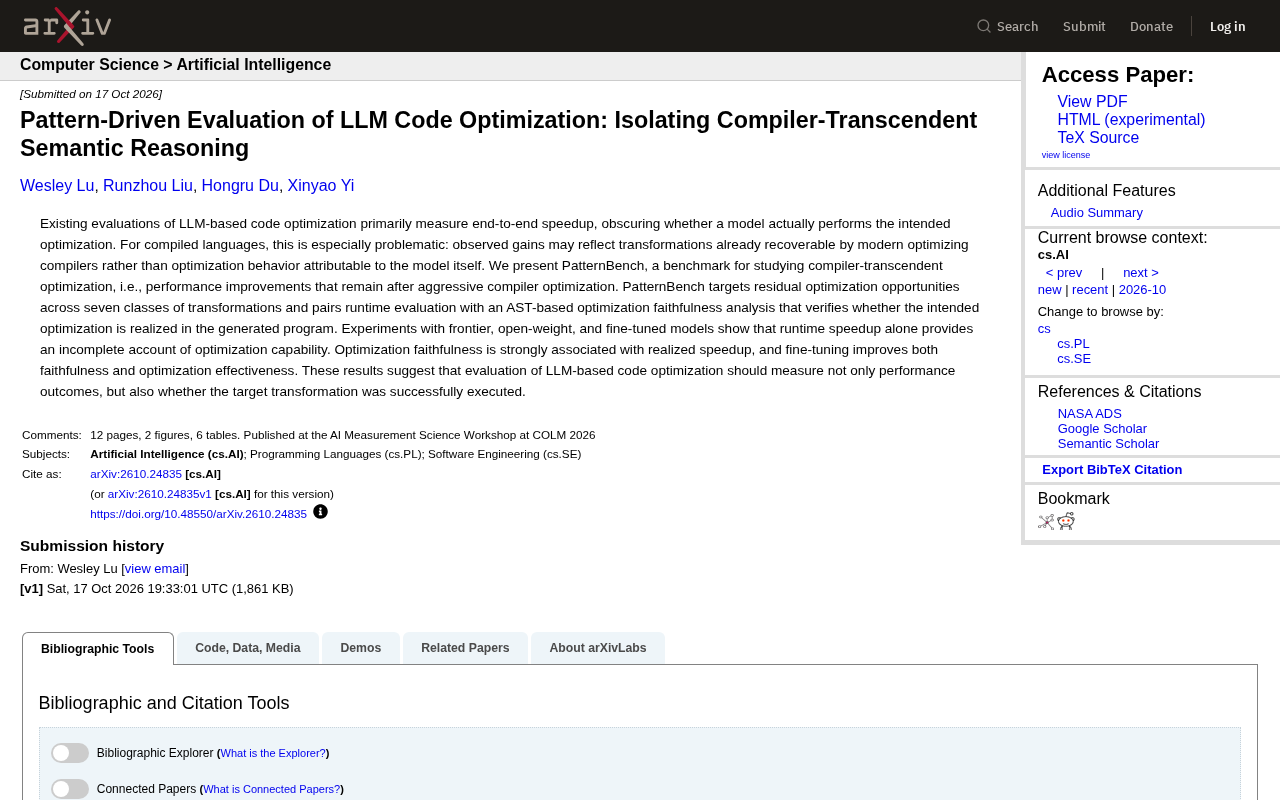
PatternBench strips away the compiler's credit via AST analysis to assess LLMs' true code optimization ability.
PatternBench is a new benchmark for evaluating LLM code optimization. It targets residual opportunities after compiler optimization, covers seven transformation types, and uses dual evaluation: runtime speedup plus AST-based optimization fidelity. Experiments show fidelity strongly correlates with speedup and that fine-tuning improves both, urging evaluation beyond end-to-end speedup.
New Benchmark for LLM Code Optimization Evaluation: How Does PatternBench Strip Away the Compiler's Credit?
When large language models (LLMs) are used for code optimization, we typically only look at how much faster the program runs. But a new study points out that this end-to-end speedup metric may severely overestimate the model's actual capability—because modern compilers themselves can perform a great deal of optimization, and the "optimizations" generated by the model may simply be transformations the compiler could already do. To clarify the LLM's true contribution, the researchers propose PatternBench, a benchmark specifically designed to evaluate "compiler-transcendent optimization."

Why Does End-to-End Speedup "Lie"?
In compiled languages (such as C/C++ and Rust), modern optimizing compilers (such as LLVM and GCC) already have a large number of transformations built in, including constant propagation, dead code elimination, and loop unrolling. If the code generated by the model merely triggers these existing optimizations, then even if the program speeds up noticeably, this cannot be attributed to the model—it may simply have happened to write code the compiler likes.
The paper's authors point out that existing evaluation methods mainly measure end-to-end speedup, which obscures whether the model actually performed the intended optimization. Especially for compiled languages, the observed performance gains may reflect transformations recoverable by the compiler rather than the model's own optimization behavior. In other words, we may have been handing out trophies to the compiler while mistakenly thinking they were for the LLM.
Compiler-transcendent optimization is the core concept of PatternBench, referring to code transformations generated by the model that go beyond the scope of conventional optimization capabilities of modern compilers. To understand this, it is necessary to distinguish two types of optimization: one is transformations already built into the compiler that can be automatically recovered (such as constant folding and loop-invariant code motion), and the other is transformations that require specific domain knowledge or complex reasoning to discover (such as changing the algorithm structure or introducing new data layouts). The former can be completed by the compiler through pattern matching even if the model does not generate it; the latter requires the model to truly understand code semantics and make decisions. PatternBench focuses on the latter, because only such optimizations can reflect the LLM's independent contribution. This distinction also explains why end-to-end speedup is unreliable: when the code generated by the model happens to trigger the compiler's built-in optimizations, the speedup is incorrectly attributed to the model, while in fact the model may not have performed any compiler-transcendent transformation.
PatternBench's Design: Seven Types of Transformations and Dual Evaluation
The core idea of PatternBench is to focus on "residual optimization opportunities"—that is, the performance improvement space that still exists after aggressive compiler optimization. The benchmark covers seven types of transformations (such as loop optimization and memory access pattern optimization), and performs dual evaluation on each generated program:
- Runtime evaluation: measures the actual execution speed of the program.
- Optimization fidelity analysis: verifies, based on the abstract syntax tree (AST), whether the intended optimization pattern is actually implemented in the generated program.
This design enables the researchers to distinguish between "the model actually performed the optimization" and "the model happened to make the compiler perform the optimization." Optimization fidelity analysis does not rely on runtime performance; instead, it directly checks whether the code structure contains the target transformation, thereby providing a more essential metric.
Optimization fidelity is an evaluation dimension introduced by PatternBench, referring to whether the generated program actually contains the target optimization pattern at the abstract syntax tree (AST) level, rather than merely showing speedup at runtime. Its technical implementation usually includes: parsing the model output into an AST, and then detecting the structural features of specific transformations through pattern matching or graph isomorphism algorithms (such as repeated code blocks after loop unrolling, or index expressions after memory access reordering). Compared with runtime evaluation, fidelity analysis does not depend on hardware and input data, so it is more stable and reproducible. But this approach also has limitations: it can only verify predefined transformation patterns and cannot discover optimizations invented by the model that are not listed in the benchmark; at the same time, some semantically equivalent transformations may appear different in the AST, leading to missed detection. Nevertheless, the strong correlation between fidelity and speedup indicates that it is still an effective proxy metric.
Experimental Findings: Strong Correlation Between Fidelity and Speedup
The researchers conducted experiments on frontier models, open-weight models, and fine-tuned models, yielding several key findings:
- Runtime speedup alone cannot fully characterize optimization capability. Some models may achieve decent speedup but have low fidelity, indicating that their optimization was not intentional; conversely, models with high fidelity often also bring actual speedup.
- Optimization fidelity is strongly correlated with the achieved speedup. This means that fidelity analysis can serve as a reliable proxy metric for optimization capability.
- Fine-tuning can simultaneously improve fidelity and optimization effectiveness. Fine-tuned models not only execute the target transformations more faithfully at the AST level, but also achieve better speedup at runtime.
These results suggest that when evaluating LLM code optimization, one should not only look at performance results but also at whether the target transformations were successfully executed.
Residual optimization opportunity refers to the performance improvement space that still exists in a program after the compiler performs aggressive optimization (such as LLVM's -O3 level) and that has not been automatically handled by the compiler. Identifying residual opportunities requires first running the compiler and analyzing its optimization reports, or comparing code differences under different optimization levels through differential testing. PatternBench chooses to evaluate models on these residual opportunities because they exclude transformations that the compiler can already cover, thereby measuring the model's optimization capability more purely. This design also brings challenges: the distribution of residual opportunities may vary with compiler version, target architecture, and optimization flags, so the benchmark needs to fix the compilation environment to ensure fair comparison. In addition, residual opportunities often correspond to more complex transformations, placing higher demands on the model's code understanding and generation capabilities, which also explains why models with high fidelity usually require fine-tuning to achieve ideal performance.
Implications for LLM Code Optimization Research
The proposal of PatternBench challenges the evaluation methodology of LLMs in the field of code optimization. In the past, researchers may have relied too heavily on the single metric of end-to-end speedup, leading to biased judgments of model capability. The new benchmark emphasizes the dimension of "optimization fidelity," which helps more precisely locate the model's weaknesses: does it not know how to optimize, or does it know but fail to generate the correct pattern?
In addition, the benchmark also provides finer-grained feedback signals for fine-tuning. If the model performs poorly on fidelity, it means it needs to learn specific code transformation patterns; if fidelity is high but speedup is not obvious, it may mean that the selection or combination of optimization patterns needs improvement.
The paper's authors conclude that the evaluation of LLM code optimization should simultaneously measure performance results and whether the target transformations are successfully executed. As LLMs are applied more deeply in software engineering, this more rigorous evaluation approach will help the community avoid being misled by false speedup signals and promote the development of genuinely effective optimization capabilities.
More details can be found in the original paper.
One-line Summary
A new benchmark, PatternBench, strips away the compiler's credit through AST analysis to evaluate LLMs' true code optimization capability.
Paragraph Summary
PatternBench is a new benchmark specifically designed to evaluate the code optimization capabilities of large language models, aiming to address the problem that end-to-end speedup metrics may overestimate model contributions. Because modern compilers already have many optimization transformations built in, the code generated by a model may merely trigger these existing optimizations rather than truly performing compiler-transcendent optimization. PatternBench focuses on residual optimization opportunities that still exist after aggressive compiler optimization, covers seven types of transformations, and performs dual evaluation on each generated program: runtime speedup measurement and optimization fidelity analysis based on the abstract syntax tree. Experiments show that optimization fidelity is strongly correlated with runtime speedup and can serve as a reliable proxy metric; fine-tuning can improve both simultaneously. The study calls for LLM code optimization evaluation to measure both performance results and target transformation execution, so as not to be misled by false speedup signals.
Related articles

WorkBuddy in Action: How AI Agents Automate Batch File Conversion and Archiving
Bilibili creator Teacher Shanyao tests WorkBuddy vs. Doubao on batch file conversion, showing how AI Agents move from "giving solutions" to "direct execution," with a full workflow and credit cost reference.

High-Frequency AI Agent Interview Topics: RAG, Multi-Agent Systems, and Token Optimization
Based on a Bilibili Agent interview video, this article covers high-frequency AI Agent interview topics: RAG evaluation, single vs. multi-agent selection, token cost control, infinite loop troubleshooting, and project presentation techniques.

The Complete AI Agent Development Workflow: From Technical Build to Compliant Launch
A full AI agent development workflow for education: architecture, four teaching modules, deep synthesis and large model filings, high-concurrency deployment, and operations.