New Benchmark for Low-Resource Language Recipe Translation: ReciLoReL and ReciLex
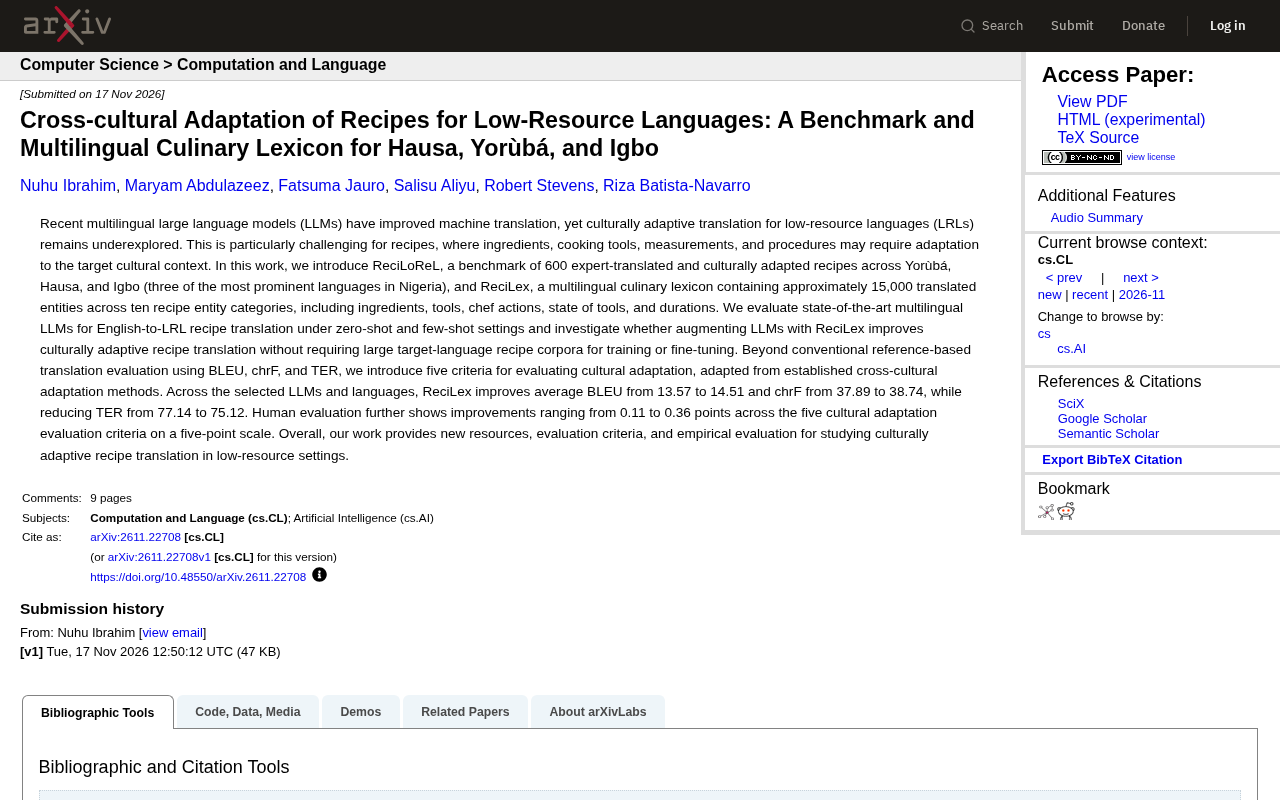
A new paper releases a recipe translation benchmark and dictionary for three Nigerian languages, showing dictionary augmentation improves culturally adapted translation.
To address the lack of culturally adapted resources for recipe translation in low-resource languages like Hausa, Yoruba, and Igbo, the paper proposes the ReciLoReL benchmark (600 expert-translated, culturally adapted recipes) and the ReciLex dictionary (~15,000 culinary entities across ten categories). Beyond BLEU, chrF, and TER, it adapts five cultural adaptation criteria with human five-point evaluation. Dictionary augmentation alone, without fine-tuning, raises average BLEU from 13.57 to 14.51, chrF from 37.89 to 38.74, and lowers TER from 77.14 to 75.12, with 0.11–0.36 point gains on the five criteria. The authors note the approach is lightweight and feasible but limited to specific languages and domains, with modest automatic metric gains—dictionary augmentation is only a starting point.
When Recipe Translation Meets Cultural Differences
Multilingual large models have made remarkable progress in machine translation, yet culturally adapted translation for low-resource languages remains largely uncharted territory. Hausa, Yoruba, and Igbo are the three main languages of Nigeria, yet they have long lacked high-quality parallel corpora. Recipe texts are especially tricky—ingredients, cookware, units of measurement, and procedural steps all need to be re-grounded in the target cultural context. A new paper proposes the ReciLoReL benchmark and the ReciLex dictionary, attempting to provide a reusable evaluation framework and knowledge resource for this challenge.
ReciLoReL: A 600-Entry Expert-Translated Recipe Benchmark
ReciLoReL contains 600 recipes, all expert-translated and culturally adapted, covering Yoruba, Hausa, and Igbo. Unlike typical general-domain parallel corpora, these recipes were deliberately rewritten so that target-language readers can follow the steps according to local cooking conventions. The benchmark's construction logic makes a key point: translation evaluation for low-resource languages cannot rely solely on literal fidelity—cultural comprehensibility must also be quantified.
Low-resource languages in NLP refer to languages lacking large-scale, high-quality annotated corpora and computational resources, and which typically do not occupy a significant share of mainstream model training data. Although Hausa, Yoruba, and Igbo have large speaker populations (over 100 million combined), their presence in internet text and publicly available parallel corpora is extremely low, and they are thus classified as low-resource languages. Machine translation for such languages faces challenges including data sparsity, insufficient domain coverage, and scarce evaluation resources, with translation quality for culturally specific content (such as recipes) being especially difficult to guarantee.
ReciLex: A Multilingual Culinary Dictionary with ~15,000 Entities
ReciLex is a multilingual culinary dictionary containing approximately 15,000 translated entities across ten recipe entity categories, including ingredients, tools, chef actions, tool states, and durations. Its role is not to replace model training but to serve as external knowledge injection—the paper's core question is precisely: without large-scale collection of target-language recipe corpora and without fine-tuning, can dictionary augmentation alone improve culturally adapted translation quality?
Evaluation Methodology: Five Cultural Adaptation Criteria Beyond Traditional Metrics
The study employs conventional reference-based metrics such as BLEU, chrF, and TER, while also adapting five cultural adaptation evaluation criteria from existing cross-cultural adaptation methods. This dual-track design is noteworthy: automatic metrics measure surface-level similarity, while the cultural adaptation criteria examine whether translations genuinely conform to target-culture cooking practices. Human evaluation uses a five-point scale, scoring each of the five criteria separately, giving qualitative judgments a comparable scale.
BLEU (Bilingual Evaluation Understudy) measures translation quality by computing the precision of n-gram matches between the translation and reference translations, ranging from 0 to 100 (higher is better), but it emphasizes literal overlap and is insensitive to word-order changes and cultural rewrites. chrF is based on character-level n-gram F1 scores and is friendlier to morphologically rich languages. TER (Translation Edit Rate) computes the minimum number of edit operations (insertions, deletions, substitutions, shifts) required to transform the translation into the reference, as a proportion of reference length—lower is better, reflecting the editing cost of the translation. All three are automatic reference-based metrics that cannot directly capture cultural adaptation, hence the need for human evaluation.
Experimental Results: Dictionary Augmentation Brings Consistent Improvements
On the selected models and languages, ReciLex augmentation raised average BLEU from 13.57 to 14.51, chrF from 37.89 to 38.74, and reduced TER from 77.14 to 75.12. In human evaluation, improvements across the five cultural adaptation criteria ranged from 0.11 to 0.36 points (on a five-point scale). These numbers are not dramatic, but the direction is consistent: without relying on large-scale target-language corpora, structured dictionaries alone can improve culturally adapted translation. Given the cost of corpus acquisition for low-resource languages, this lightweight augmentation path has practical value.
Fine-tuning refers to continuing to train a pretrained large model on domain- or task-specific data so that its parameters adapt to the target scenario. For low-resource languages, fine-tuning typically requires hundreds to thousands of high-quality parallel sentences, which are costly to collect and may lead to overfitting. The dictionary augmentation adopted in this paper is a training-free knowledge injection method: entity translations from ReciLex are provided to the model via retrieval or prompting, guiding it to generate translations that better conform to the target culture, thereby bypassing the data and compute thresholds required for fine-tuning.
Significance and Limitations
This work contributes three types of resources: an expert-translated benchmark, a culinary dictionary covering multiple entity categories, and operational cultural adaptation evaluation criteria. For low-resource language NLP, it turns "cultural adaptation" from a vague slogan into a measurable, comparable set of indicators. It should be noted that the study focuses on three Nigerian languages and the specific domain of recipes; whether the conclusions transfer to other low-resource languages or text types still requires further validation. Moreover, the gains in automatic metrics are limited, indicating that dictionary augmentation is only a starting point, not an endpoint.
Implications for Multilingual AI Development
For teams building multilingual applications, the ReciLex approach offers a transferable paradigm: rather than waiting for large-scale corpora, it is better to first compile domain entity dictionaries and augment models via retrieval or prompt injection. The cultural adaptation evaluation criteria also remind developers that when evaluating low-resource language outputs, localization quality beyond BLEU scores deserves inclusion in acceptance workflows.
One-line Summary
A new paper releases a recipe translation benchmark and dictionary for three Nigerian languages, demonstrating that dictionary augmentation can improve culturally adapted translation quality.
Paragraph Summary
Addressing the lack of culturally adapted resources for recipe translation in low-resource languages such as Hausa, Yoruba, and Igbo, the paper proposes the ReciLoReL benchmark (600 expert-translated and culturally adapted recipes) and the ReciLex dictionary (~15,000 culinary entities across ten categories). Beyond automatic metrics including BLEU, chrF, and TER, the study adapts five cultural adaptation evaluation criteria and conducts human evaluation on a five-point scale. Experiments show that dictionary augmentation alone, without fine-tuning, raises average BLEU from 13.57 to 14.51, chrF from 37.89 to 38.74, and reduces TER from 77.14 to 75.12, with improvements of 0.11 to 0.36 points across the five cultural adaptation criteria. The authors note that this path is lightweight and feasible, but conclusions are limited to specific languages and domains, automatic metric gains are modest, and dictionary augmentation is only a starting point.
Related articles
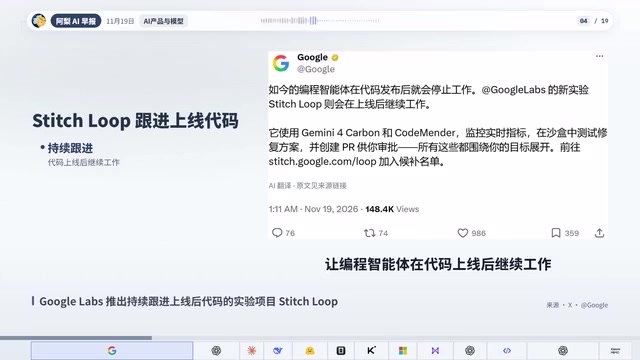
Gemini 4 Neon Released: Tops Coding Benchmarks, Gemini 4 World Model Opens Up
Google releases Gemini 4 Neon, topping the coding agent index with million-token context; Gemini 4 world model opens Project Genie; DeepSeek web search goes free; Microsoft unveils an on-device Windows small model; the White House discusses requiring US companies to disclose whether they use Chinese open-source models.
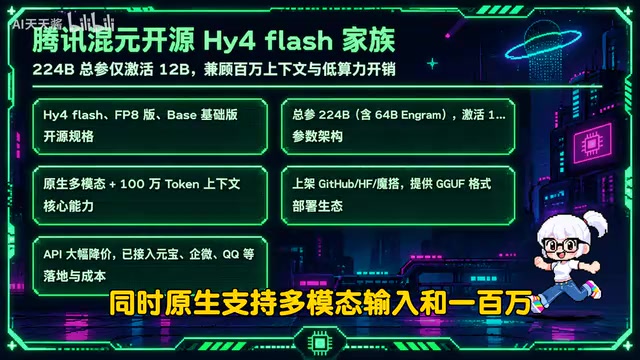
Google Gemini 4 Neon Released: Just $3 per Million Tokens as the AI Price War Escalates
Google releases Gemini 4 Neon at just $3 per million input tokens; Tencent open-sources Hy4 Flash; DeepSeek scraps search-crawling fees; Microsoft unveils new image and voice models; NVIDIA halts H200 shipments to China; Citi says no reimbursement for AI-agent fraud losses. Today's hardcore AI news in one read.
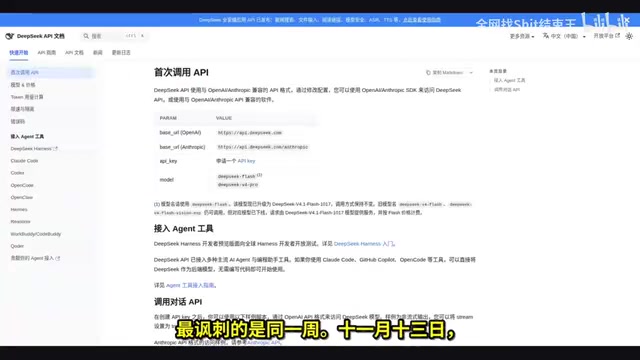
DeepSeek Quota Wall Pre-embedded in Code: The 48 Hours of Open-Source Migration Tools and Chat Restrictions
DeepSeek pre-embedded quota limits in frontend code two days early; old chats expire after 72 hours of inactivity on Nov 15, while APIs and client code go open-source the same week. This analysis examines the VRAM pressure and three-way resource contention behind rapid quota depletion, and the user dilemma of "not unwilling to pay, but unable to find where to pay."