New Breakthrough in Quantum Optimization: Learning QAOA Angles to Accelerate Combinatorial Optimization

Machine learning models learn problem-to-QAOA-angle mappings, replacing expensive optimization with a single forward pass and achieving orders-of-magnitude speedup.
This study addresses the high computational cost of variational angle optimization in the Quantum Approximate Optimization Algorithm (QAOA) by proposing a machine learning model that learns the mapping from combinatorial optimization problem instances to high-quality QAOA angles. The trained model outputs angles through a single forward pass, orders of magnitude faster than traditional per-instance classical optimizers, with comparable angle quality. The model generalizes to unseen graph topologies (such as Barabási-Albert graphs and 2D grid graphs), and its sampling results have been verified on quantum hardware to be statistically indistinguishable from those using traditional solver angles. Additionally, topology-sensitive models can further improve angle quality. This method amortizes optimization costs into upfront training investment, with potential value for industries that need to repeatedly solve similar problems, though the model must be trained for the problem distribution and QAOA's overall advantages still require larger-scale validation.
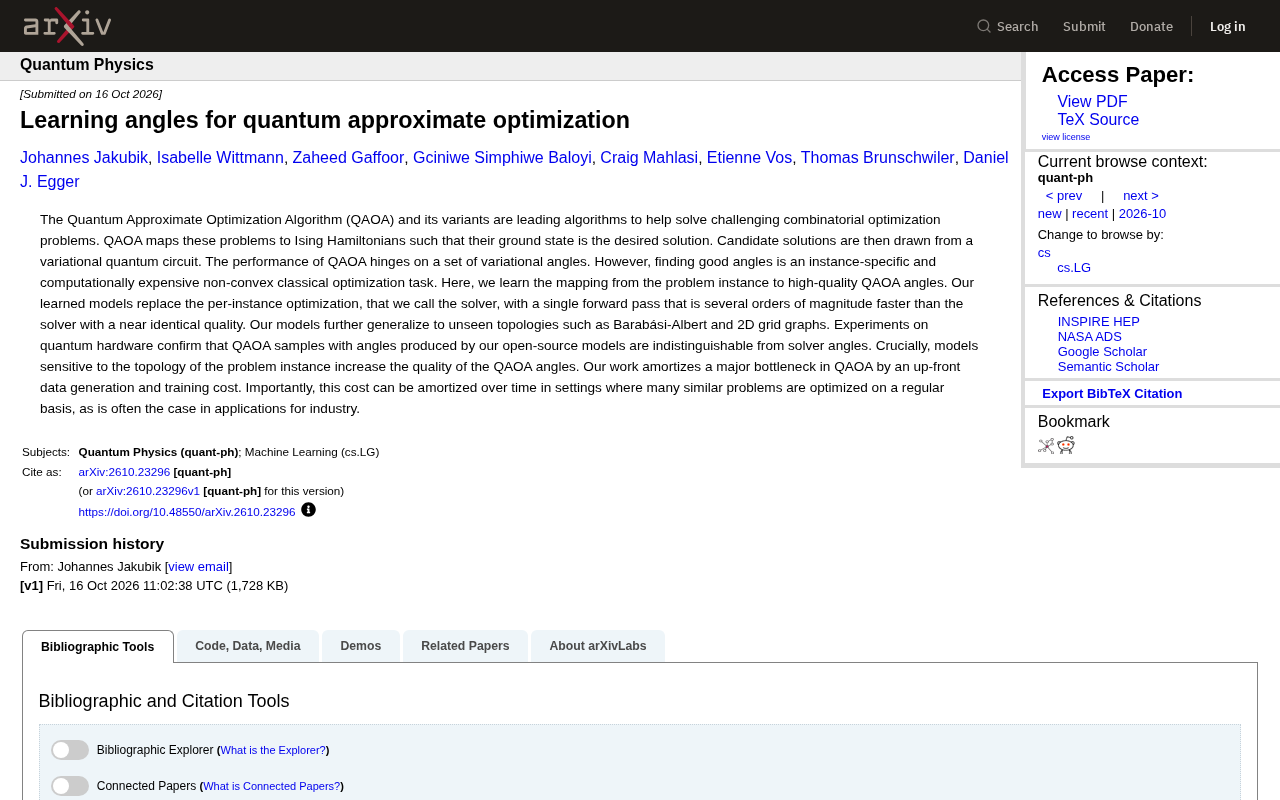
The Quantum Approximate Optimization Algorithm (QAOA) is an important tool for solving combinatorial optimization problems, but its performance depends heavily on a set of variational angles, and finding these angles is a computationally expensive non-convex optimization task. A recent study proposes using a machine learning model to directly learn the mapping from problem instances to high-quality QAOA angles, replacing the per-instance classical optimizer with a single forward pass, achieving orders-of-magnitude speedup with nearly identical quality. The model can also generalize to unseen graph topologies, and the indistinguishability of sampling results has been verified on quantum hardware.
The Core Bottleneck of QAOA: Angle Optimization
QAOA maps combinatorial optimization problems to Ising Hamiltonians, whose ground states correspond to optimal solutions. Candidate solutions are generated by a variational quantum circuit, and the circuit's performance depends on a set of variational angles. However, finding high-quality angles is an instance-specific non-convex classical optimization problem that is extremely computationally expensive—traditional solvers need to run an optimization loop separately for each problem instance.
According to the study, this per-instance optimization, called a "solver," is the main bottleneck in QAOA applications. Especially when facing a large number of similar problems, repeated optimization causes enormous computational waste.
Ising Hamiltonians and Combinatorial Optimization
The Ising Hamiltonian is a classical model describing the energy of a spin system, of the form $H = \sum_{i<j} J_{ij} \sigma_i \sigma_j + \sum_i h_i \sigma_i$, where $\sigma_i \in {+1,-1}$ represents the spin value. Many combinatorial optimization problems (such as Max-Cut and graph coloring) can be encoded as finding the spin configuration that minimizes $H$. QAOA constructs a quantum circuit to prepare a quantum state approximating this ground state, and the variational angles in the circuit control the evolution of the quantum state between the "problem Hamiltonian" and the "mixer Hamiltonian." Therefore, understanding the Ising model is a key prerequisite for understanding how QAOA transforms optimization problems into quantum problems.
Variational Quantum Circuits and Angles
The QAOA quantum circuit consists of alternating "problem layers" and "mixer layers," each with tunable parameters (angles). Typically, with $p$ layers, there are $2p$ angles to optimize. These angles determine the probability distribution of obtaining low-energy solutions at final measurement. The angle space is non-convex and high-dimensional, and classical optimizers (such as gradient descent and Nelder-Mead) need to repeatedly call the quantum circuit for sampling to evaluate gradients or objective functions, making the optimization process extremely time-consuming. This is precisely the "per-instance optimization" bottleneck referred to in the article.
Learning the Angle Mapping: A Single Forward Pass Replaces the Optimizer
The research team trained a machine learning model to learn the mapping from problem instances to high-quality QAOA angles. After training, the model can output angles through a single forward pass, orders of magnitude faster than traditional solvers, with comparable quality.
The essence of this approach is to amortize the optimization cost: invest in data generation and training costs upfront, then perform fast inference on large numbers of similar problems afterward. The paper notes that industrial applications often require periodically optimizing many similar problems, and this cost can be amortized over time.
The model also demonstrates generalization capability, handling unseen topologies such as Barabási-Albert graphs and 2D grid graphs. This indicates that the model is not simply memorizing instances but has learned topology-related features.
The Concept of Amortized Optimization
Amortization is a strategy of front-loading repetitive computational costs. In machine learning, it refers to training a model to approximate the output of some expensive process, so that at inference time only a single forward pass is needed to obtain the result. For example, amortized inference in variational autoencoders uses a neural network to directly predict the posterior distribution of latent variables, avoiding running optimization separately for each data point. This paper transfers this idea to QAOA: first, invest substantial computational resources to generate "problem instance–optimal angle" paired datasets and train the model; afterward, for large numbers of similar problems, only a single forward pass is needed, and the total cost is spread across many instances.
Generalization to Unseen Topologies
The Barabási-Albert graph is a scale-free network model generated through a preferential attachment mechanism, whose degree distribution follows a power law, and is commonly used to simulate social networks and internet topologies. The 2D grid graph is a regular structure with nodes arranged in a two-dimensional grid. The model's ability to handle these two types of unseen graph topologies indicates that it has learned general features related to graph structure (such as node degree distribution and local connectivity), rather than simply memorizing specific instances in the training set. This topology generalization capability is crucial for practical applications, because real-world optimization problems often have diverse graph structures.
Hardware Verification and Topology-Sensitive Models
The study conducted experiments on quantum hardware, confirming that QAOA sampling results using model-generated angles are statistically indistinguishable from those obtained with traditional solver angles. This is a key validation, showing that the learned angles are equally effective on actual quantum devices.
An interesting finding is that models sensitive to problem instance topology can further improve QAOA angle quality. This means that model design should consider graph structure information rather than relying solely on problem parameters.
The Meaning of Statistical Indistinguishability
"Statistically indistinguishable" means that two sets of sampling results (from model angles and solver angles) show no significant difference under statistical tests. This is usually determined by comparing the mean and variance of energy distributions or using the Kolmogorov-Smirnov test. This validation was completed on quantum hardware, meaning that the model-generated angles not only work in ideal simulators but can also withstand the noise and decoherence of real quantum devices. This enhances the credibility of the method on actual quantum computing platforms, because hardware noise may amplify angle errors, and statistical indistinguishability indicates that model angles and optimized angles perform equivalently under noise.
Design of Topology-Sensitive Models
Topology-sensitive models refer to machine learning models that explicitly encode graph structure information (such as adjacency matrices, node degrees, and graph Laplacian eigenvalues) in their input features. For example, graph neural networks (GNNs) can naturally process graph-structured data and capture topological relationships between nodes through message-passing mechanisms. The article finds that such models can generate higher-quality QAOA angles than models using only problem parameters (such as edge weights), suggesting that future designs should incorporate graph structure priors to improve generalization and angle quality.
Industry Impact and Limitations
The core value of this method lies in transforming QAOA's classical optimization bottleneck into an amortizable upfront cost. For industries that need to repeatedly solve similar combinatorial optimization problems (such as logistics, finance, and pharmaceuticals), this amortization strategy may significantly reduce overall computational overhead.
However, the study also implies limitations: the model needs to be trained for a specific problem distribution, and if the instance distribution changes dramatically, retraining may be required. In addition, quantum hardware is still in its early stages, and the overall advantages of QAOA still require larger-scale validation.
Conclusion
This study provides a practical path for the real-world application of QAOA: replacing expensive per-instance angle optimization with a machine learning model, achieving near-optimal quality and orders-of-magnitude speedup through a single forward pass. The open-source model and hardware verification enhance credibility, and the design approach of topology-sensitive models is worth drawing on in future work.
Related articles

Free Unlimited Claude Code Solution: Agnes AI + CC Switch Setup Guide
No paid subscription needed — pair the free AI platform Agnes AI with the open-source tool CC Switch to provide a backend for Claude Code, enabling unlimited free calls to text, image, and video models. This guide covers the full setup, test results, and usage boundaries.

A Complete Zero-Cost Guide to Getting Started with Claude Code for Beginners in China
A beginner's guide to Claude Code for users in China: two installation methods (command line and IDE plugin), full configuration steps for replacing the official API with the free domestic LongCat model, and a hands-on demo of building a small tool with natural language, plus tips.

When the NSA Gets Involved: The AI Supply Chain Crisis Behind Open-Source CVEs and API Key Hijacking
Multiple open-source projects disclosed severe CVEs in one day, PHP flaws alarmed the FBI, and Railway and OpenCode were breached with API keys stolen. This article breaks down the vulnerability window, AI-accelerated exploitation, and the AI supply chain crisis behind the API key black market, with a developer defense checklist.