New Membership Inference Method LoFIT for Diffusion Models: Detecting Training Data via Local Conditional Fit
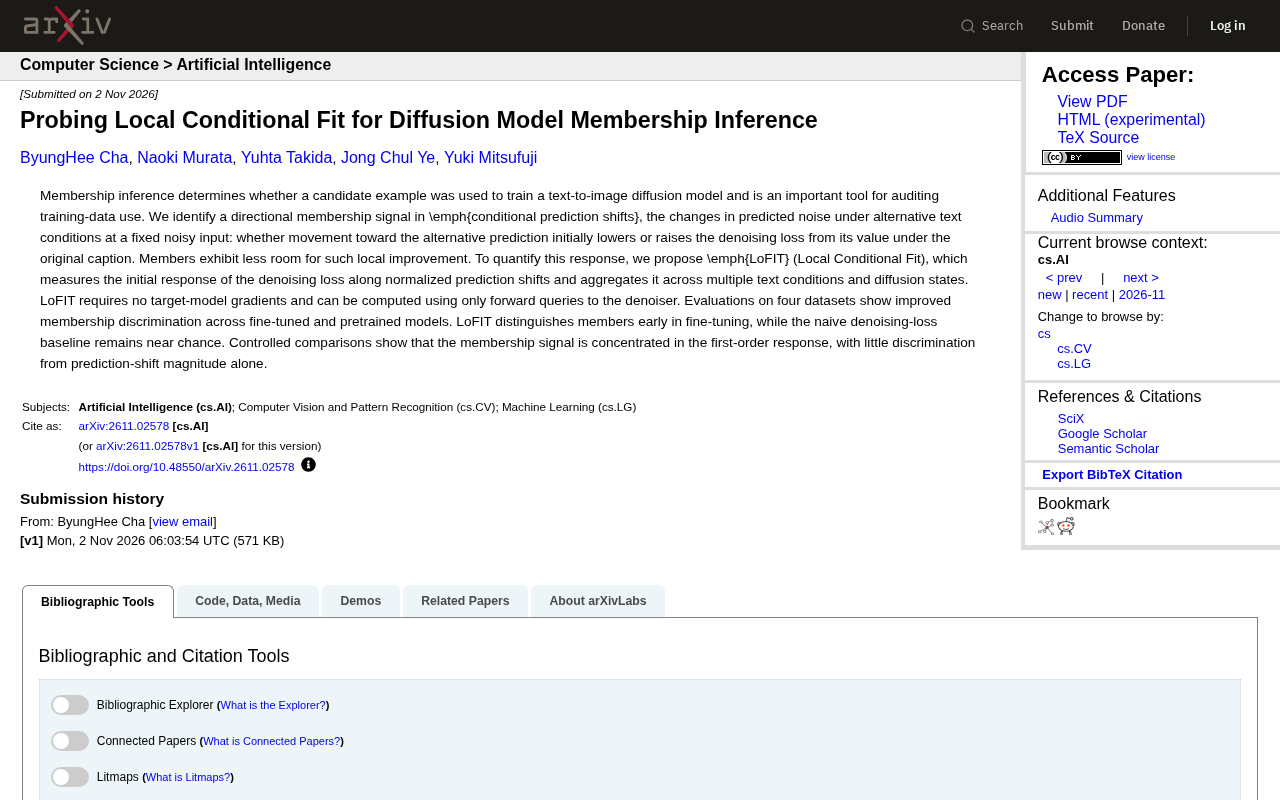
The paper finds a directional membership signal in conditional prediction shifts of diffusion models and proposes the gradient-free LoFIT membership inference method.
This article introduces LoFIT, a new membership inference method for text-to-image diffusion models. Researchers found that fixing a noisy input and changing the text condition produces a conditional prediction shift, and the difference between members and non-members lies not in shift magnitude but in the denoising loss improvement space along the normalized shift direction: training samples have more rigid conditional predictions and less local improvement room. LoFIT quantifies this first-order response and aggregates over multiple text conditions and diffusion states, requiring only forward queries without target model gradients, making it suitable for black-box auditing. Experiments on four datasets show LoFIT improves member discrimination on both fine-tuned and pretrained models and works early in fine-tuning, while the naive denoising loss baseline remains near random.
Why Membership Inference for Diffusion Models Matters
Text-to-image diffusion models (such as Stable Diffusion) are often trained on data that includes copyrighted or private content, making data usage auditing an urgent need. Membership inference is precisely the key technique for determining whether a given sample was used in training. However, the high-dimensional noise prediction process of diffusion models limits the effectiveness of traditional membership inference methods. A recent paper proposes a new approach: achieving more accurate membership inference by analyzing directional signals in conditional prediction shifts.
Membership Inference is a foundational technique in privacy auditing and data governance: given a sample and an already-trained model, determine whether that sample appeared in the training set. It serves both as a means of assessing training data leakage risk and as a tool for copyright holders to verify whether a model used their content without authorization. For classification models, membership inference typically relies on the model's overconfidence on training samples (higher output probabilities, lower loss). But diffusion models do not directly output class probabilities—their objective is to predict the noise injected into data, and the differences between training and non-training samples are obscured by high-dimensional noise prediction and random timesteps, so traditional attacks based on confidence or loss thresholds transfer poorly.
Text-to-image diffusion models (such as Stable Diffusion) consist of a text encoder, a U-Net denoiser, and a variational autoencoder. During training, noise is added to images in latent space, and the U-Net is trained to predict noise conditioned on text and timestep. Since training corpora are often scraped from the web and may include copyrighted artwork, personal photos, or sensitive images, whether a model owner used specific data is often opaque. This makes membership inference not only an academic problem but also a real-world need for compliance auditing, infringement forensics, and model transparency reporting.
Key Finding: Directional Signals in Conditional Prediction Shifts
The paper identifies a directional membership signal that exists in conditional prediction shifts. Specifically, fix a noisy input and change the text condition (e.g., use a different description)—the model outputs a different predicted noise. Starting from the prediction corresponding to the original condition, how does the denoising loss change when moving along the normalized direction of the prediction shift?
For training set members, this local improvement space is smaller—i.e., when moving toward the alternative prediction, the denoising loss decreases little or even increases; non-members, by contrast, have greater room for improvement. This difference forms the basis for distinguishing members from non-members.
The key to this signal lies in "directionality": it is not the magnitude of the prediction shift itself, but the first-order response of the loss to the direction of movement. Through controlled experiments, the paper confirms that the membership signal is concentrated in the first-order response, and that the magnitude of the prediction shift alone can barely distinguish members.
Denoising loss refers to the diffusion model training objective: after adding noise to an image at a given timestep t, the model predicts the added noise ε under text condition c, and the loss is typically the mean squared error between the predicted noise and the true noise. Fixing the same noisy input x_t and changing only the text condition c to c', the model outputs two different noise predictions ε_θ(x_t, c) and ε_θ(x_t, c'), whose difference is the conditional prediction shift.
First-order response refers to the instantaneous rate of change of the loss function when moving along a certain direction, mathematically equal to the inner product of the loss gradient with respect to that direction and the direction vector. If the direction is close to the negative gradient direction, the loss decreases quickly; if the direction is orthogonal or opposite to the gradient, the loss barely decreases or even increases. LoFIT uses finite differences to approximate this first-order derivative: comparing the loss at the original position with the loss after taking a small step along the normalized shift direction, the difference reflects the local improvement space.
Normalized prediction shift direction means dividing the conditional prediction shift vector by its norm to obtain a unit direction vector, thereby retaining only direction information and eliminating magnitude effects. This processing is key to the experimental conclusions: without normalization, samples with larger shift magnitudes would dominate the signal and mask the directional differences that actually matter.
The LoFIT Method: Gradient-Free Forward Queries
Building on the above findings, the authors propose LoFIT (Local Conditional Fit), which quantifies the initial response of the denoising loss along the normalized prediction shift and aggregates over multiple text conditions and diffusion states.
LoFIT offers clear practical advantages:
- No target model gradients required: only forward queries to the denoiser are needed, making it usable in black-box settings.
- Computationally efficient: no backpropagation is involved, making it suitable for large-scale auditing.
- Aggregates multiple conditions: robustness is improved through combinations of multiple text conditions and diffusion states.
Evaluation on four datasets shows that LoFIT achieves better member discrimination on both fine-tuned and pretrained models. Notably, in the early stages of fine-tuning, LoFIT can already distinguish members, while the naive denoising loss baseline remains near random. This means LoFIT is more sensitive to data leakage during the fine-tuning process.
Black-box setting means the attacker or auditor can only call the model interface to obtain outputs (here, noise predictions given noisy inputs and text conditions) and cannot read model parameters, architecture, or backpropagation gradients. Many commercial text-to-image services expose only generation interfaces, so gradient-free forward query methods are more practically feasible.
Forward query means executing model inference only once, without involving backpropagation. Compared with gradient-based membership inference, forward queries typically cost an order of magnitude less computation and are not limited by whether the framework supports automatic differentiation or exposes intermediate layers. LoFIT aggregates forward query results over multiple text conditions and diffusion states (different timesteps or noise levels); this aggregation is equivalent to averaging multiple independent measurements, which reduces the random noise of a single query and improves robustness to the membership signal.
It should be noted that fine-tuning refers to continuing to train a pretrained diffusion model on a specific dataset. Fine-tuning data is often exactly the sensitive data that needs auditing, and in the early stages of fine-tuning the model's memorization of training samples is not yet fully reflected in an overall loss decrease, so traditional baselines remain near random; LoFIT relies on local directional responses and can capture differences while the memorization signal is still weak.
Experiments and Comparisons: First-Order Response Is Key
The paper conducts controlled comparisons to isolate the contributions of different factors. Results show that the membership signal mainly comes from the first-order response of the loss to the prediction shift, while the magnitude of the prediction shift itself provides almost no discriminative information. This finding deepens the understanding of the mechanism of membership inference for diffusion models: the model's conditional predictions for training samples are more "rigid" and difficult to further improve via local adjustments.
Compared with existing methods, LoFIT performs better in black-box settings and does not require access to the model's internal gradients. This provides a feasible tool for real-world auditing scenarios.
Limitations and Outlook
LoFIT has so far been validated only on four datasets and mainly targets text-to-image diffusion models. Future work could explore more modalities (such as video diffusion) and larger-scale models. In addition, how to combine LoFIT with existing membership inference attacks to further improve effectiveness is also a direction worth attention.
Overall, this research reveals a new dimension of membership inference for diffusion models and provides a practical method. As regulation of generative models tightens, such auditing tools will become increasingly important.
One-line Summary
The paper finds a directional membership signal in conditional prediction shifts of diffusion models and proposes LoFIT, a gradient-free membership inference method.
Paragraph Summary
This article introduces LoFIT, a new membership inference method for text-to-image diffusion models. The researchers found that fixing a noisy input and changing the text condition produces a conditional prediction shift, and the difference between members and non-members lies not in the shift magnitude but in the improvement space of the denoising loss when moving along the normalized shift direction: conditional predictions for training samples are more "rigid" and have less room for local improvement. LoFIT quantifies this first-order response and aggregates over multiple text conditions and diffusion states. It requires only forward queries to the denoiser and no target model gradients, making it suitable for black-box auditing. Experiments on four datasets show that LoFIT improves member discrimination on both fine-tuned and pretrained models, and it works in the early stages of fine-tuning, whereas the naive denoising loss baseline remains near random.
Related articles

Gemini 4 Neon Review: Benchmark Scores Rival Carbon, API Pricing and Quota Breakdown
Google Gemini 4 Neon is now live, benchmark scores closely tracking Carbon, API pricing 3/15 at twice Hydrogen's rate. This article compiles Bilibili creator testing: Neon can replace 90% of Carbon scenarios, AntiGravity quota consumption is only one-third of Carbon, plus subscription channel restrictions and 2API ban risks.

Gemini 4 Helium Coming Soon? Signals of Google Loosening Subscription Restrictions
Google team member hints releases will continue; community speculates Gemini 4 Helium (Flash Lite) may be next. Subscription ban controversy gets a response as product lead says "Soon," suggesting restrictions may be lifted. This article covers Gemini developments, OpenAI Coding Agent and risk management, Doubao real-time audio-video API, and compute business dynamics.

AI-Assisted React Development in Practice: Optimizing a Video App and Handling Errors
A 14-year veteran developer demonstrates AI-assisted React video app optimization: compressing video from 80MB to 5MB (~94%) via ImageKit, plus reliable error handling and retry mechanisms. Includes planning, code understanding, and verification methods for working with AI.