New Method for Stochastic Gradient Descent Convergence Rates: A Guide to Rate Transfer

A new study proposes rate transfer, using SDE Lyapunov analysis to directly derive finite-time convergence bounds for SGD.
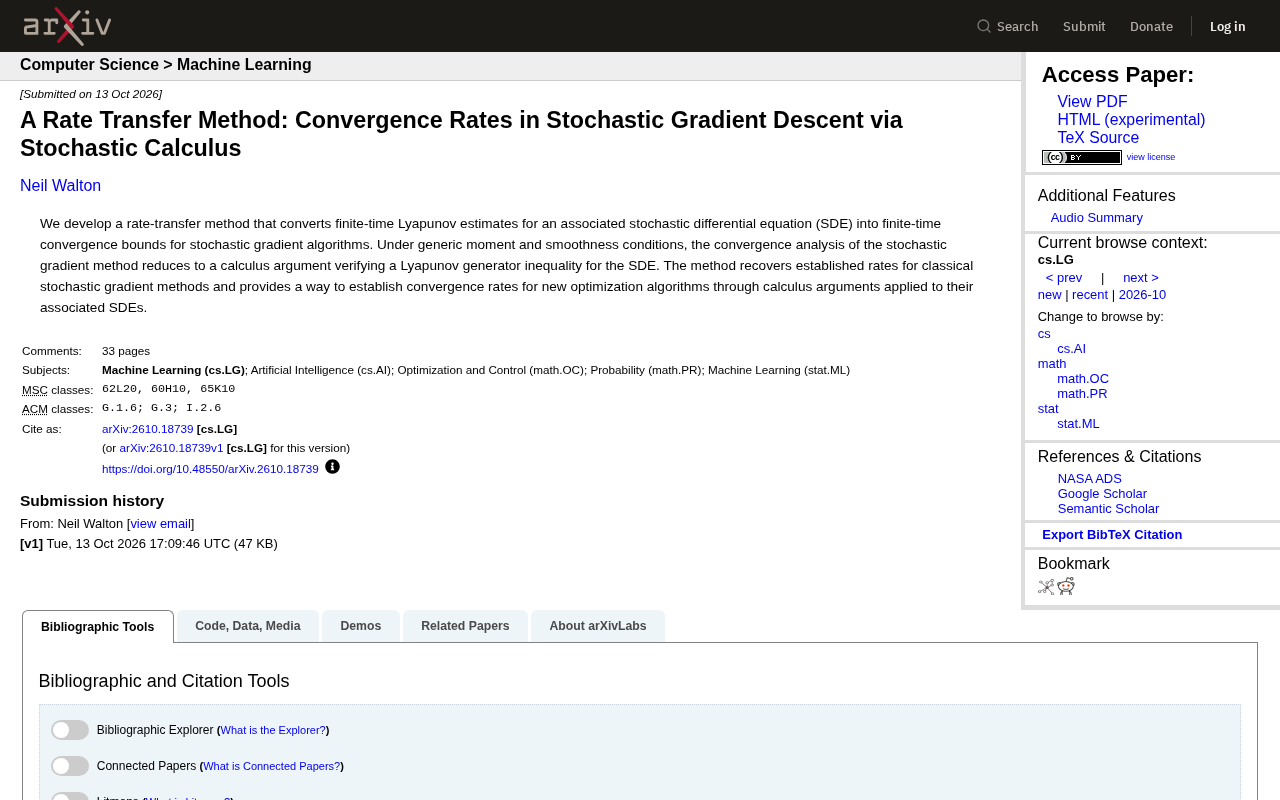
To address the cumbersome probabilistic inequality derivations in SGD convergence analysis, this study proposes a "rate transfer" method. It first associates SGD with a continuous-time stochastic differential equation (SDE), characterizes the SDE's stability by verifying a Lyapunov generator inequality, and then, via a general theorem, automatically converts the SDE's finite-time Lyapunov estimate into a convergence bound for the discrete algorithm. This decomposes convergence analysis into verifying SDE stability and applying a transfer theorem, replacing many probabilistic estimates with calculus arguments. It not only recovers the optimal convergence rate of classical SGD but also provides a modular analysis tool for new algorithms with momentum or adaptive step sizes, lowering the theoretical barrier.
Stochastic gradient descent (SGD) is a cornerstone of machine learning optimization, but rigorous analysis of its convergence rate often relies on cumbersome probabilistic inequality derivations. A recent study proposes a "rate transfer" method that, through Lyapunov analysis of stochastic differential equations (SDEs), directly converts continuous-time stability estimates into finite-time convergence bounds for discrete algorithms. This opens a more streamlined path for the theoretical analysis of optimization algorithms.
Core Idea: A Bridge from SDE to SGD
Traditional SGD convergence analysis typically requires handling noise terms in discrete iterations, using martingale theory or concentration inequalities to derive results step by step. This study takes a different strategy: it first associates the stochastic gradient algorithm with a continuous SDE, then analyzes how the Lyapunov function of that SDE evolves over time.
The term "rate transfer" refers to converting the finite-time Lyapunov estimate of the SDE—that is, the amount by which the Lyapunov function decreases over time t—into a finite-time convergence bound for the SGD algorithm. This conversion relies on general moment conditions and smoothness assumptions, without the need to reconstruct complex probabilistic arguments for each algorithm.
This approach essentially decomposes convergence analysis into two independent steps: first, verify the Lyapunov generator inequality for the SDE; second, obtain the convergence rate of the discrete algorithm through the rate transfer theorem.
The connection between stochastic differential equations (SDEs) and discrete algorithms
A stochastic differential equation is a continuous-time stochastic process of the form $dX_t = b(X_t),dt + \sigma(X_t),dW_t$, where $W_t$ is Brownian motion. In optimization theory, the SGD iteration $x_{k+1} = x_k - \eta \nabla f(x_k) + \eta \xi_k$ can, as the step size $\eta \to 0$, have its trajectory approximated by an SDE: $dX_t = -\nabla f(X_t),dt + \sqrt{\eta},\Sigma,dW_t$. This continuous-time treatment "smooths" discrete noise into Brownian motion, making powerful tools such as Itô calculus available. Researchers can first analyze the long-time behavior of the SDE (such as ergodicity or stability), and then "transfer" the conclusion back to the discrete iteration through appropriate coupling or interpolation arguments. The rate transfer proposed in this paper is precisely a rigorous formalization of this idea: it does not require the step size to be extremely small, but instead quantifies the deviation between the SDE and SGD under a finite step size, thereby obtaining non-asymptotic convergence bounds.
Methodological Framework: Computation Instead of Probabilistic Inequalities
In practice, the method requires researchers to verify a Lyapunov generator inequality associated with the SDE. This inequality characterizes the expected rate of decrease of the Lyapunov function along the SDE trajectory. Once it is verified, the rate transfer theorem automatically yields a convergence bound for SGD.
This kind of "calculus argument" replaces the large number of probabilistic estimates used in traditional analysis. For classical SGD, the method can recover the known optimal convergence rate, showing that its framework is consistent with existing theory. More importantly, for new optimization algorithms, researchers only need to analyze the Lyapunov properties of the associated SDE, rather than building a discrete convergence proof from scratch.
This lowers the barrier to theoretical analysis and also makes the derivation of convergence rates more modular: algorithm designers can focus on the stability of the SDE, while the rate transfer part is guaranteed by a general theorem.
Lyapunov functions and generator inequalities
The Lyapunov function is a positive definite function that measures the "energy" of a system or "distance from the optimal solution," denoted $V(x)$ (often taken as $V(x)=|x-x^*|^2$ or $f(x)-f^*$). For an SDE, its generator $\mathcal{L}$ acting on $V$ gives $\mathcal{L}V(x) = \langle \nabla V(x), b(x)\rangle + \frac12 \mathrm{Tr}(\sigma(x)\sigma(x)^\top \nabla^2 V(x))$, which characterizes the instantaneous expected rate of change of $V$ along the SDE trajectory. The Lyapunov generator inequality usually takes the form $\mathcal{L}V(x) \leq -\kappa V(x) + C$, where $\kappa>0$ is the dissipation rate and $C$ comes from noise. Verifying this inequality is equivalent to proving that the SDE has exponential stability or geometric ergodicity. The rate transfer theorem further states that if this inequality holds for the coefficients $(b,\sigma)$, and the SGD update operator and the SDE coefficients satisfy certain matching conditions in terms of moments and smoothness, then the expected Lyapunov function of the discrete iteration also decays at a similar rate, and an explicit finite-time bound is obtained.
Implications for Optimization Algorithm Research
The value of this work lies not only in simplifying existing results, but also in providing a scalable tool for convergence analysis of new optimization algorithms. For example, for stochastic algorithms with momentum or adaptive step sizes, their SDE approximations are often easier to analyze with Lyapunov methods. Through rate transfer, these continuous-time results can be quickly mapped back to discrete algorithms.
In addition, the method emphasizes the generality of moment conditions and smoothness assumptions, making it applicable to a broad class of stochastic gradient-type algorithms. However, researchers also need to pay attention to error control between the SDE approximation and the discrete algorithm—this is precisely the key technical point that the rate transfer theorem needs to handle.
Overall, this study provides an elegant framework for the theoretical analysis of stochastic optimization. It more tightly combines the tools of stochastic analysis with the study of convergence of optimization algorithms, and may in the future give rise to more work on algorithm design and analysis from a continuous-time perspective.
Error control in SDE approximation
When linking discrete SGD with a continuous SDE, the core errors come from two sources: first, discretization error, namely the deviation between the Euler scheme and the true SDE solution; second, noise approximation error, namely the difference between the covariance of the stochastic gradient noise and the Brownian motion driving term. Typical treatments include: constructing an auxiliary SDE whose drift and diffusion coefficients match the expected update and conditional covariance of SGD; then using the Burkholder-Davis-Gundy inequality for martingale difference sequences or the Azuma-Hoeffding inequality to control the cumulative deviation of "discrete trajectory minus SDE trajectory." The rate transfer theorem in this paper proves, through refined moment conditions (such as bounded variance or sub-Gaussianity of gradient noise) and smoothness assumptions on the drift term (such as Lipschitz continuity), that this deviation can be bounded within finite time by powers of the step size, thereby ensuring that non-asymptotic convergence rates for SGD can be inferred from SDE stability.
Related articles

Uber Deploys ChatGPT Work Company-Wide: AI in the Workplace Enters the Scaled Implementation Phase
Uber deploys ChatGPT Work to 30,000+ employees, extending it from engineering to all roles. We analyze its expert-engineer pairing, end-to-end automation, and questions of AI control and power concentration—insights for scaling AI in the workplace.

Shift at Midnight Hands-On: When "ID Verification" Becomes Alien Hunting
Shift at Midnight blends ID verification with horror survival in a four-player co-op game. We break down its inspection mechanics and chaotic humor.

Zelensky Recounts the Outbreak of War: I Need Ammunition, Not a Ride
Zelensky recalls the first day of war in a YouTube interview: farewell to family, rejecting Biden's evacuation offer with "I need ammunition, not a ride," and how Bucha shaped his stance on compromise and peace talks.