New Trends in LLM Engineer Interviews: Why Simple Agents No Longer Land You an Offer

LLM engineer interviews now test system design skills for complex, long-cycle task agents.
The article notes that since the second half of 2025, LLM engineer interviews have clearly leveled up. Interviewers are no longer satisfied with weather-query-style simple agents, but probe into multi-agent collaboration, task planning, and complex task handling. Real enterprise needs often involve long-cycle, multi-step tasks behind a single vague instruction, requiring agents to decompose and decide autonomously. Using an enterprise-level project presented by Xiao Bin as an example, the article covers FastAPI backend, multi-vendor model backups (DeepSeek as main reasoning model, a lightweight summarization model, and Zhipu as backup), MCP gateway and crawler tools for multi-source data access, and engineering practices such as state management and context compression in long-cycle tasks. It advises candidates to deeply deconstruct one complex scenario to demonstrate complete system design thinking.
Interviewers Are No Longer Satisfied with "Weather Query"-Style Agents
Recently, I chatted with several LLM engineers who are currently job hunting, and we all share a common feeling: interviewers' questions have clearly become more "tricky." In the past, writing a single-task agent that could query a database or call a weather API would earn you plenty of bonus points on your resume. But now, interviewers prefer to probe further: "Can your project handle complex tasks?" "How do multiple agents collaborate?" "How exactly is the task planning module implemented?"
According to observations by Xiao Bin, a Bilibili creator and instructor at MashiBing Education, during his training camp, this shift has become increasingly pronounced since the second half of 2025. Companies' requirements for LLM engineers are shifting from "can call models" to "can design systems." Simple agents solve problems with clear boundaries and fixed steps, while real enterprise needs often involve long-cycle, multi-step tasks behind a single vague instruction. Users won't tell you what to do at each step—the agent needs to plan and make decisions on its own.
The Core of Complex Task Agents: Planning and Decision-Making Capabilities
What is a complex task? Xiao Bin gave an intuitive example: have the agent analyze a comprehensive procurement comparison of two components. This task has no clear data sources, no specified comparison dimensions, and no described steps—everything needs to be broken down by the agent itself. It must first determine what data is needed, then obtain it from different channels, and finally generate a comparative analysis along reasonable dimensions. This relies on the task planning capability of strong reasoning models—preparing prompts, context, and specifications for the model so it can generate an execution plan step by step according to the specifications.
This capability cannot be achieved by simply stacking tools. It requires engineers to understand how to transform vague goals into executable sequences of subtasks and design feedback mechanisms so the agent can adjust its strategy when encountering anomalies. The frequently appearing interview topics of multi-agent management, task decomposition, and tool orchestration are essentially examining this system design capability.
Task Planning refers to the process by which an agent automatically decomposes a vague high-level goal into an ordered sequence of subtasks. Common paradigms include ReAct (alternating reasoning and action), Plan-and-Execute (plan holistically first, then execute step by step), and tree-search-based planning methods. Unlike simple agents with fixed workflows, planning agents need to autonomously determine subtask dependencies, select appropriate tools, and re-plan when execution results fall short of expectations. Planning quality depends heavily on the reasoning capability of the underlying model, so in practice, a strong reasoning model is often designated specifically for the planning module, with prompt constraints on output format (such as a structured step list) so that subsequent execution modules can parse and schedule it.
Enterprise-Level Project Architecture in Practice: Multiple Models, Multiple Tools, Multiple Data Sources
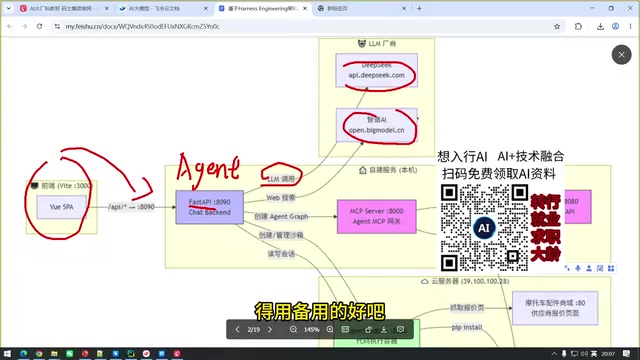
Xiao Bin showcased a recently completed enterprise-level project architecture in the training camp. The frontend accesses the FastAPI backend via HTTP requests, and the core agent logic runs in FastAPI. To cope with the uncertainty of real production environments, the project simultaneously integrates multiple LLM vendors: the main reasoning model uses the DeepSeekAd series, the summarization model uses a lightweight version, and a Zhipu model is configured as a backup reasoning channel. This multi-model backup strategy is exactly the engineering mindset that interviewers value highly—when a single model fails, the agent must not stall.
According to the code structure he demonstrated, a single project can call models from multiple vendors simultaneously, and can even designate a separate model for the task planning module. This flexible configuration capability is precisely the dividing line between complex agent systems and simple demos.
The Breadth of the Toolchain Determines Task Boundaries
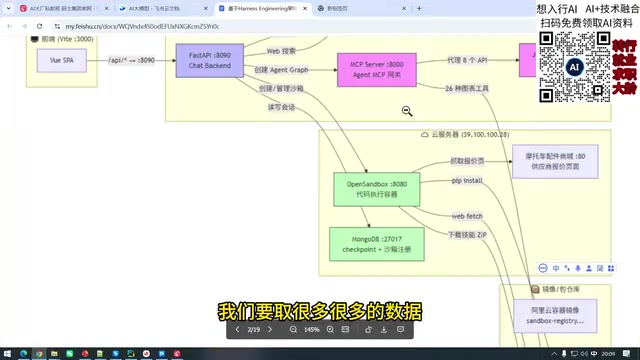
At the tool layer, the project uses the MCP gateway protocol to retrieve data from an existing Java project, calls remote charting tools to generate visualizations, and also uses various crawler tools (based on the Scrapy framework) to scrape pricing information from supplier official websites and platform sites. With so many tools of mixed types, how to orchestrate them uniformly and handle faults is a problem that complex agents must solve.
MCP (Model Context Protocol) is an open protocol proposed by Anthropic at the end of 2024, aimed at standardizing how large language models interact with external tools and data sources. You can think of it as the "USB interface for AI applications": the model discovers and calls tools, resources, and prompt templates exposed by MCP servers through an MCP client in a unified format, without writing separate adapter code for each data source. In complex agent systems, the MCP gateway serves as a unified entry point, encapsulating existing enterprise Java services, databases, third-party APIs, etc. as standardized tools for the agent to call on demand. This greatly reduces the marginal cost of tool integration and gives tool orchestration and permission control a unified foothold.
Challenges and Responses for Long-Cycle Tasks
Long-cycle tasks mean the agent may need multiple rounds of interaction, multiple tool calls, and even waiting for external data to return. State management, error retries, and context compression during this period are all engineering challenges. Xiao Bin mentioned that the summarization model plays a key role here—compressing long conversation histories to avoid context window overflow. Such detailed design is often the dividing line that distinguishes candidates' practical experience in interviews.
Context Compression is a core technique for long-cycle agents to maintain a usable context window. As multi-turn interactions and tool calls accumulate, conversation history easily exceeds the model's context length limit, causing early critical information to be truncated or reasoning quality to degrade. Common approaches include: using a lightweight summarization model to perform rolling summaries of historical conversations in segments, retaining the original text of the most recent several rounds while compressing earlier content into structured key points, and selectively extracting large blocks of data returned by tools. Compression strategies need to balance "information fidelity" and "window occupancy"—over-compression loses task constraints, while under-compression fails to mitigate overflow. This is precisely where differences in engineering experience manifest.
Implications for Engineers: From "Can Use" to "Can Design"
The change in interview requirements reflects an upgrade in industry demand. Engineers who can only write simple agents often lack a systematic answer framework when facing questions like "how to manage multiple agents" and "how to do task planning." Candidates with enterprise-level project experience, on the other hand, can elaborate from multiple dimensions such as model selection, backup strategies, tool orchestration, and state management, demonstrating complete systems thinking.
For engineers preparing for interviews, rather than piling up multiple simple demos on a resume, it's better to deeply deconstruct one complex task scenario and think through the stages of planning, execution, fault tolerance, and evaluation. Interviewers don't care about how many models you've used—they care about whether you can design an agent system that runs stably in real environments.
Related articles

The Truth Behind Titanic's Sinking: Key Decisions and Communication Failures in the National Geographic Documentary
National Geographic's The Unsinkable Ship uses survivor testimony to reconstruct Titanic's fatal decisions—from the missing MSG telegram prefix and the broken boiler-room-to-bridge link to how 'unsinkable' thinking delayed damage control and evacuation.

74M-Parameter Open-Source Model Partially Outperforms Jev AI in Testing
Fastino AI's Glider 2.5 models, with just 74M–300M parameters, reportedly outperform Jev AI in some guardrail benchmarks per YouTube testing, run on consumer hardware, and even play Doom. We analyze small models' competitiveness and deployment value on specific tasks.

Gemini 4 Argon Hands-On: Aggressive Pricing, 3D Capabilities Need Coaching
Gemini 4 Argon hands-on: limited-time $2/$10 pricing, million-token output, strong 3D and reverse-engineering work, but weak front-end aesthetics and zero-shot ability need coaching.