New York VC Pushes Back: Inspired Capital Raises $450M Fourth Fund

Inspired Capital completes a $450M fourth fund, seen as New York VC's direct response to Silicon Valley's capital gravity.
New York-based VC firm Inspired Capital announced the close of its fourth fund at $450 million. As venture capital continues to cluster in Silicon Valley and LP money flows to established West Coast funds, a New York-based institution completing a mid-tier-sized raise is a signal. New York's differentiation lies in its diverse industrial structure—finance, media, consumer, and healthcare—which creates application scenarios that lead local funds to invest in companies closer to customers. For East Coast founders, a larger local capital pool means more financing options. Yet a single raise cannot reverse Silicon Valley's overall advantage; New York's pushback is a partial advance in a long game. Given limited source material, the article remains restrained on specific strategies and LP structure.
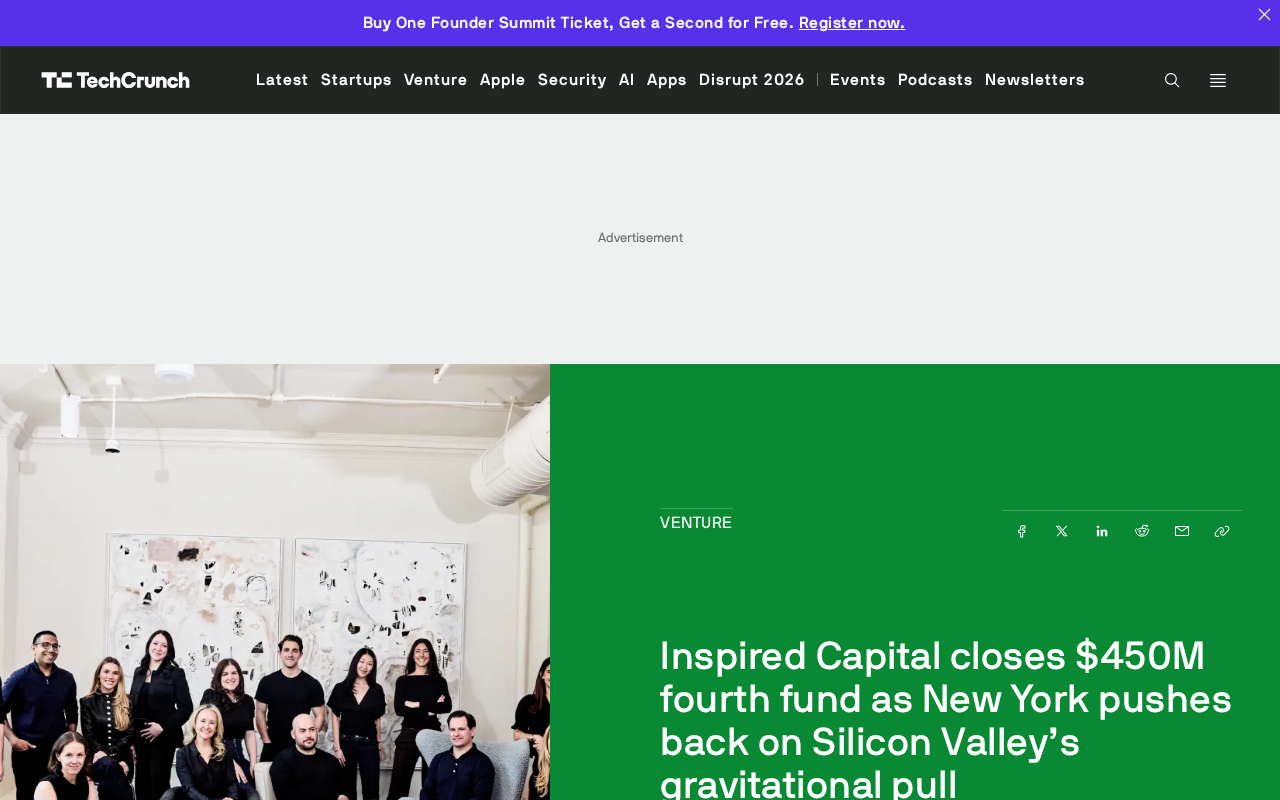
New York-based venture capital firm Inspired Capital recently announced the close of its fourth fund at $450 million. The move comes as venture capital continues to cluster in Silicon Valley, and is seen by outsiders as a direct response from New York's VC ecosystem to Silicon Valley's gravitational pull.
A Raise That Runs Against the Tide
According to an RSS source, Inspired Capital's fourth fund ultimately closed at $450 million. The report describes the current environment as one where "venture money is piling up on the West Coast"—in other words, LP (limited partner) capital is flowing toward established Silicon Valley funds and star projects, so the fact that a New York-based firm could still complete a sizable raise is itself a signal.
It should be noted that the original material is limited in scope: it provides only two core facts—the fund size and the macro backdrop—and does not disclose details such as LP composition, stage preferences, or historical returns. Accordingly, the analysis in this article draws more on industry common sense and public context; specific figures should be based on the institution's official disclosures.
LP (Limited Partner) is a provider of capital to venture capital funds, typically including institutional investors such as pension funds, university endowments, family offices, funds of funds (FoF), and sovereign wealth funds. In a typical VC fund structure, the GP (General Partner) is responsible for the fund's day-to-day investment and management work, while LPs as capital providers enjoy investment returns but do not participate in specific decisions. VC funds generally have a lifespan of 7-10 years, with the first 3-5 years being the investment period, during which the GP issues capital calls to LPs to deploy capital; the later stage then enters the exit and distribution phase. When selecting a GP, LPs pay close attention to historical returns (such as IRR and DPI), team stability, consistency of investment strategy, and the GP's own contribution ratio (GP commitment). In the current U.S. market, LP capital is concentrating in top-tier large funds, and mid-tier funds must clearly articulate their differentiated advantages in their fundraising narrative in order to pass LPs' due diligence and allocation committee approval.
Why New York Wants to "Push Back"
The phrase "New York pushes back against Silicon Valley's gravitational pull" highlights the long-standing tension in the U.S. venture capital landscape. Silicon Valley has the densest concentration of startups, the most mature angel networks, and the most active M&A exit channels, so capital naturally concentrates where efficiency is highest.
But New York's advantage lies in the diversity of its industrial structure: digitalization needs across finance, media, consumer, healthcare, and fashion provide application scenarios for B2B software, fintech, and consumer brands that differ from those in Silicon Valley. Funds anchored in New York tend to be more willing to invest in companies that are "closer to the customer" rather than purely technology-driven底层 innovation. This positioning difference is the differentiation card that New York institutions repeatedly emphasize in their fundraising narratives.
Survival Space for Small and Mid-Sized Funds Under Capital Agglomeration
When capital concentrates in top-tier funds, small and mid-sized institutions face stricter LP scrutiny. A size of $450 million is mid-tier in the U.S. venture market—not enough to compete for deals based on check size like mega-funds, but enough to support a team with a clear strategy in making early- and growth-stage investments. For Inspired Capital, closing its fourth fund means its investment pace can continue without missing deals due to an interrupted fundraising cycle.
Capital agglomeration in the venture capital industry refers to the phenomenon in which capital, high-quality projects, and talent concentrate in a small number of geographic or brand high grounds. Silicon Valley, relying on talent pipelines from universities such as Stanford and Berkeley, dense angel investment networks, and mature M&A and IPO exit channels, has formed a self-reinforcing positive feedback loop. The direct consequence of this effect is that top-tier funds can reach multi-billion-dollar sizes per fund and compete for hot deals through check size and brand premium; while mid-tier funds (typically ranging from $100 million to $1 billion per fund) find it difficult to compete on price and can only build advantages through deeper industry specialization, more active post-investment services, and earlier-stage entry. For LPs, after their allocations to top-tier funds are saturated, carefully selecting mid-tier funds with unique industry positioning is also one strategy for diversifying risk and seeking excess returns.
Practical Implications for Founders
For founders in New York and along the East Coast, a local fund completing a new fundraising round is a direct positive: the pool of investable capital expands, and financing negotiations offer more choices. The deeper impact is that when a local institution continues to raise funds and build a brand, it drives the surrounding angel networks, accelerators, and talent flows, gradually strengthening weak links in the ecosystem.
However, a single fundraising cannot change Silicon Valley's overall advantage. The geographic distribution of capital is a long-term structural issue, and New York's "push back" is more a partial advance in a protracted war than a reversal of the landscape.
Editor's Observation
The value of this news is not in the $450 million itself, but in the observation window it provides: at a time when Silicon Valley's ability to attract capital remains strong, how can regional funds persuade LPs with industry positioning and local networks? Because the original material lacks details on investment strategy and LP structure, this article remains restrained in judging Inspired Capital's specific approach; if official disclosures or LP interviews emerge later, they would be worth following up.
One-line Summary
Inspired Capital completes a $450 million fourth fund raise, seen as New York venture capital's direct response to Silicon Valley's capital gravity.
Paragraph Summary
New York-based venture capital firm Inspired Capital announced the close of its fourth fund at $450 million. Against the backdrop of venture capital continuing to cluster in Silicon Valley and LP capital flowing to established West Coast funds, a New York-based institution completing a mid-tier-sized raise is significant as a signal. The article points out that New York's differentiated advantage lies in the rich application scenarios brought by its diverse industrial structure in finance, media, consumer, and healthcare, which makes local funds more inclined to invest in companies closer to customers. For East Coast founders, an expanded local capital pool means more financing options and may drive angel networks and talent flows. However, a single fundraising can hardly reverse Silicon Valley's overall capital advantage; New York's "push back" is more a partial advance in a protracted war. Because the original material is limited, the article remains restrained about specific investment strategies and LP structure.
Related articles

GPT-Next Leak, Gemini 4 Argon Imminent: AI News Roundup
GPT-Next leak suggests extreme efficiency; OpenAI's 28-day shipping pledge boosts speed 50%; Gemini 4 Argon nears release; Anthropic subscription value report sparks debate.

GPT-Next Leaked, Gemini 4 Argon Speeds Up, Fable 5.5 May Launch Today
OpenAI's GPT-Next model leaks, expected to be extremely low-cost and possibly part of the 28-day release plan; Gemini 4 Argon internal testing accelerates, NanoBanana 2.1 is live; Semi Analysis tests show Claude Max's equivalent API value is about 5 times that of ChatGPT Pro; Fable 5.5 may launch today.

Gemini 4 Argon Launches Globally: Key Highlights from the AI Daily Brief
Google opens Gemini 4 Argon globally across Pro and Ultra subscriptions and the API, and demonstrates robot control. This article rounds up open-source models, Agent infrastructure, cost transparency, and safety governance updates.