Next-Concept Modeling: Moving Beyond Token-by-Token Generation, Up to 31x Faster

NCM replaces token-by-token prediction with hierarchical discrete concept encoding, running up to 31x faster than a diffusion baseline on specific benchmarks.
The article introduces Next-Concept Modeling (NCM) as a new approach to text generation. Unlike mainstream autoregressive next-token prediction, NCM first learns a multi-level hierarchy of discrete concept codes; generation starts at the coarse layer and predicts fine-grained codes in parallel layer by layer, with a decoder finally reconstructing the text. Its key component is VQ-VAE, which quantizes continuous representations into discrete codebook entries to build the coarse-to-fine hierarchy. Researchers report that on specific benchmarks, NCM generates up to 31x faster than a diffusion language model baseline. However, the article emphasizes that this figure is limited to a comparison against a diffusion baseline on specific benchmarks, not a comprehensive comparison with autoregressive models. Generation quality, training stability (e.g., codebook collapse), and large-scale generality remain open questions.
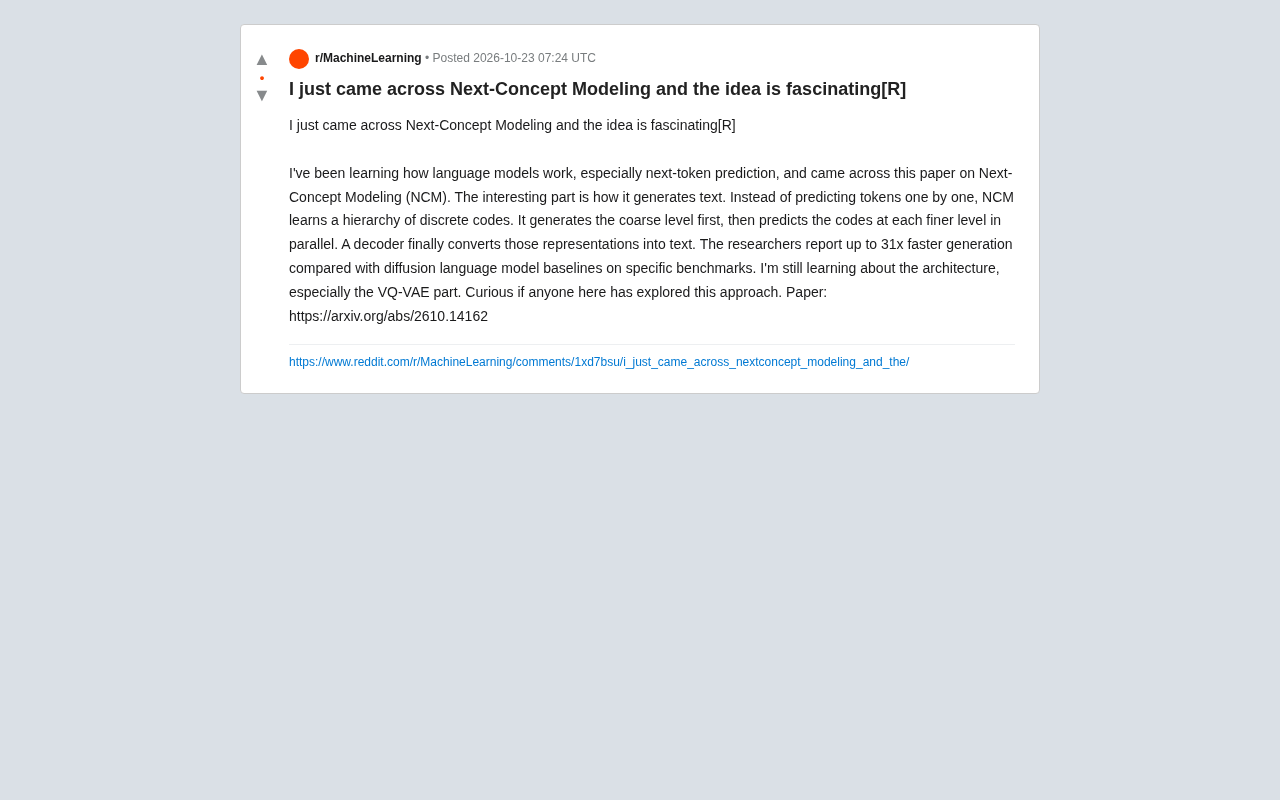
The way language models generate text is being reexamined. A Reddit user, while studying next-token prediction, came across a paper on Next-Concept Modeling (NCM) and shared its core idea: instead of generating text token by token, the model first learns a hierarchical encoding of discrete concepts, predicts them in parallel from coarse to fine, and finally a decoder reconstructs the text. The researchers report that on specific benchmarks, this method can generate up to 31 times faster than a diffusion language model baseline.
From next-token to next-concept: a shift in generation granularity
Nearly all mainstream language models today are built on autoregressive next-token prediction: predict one token at a time, append the result to the context, then predict the next. This approach is simple and scalable, but inherently serial—generating long text means calling the model repeatedly many times.
NCM takes a different angle. Rather than treating "the next word" as the unit of modeling, it learns a hierarchical structure of discrete concepts. In the authors' words, the model first learns a hierarchy of discrete codes; during generation it produces a coarse-grained layer first, then predicts the corresponding codes in parallel at each finer layer. This separates the "skeleton" of the text from its "details," and parallelism emerges as a result.
According to the Reddit post, NCM is up to 31 times faster than a diffusion language model baseline on specific benchmarks. Note the qualifiers—"specific benchmarks" and "diffusion language model baseline"—this is not a head-to-head comparison against all mainstream autoregressive models.
Diffusion language model baseline: Diffusion models were originally used for image generation, reconstructing data from noise through gradual denoising. When adapted to text, discrete tokens must be mapped into a continuous space (e.g., embedding vectors), where forward noising and reverse denoising are performed, and finally discretized back into tokens. A typical diffusion language model requires tens to hundreds of iterative denoising steps, each calling the network once, so its inference overhead is significantly higher than that of an autoregressive model with a single forward pass. NCM's comparison baseline is precisely this type of iterative diffusion model; its parallel hierarchical prediction needs only a small number of hierarchy steps, giving it an advantage in step count. But note that an autoregressive model generates one token per step, with total steps equal to sequence length—a different cost structure from a diffusion model's iteration count. Directly comparing speedup ratios requires clarifying the benchmark setup.
How hierarchical discrete encoding works
The post's author admits they are still digesting this architecture, especially its VQ-VAE component. This is exactly the key to understanding NCM.
VQ-VAE (Vector Quantized Variational Autoencoder) maps continuous representations onto a set of discrete codebook entries. NCM uses this to compress text into multi-level discrete codes: coarse layers correspond to paragraph- or semantic-topic-level abstraction, while fine layers correspond to more specific expressive details. Generation starts from the coarse layer and fills in parallel downward layer by layer, and finally a decoder converts these discrete representations back into natural language.
This design has parallels with hierarchical vector quantization in image generation: first generate a low-resolution overall structure, then progressively fill in high-frequency details. Transferring this to text, the challenge is that language lacks the intuitive spatial continuity of images, and the division of conceptual hierarchies itself must be learned.
VQ-VAE and the codebook mechanism: At the core of VQ-VAE is a learnable codebook containing a number of discrete vectors. After the encoder outputs continuous representations, each position is replaced by the nearest vector in the codebook (nearest-neighbor quantization), yielding a sequence of discrete codes. During training, a straight-through estimator backpropagates gradients from the decoder to the encoder, and a commitment loss constrains the encoder output to stay close to the selected codebook vector. Codebook collapse is a common failure mode: only a few codebook entries are used while the rest become "dead codes." Common mitigations include exponential moving average updates, codebook resets, and diversity regularization. NCM extends this mechanism to multiple codebook layers, each responsible for a different level of abstraction—coarse layers have few entries with broad semantics, while fine layers have many entries with specific expression.
Where the speed advantage comes from—and its limits
The 31x figure is eye-catching, but it needs to be understood in context. Diffusion language models generate text through iterative denoising, typically requiring multiple refinement steps, so inference overhead is substantial. NCM's parallel hierarchical prediction reduces the number of serial steps, making it appear faster when compared against diffusion baselines.
This does not mean NCM can already replace autoregressive models. The post itself is just study notes and does not cover a complete evaluation of model scale, training cost, long-text coherence, and other dimensions. For researchers and engineers focused on inference efficiency, this is a direction worth tracking, but it would be unwise to draw conclusions from a single benchmark number alone.
Open questions worth watching
Around NCM, at least a few questions deserve continued attention. First, generation quality: does parallel prediction of fine-layer codes sacrifice token-level precision, especially on tasks requiring strict formatting or long-range dependencies? Second, training difficulty: is learning hierarchical discrete codebooks stable, and will VQ-VAE-style quantization encounter codebook collapse on text? Third, generality: can the 31x speed advantage be reproduced at larger model scales and across broader benchmarks?
For those learning the principles of language models, NCM offers a valuable contrasting perspective—it reminds us that next-token prediction is only one of many possible designs, not the only solution.
FAQ
Will NCM replace autoregressive language models? There is currently no evidence to support this. NCM demonstrates an alternative approach to the generation paradigm; its speed advantage on specific benchmarks still needs to be validated across broader model scales and tasks.
What is VQ-VAE, and why is it important in NCM? VQ-VAE uses vector quantization to map continuous representations onto discrete codebook entries. NCM uses it to build multi-level discrete concept encodings, which is the foundation for achieving "coarse-to-fine, parallel prediction."
Can the 31x speedup be directly applied to real-world applications? Not directly. The figure comes from a comparison against a diffusion language model baseline on specific benchmarks. The actual speedup in deployment depends on task type, model scale, and implementation details.
Related articles

AI Digital Twin in Action: Using DOT to Automatically Track Bugs and User Feedback
DOTS engineers demonstrate how AI digital twin DOT collects cross-platform user feedback, categorizes issue themes, opens threads to investigate bug root causes, and submits PRs—showcasing a complete AI agent workflow for defect triage with auditable design.

Why Transistors Are No Longer Flat: The Evolution from Planar to Gate-All-Around
Transistor evolution from planar to FinFET to gate-all-around: why gates went from three-sided to four-sided wrapping to suppress short-channel effects and leakage current, extending Moore's Law.

Swarm Intelligence = a Single RL Agent? A Proof of Multi-Armed Bandit Equivalence
A paper proves that collective decision-making through local imitation in swarms is mathematically equivalent to single-agent reinforcement learning: N blind imitators act as N parallel environment samples, with an effective learning rate of 1/N. This article explains the derivation and implications of the Maynard-Cross Learning algorithm.