Nexus-CLI: A Pure Go DeepSeek Bridge Tool

Pure Go Nexus-CLI bridges DeepSeek with Claude Code and Ollama, still early-stage.
Nexus-CLI is a pure Go AI model bridge tool on Hacker News that integrates DeepSeek R1/V3 with Claude Code and Ollama into a unified CLI workflow. Its value lies in a statically compiled single executable and protocol conversion. With only 7 upvotes and key details undisclosed, it faces upstream API adaptation risks. A pragmatic "connector" route worth watching, not yet production-ready.
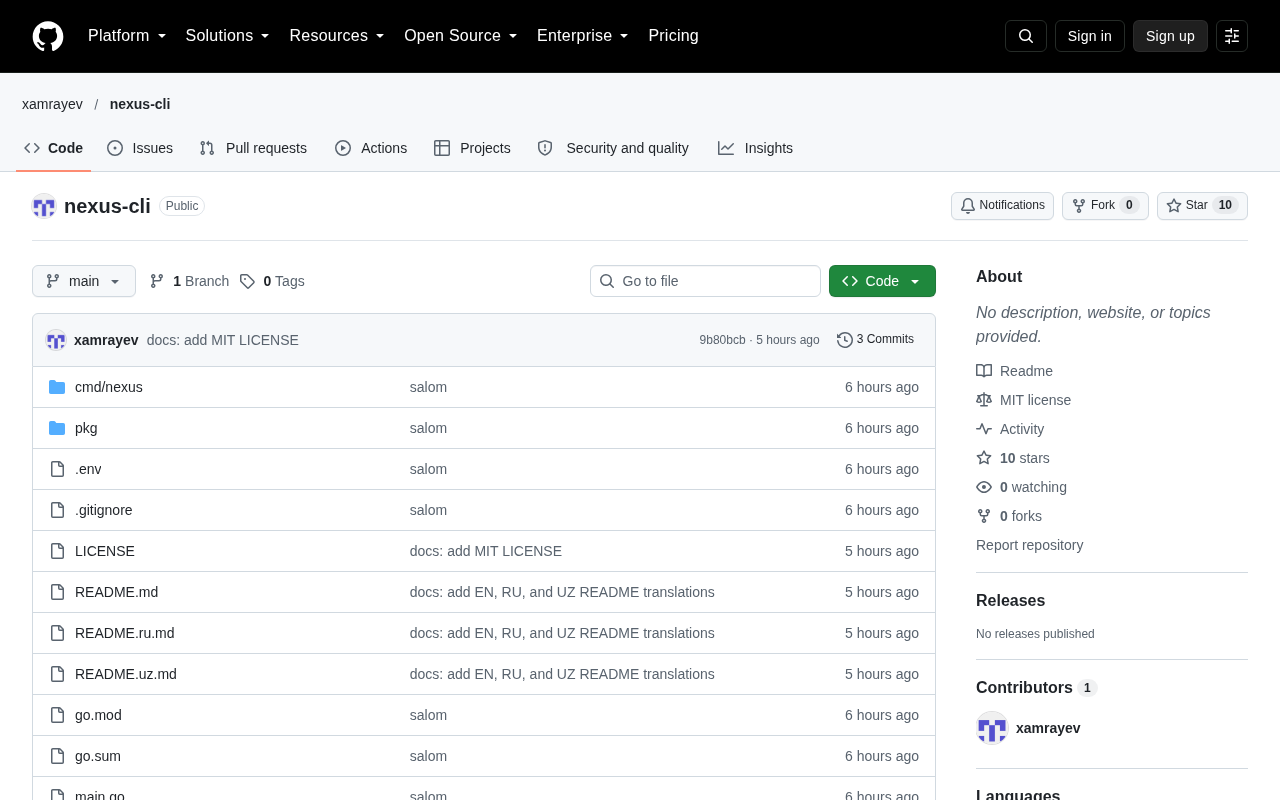
In today's increasingly fragmented AI development tooling landscape, a project called Nexus-CLI has quietly appeared on Hacker News, attempting to bridge DeepSeekAd R1/V3 models with the Claude Code and Ollama ecosystems using pure Go. Although the project has so far received only 7 upvotes and 1 comment, its technical positioning is worth noting.
Why Do We Need AI Model Bridge Tools?
The current AI development environment is clearly fragmented: Claude Code excels at code generation and editing, Ollama provides local model running capabilities, and DeepSeek R1/V3 is known for its high cost-performance reasoning. Developers often need to switch between multiple tools, manually handling API differences and context passing. Nexus-CLI emerges precisely to solve this pain point—integrating model capabilities from different sources into a single workflow through a unified command-line interface.
According to the project description on Hacker News, the core value of Nexus-CLI lies in its "pure Go" implementation. This means no dependency on a Python runtime or Node.js environment—after compilation, you get a single executable file, offering natural advantages in deployment convenience and cross-platform compatibility.
Technical Architecture and Core Capabilities
Lightweight Design with Pure Go
Nexus-CLI chooses Go as its sole technology stack, a decision worth pondering. Go's static compilation produces a binary with no external dependencies, which for command-line tools frequently used in containers and CI/CD pipelines can significantly reduce environment configuration costs. Meanwhile, Go's concurrency model is naturally suited to handling routing and aggregation of multi-model requests.
Bidirectional Bridging: Claude Code and Ollama
The "Bridge" in the project name hints at its core working mode. According to the Hacker News launch information, Nexus-CLI supports using DeepSeek R1/V3 as a backend inference engine while being compatible with Claude Code's interaction protocol and Ollama's model management interface. This means developers can invoke DeepSeek models within Claude Code workflows, and can also manage the lifecycle of DeepSeek models through the Ollama ecosystem.
The cleverness of this bridging strategy is that it doesn't try to replace either side, but rather acts as a "connector." For teams already using Claude Code, they can introduce DeepSeek's reasoning capabilities at low cost; for Ollama users, there's an additional high-performance model option.
DeepSeek R1/V3 is a series of open-source large language models released by DeepSeek. R1 focuses on reasoning capabilities, trained with reinforcement learning, and excels at complex tasks such as math and code; V3 is a general-purpose dialogue model known for its high cost-performance—its API pricing is significantly lower than closed-source models of the same tier, and it supports long context. Both provide APIs compatible with the OpenAI format, which lowers the barrier for third-party tool integration. For bridge tools, DeepSeek's openness (public weights, standardized API) makes it an ideal backend inference engine option, allowing developers to complete integration without dealing with proprietary protocols.
Claude Code is a command-line AI programming assistant launched by Anthropic, deeply integrated into the terminal environment, capable of reading project files, executing commands, and editing code. It originally only connects to the Claude series models, and its interaction protocol is based on Anthropic's Messages API. Ollama is a local large model running and management tool that provides a unified model pulling, running, and API interface (compatible with the OpenAI format by default), supporting many open-source models such as Llama, Qwen, and DeepSeek. Nexus-CLI's bridging approach is essentially protocol conversion between these two heterogeneous interfaces: translating Claude Code's requests into a format DeepSeek can understand, while leveraging Ollama's model management capabilities to schedule the lifecycle of DeepSeek models. This "adapter" pattern has mature practices in the API gateway field, but specialized optimization for AI programming scenarios is still rare.
Community Feedback and Potential Challenges
Signals from an Early Stage
The data of 7 upvotes and 1 comment on Hacker News indicates that the project is still at a very early stage. In today's white-hot competition among AI tools, for a new project to gain developer attention, beyond technical highlights, it also needs clear documentation, reproducible examples, and an active maintenance rhythm. In the currently public information, details on these aspects remain limited.
Hacker News is a technology community under Y Combinator, and its "Show HN" section is often used as the launch channel for open-source projects. The community's voting mechanism is relatively strict: new submissions that don't gain enough attention within a short time quickly sink. 7 upvotes mean the project was only seen within a very small circle and has not yet triggered algorithmic recommendation. However, early feedback on Hacker News doesn't fully represent project quality—many well-known tools (such as Bun and htmx) also received a lukewarm response at launch. For Nexus-CLI, the more critical indicators should be whether it is subsequently included in GitHub Trending, whether it receives independent reviews from tech blogs, and the quality of discussions in the issue section.
Unknowns Worth Watching
Based on the available material, Nexus-CLI's license agreement, specific supported API versions, performance benchmark data, and error handling mechanisms have not been disclosed. This information is crucial for evaluating its production readiness. In addition, bridge tools naturally face the risk of upstream API changes—interface adjustments by any of DeepSeek, Claude Code, or Ollama may require Nexus-CLI to follow up with adaptations.
Practical Significance for Developers
For developers focused on the AI programming toolchain, Nexus-CLI represents a pragmatic technical route: using a lightweight bridge layer to integrate scattered model capabilities rather than reinventing the wheel. The deployment convenience brought by the pure Go implementation gives it imaginative potential in automation scripts, local development environments, and edge computing scenarios.
However, given insufficient information on project maturity, it is advisable to view it as a technical signal worth observing rather than a choice for immediate production investment. Going forward, one can watch its GitHub repository's update frequency, issue response speed, and whether it offers distribution forms such as Docker images.
Against the backdrop of rapid iteration in AI model capabilities, the value of bridge tools will rise as model diversity increases. Whether Nexus-CLI can grow from a small dot on Hacker News into a staple component in developers' toolboxes depends on whether the team can find a balance between technical refinement and community operations.
One-line Summary
Pure Go Nexus-CLI bridges DeepSeek with Claude Code and the Ollama ecosystem, still at an early stage.
Paragraph Summary
Nexus-CLI is a pure Go AI model bridge tool that appeared on Hacker News, aiming to integrate DeepSeek R1/V3 models with the Claude Code and Ollama ecosystems into a unified command-line workflow. Its core value lies in reducing deployment costs with a statically compiled single executable, and through protocol conversion enabling developers to invoke DeepSeek reasoning capabilities within Claude Code, or manage DeepSeek models via Ollama. The project has so far received only 7 upvotes, and key information such as license agreement, API versions, and performance benchmarks has not been disclosed; bridge tools also face adaptation risks from upstream API changes. The article considers it representative of a "connector"-style pragmatic technical route, worth observing but not yet suitable for production investment.
Related articles

Random Pruning of the DPO Computation Graph: 1.4x Training Speedup and Lower Peak Memory
DPO training too slow and memory-hungry? This paper proposes a random pruning framework for the DPO computation graph, sampling independently across position, sequence, and branch dimensions; branch pruning achieves a 1.426x step-time speedup and cuts training time by about 30%, with in-depth attribution of memory and time gains.

Why Does JEPA Underperform MLM in Longitudinal EHR Representation Learning?
New study compares JEPA and MLM for longitudinal EHR representation learning on MIMIC-IV: three JEPA variants train stably without collapse but underperform MLM; target size, not heterogeneity, drives prediction error.

Transfer Learning + Visible Light Communication: A New Approach to Energy-Efficient Indoor Positioning
A study proposes a transfer learning-based visible light communication indoor positioning method, achieving 47% accuracy improvement on the BOSCH factory dataset, 67.5% model efficiency under high noise, and introducing the ME composite metric for energy-efficient positioning in energy-constrained industrial IoT scenarios.