Nimble Enters the Item Tracker Market: Eco-Friendly Trackable Luggage Tags and Keychains
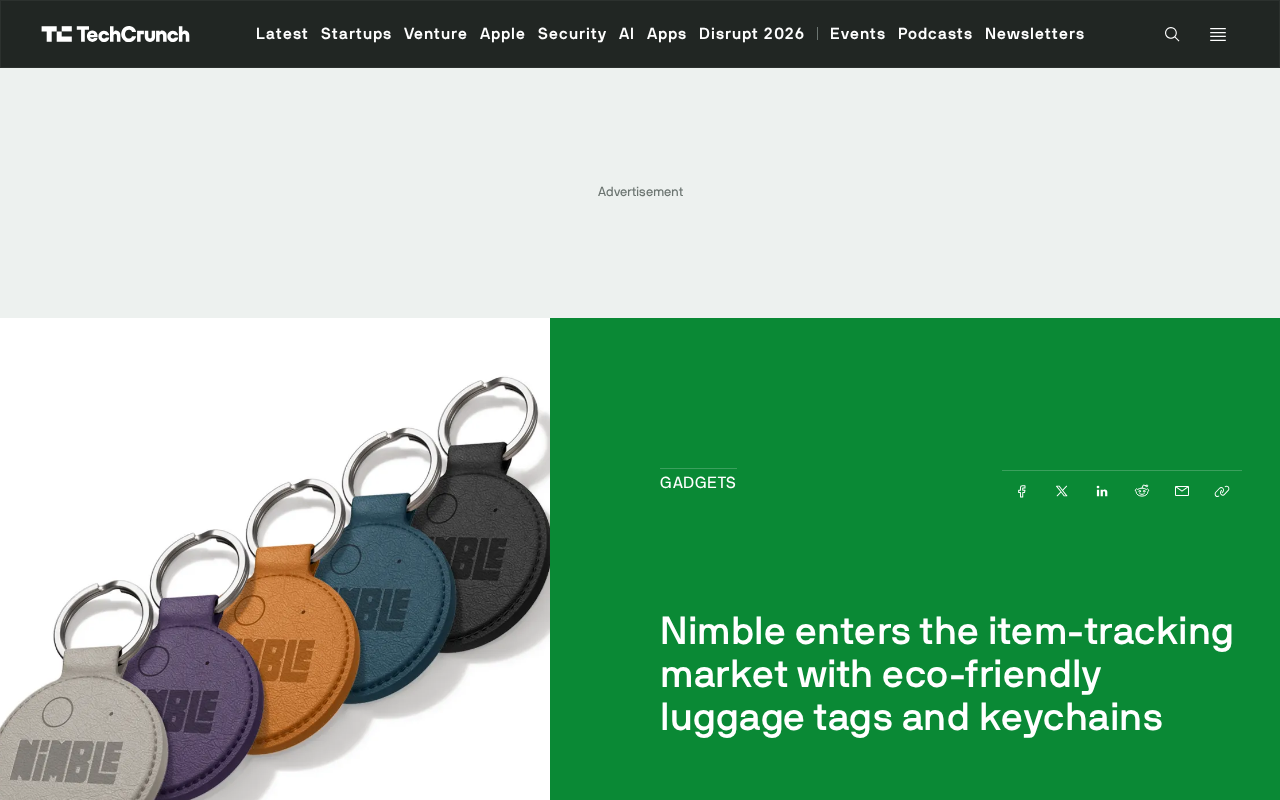
Consumer electronics brand Nimble launches eco-friendly tracker accessories, entering the item-tracking market dominated by Apple and Google.
As Apple's AirTag and Google's Find My Device network compete for the item-tracking market, consumer electronics brand Nimble has announced its entry with trackable wallets, keychains, luggage tags, and passport holders. Nimble continues its eco-friendly brand DNA, seeking to differentiate itself from plastic-heavy first-party platform accessories through sustainable materials and scenario-based design. The article notes that third-party trackers typically need to be tied to the Apple or Google ecosystems, with the experience constrained by platform rules and network coverage, but niche form factors such as luggage check-in, cross-border travel, and daily commuting leave room for third parties. Currently, key information such as pricing, launch date, compatible networks, and anti-stalking alerts has not been disclosed, and whether the product can break through with its eco-friendly approach remains to be seen.
A New Player Joins the Item Tracker Race
As Apple's AirTag and Google's Find My Device network battle for the item-tracking market, consumer electronics brand Nimble has announced its entry into the space with trackable wallets, keychains, luggage tags, and passport holders. According to a brief report from an RSS source, Nimble aims to differentiate itself through eco-friendly materials and design to secure a foothold in an increasingly crowded tracker accessory market.
This move signals that item tracking is no longer just a battleground for tech giants. Third-party accessory makers are finding their place around the "Find My" ecosystem, and Nimble is targeting the high-frequency scenarios of travel and personal belongings.
How the Eco-Friendly Positioning Creates Differentiation
Sustainability has always been a core selling point in Nimble's brand DNA. This new tracker product line continues that approach, covering four categories of everyday carry items: wallets, keychains, luggage tags, and passport holders. Compared to the many plastic-heavy tracker accessories on the market, the eco-friendly angle gives Nimble clear recognition.
However, the source material does not disclose specific material composition, recycled content ratios, or certification information. Whether the eco-friendly claims translate into actual purchase reasons for users still depends on the product's performance in battery life, tracking accuracy, and durability.
Third-Party Space Under Dual-Giant Competition
The report specifically notes that Google is competing with Apple in the item-tracking market. Both platforms have massive device networks, and third-party trackers typically need to be tied to one of these ecosystems. For Nimble, this means the product experience is largely constrained by platform rules and network coverage.
The opportunity for third-party manufacturers lies in scenario-based design: luggage tags for travel check-in, passport holders for cross-border travel, and wallets and keychains for daily commuting. These niche form factors are difficult for platform first-party products to cover comprehensively. Nimble's product portfolio is built around this gap.
How Find My / Find My Device Networks Work
Apple's Find My network and Google's Find My Device network are essentially crowdsourced positioning systems that use massive numbers of existing devices as relays. Take Apple as an example: an offline or disconnected tracker broadcasts an anonymous identifier via Bluetooth, and nearby passing iPhones, iPads, Macs, and other devices unknowingly receive that signal and upload their own encrypted location, which the owner then decrypts and views through the Find My app. Google's approach is similar in logic, relying on the Android device population to form coverage.
This type of network has three key characteristics: first, positioning accuracy depends on the density of surrounding devices, with urban areas outperforming remote areas; second, the entire process is anonymously encrypted, making it difficult even for the platform itself to directly determine item ownership; third, to prevent abusive tracking, both companies have built in an "unknown tracker alert" mechanism—when a tracker not paired with the person is detected to be traveling with them for an extended period, an alert is sent to nearby people. For third-party trackers to connect to these networks, they typically need to go through the platform's certification program and comply with its anti-stalking specifications at the firmware level, which explains why compatibility and platform rules are so critical for accessory manufacturers.
Unresolved Questions
The currently public information is quite limited. Key details such as pricing, launch date, which Find My networks are compatible, and whether anti-stalking alerts are supported have not been disclosed. For a tracking product, these are precisely the core factors in user decision-making.
What is certain is that competition in the item-tracking market is shifting from standalone hardware to a comprehensive contest of ecosystem and design. Whether Nimble can carve out a share through its eco-friendly approach will depend on subsequent product details and market feedback.
Note: This article is based on a brief report from a single source. Some product details have not yet been made public, and we will continue to follow up with updates.
Why Anti-Stalking Alerts Are a Must-Have for Trackers
Anti-stalking alerts refer to a mechanism that proactively notifies the person being followed when the system detects that a tracker has been separated from its owner but has been moving with the same person for an extended period. In 2023, Apple and Google jointly submitted a draft industry standard for "unwanted tracking detection" to promote cross-platform unified alerts.
The reason this mechanism has become central to product decisions is that trackers are inherently dual-use: they can help recover lost items but can also be used to secretly track others. If a product does not support alerts or has insufficient compatibility, it may not only be restricted from network access by the platform but also face regulatory and public opinion risks. For users, whether alerts are supported and whether alerts work across platforms directly determines whether the product can be used normally under compliance requirements. Therefore, the undisclosed compatible networks and anti-stalking capabilities of Nimble's products are actually more important than appearance and materials in determining the product's usable boundaries.
One-line Summary
Consumer electronics brand Nimble launches eco-friendly tracker accessories, entering the item-tracking market dominated by Apple and Google.
Paragraph Summary
As Apple's AirTag and Google's Find My Device network compete for the item-tracking market, consumer electronics brand Nimble has announced its entry into the space with trackable wallets, keychains, luggage tags, and passport holders. Nimble continues its eco-friendly brand DNA, seeking to differentiate itself from plastic-heavy first-party platform accessories through sustainable materials and scenario-based design. The article notes that third-party trackers typically need to be tied to the Apple or Google ecosystems, with the experience constrained by platform rules and network coverage, but niche form factors such as luggage check-in, cross-border travel, and daily commuting leave room for third parties. Currently, key information such as pricing, launch date, compatible networks, and anti-stalking alerts has not been disclosed, and whether the product can break through with its eco-friendly approach remains to be seen.
Related articles

Harvard AI Safety Course CS 2881R Sparks Discussion
Harvard's CS 2881R AI Safety course was mentioned on Hacker News. This article covers the course background, core AI safety topics, and takeaways for learners, helping readers understand how top universities cultivate AI safety talent.

Expanding Your Social Circle: Friend-Making Apps Worth Trying
How to choose a friend-making app? This article reviews friendship apps like the friend-discovery platform BFF and activity-oriented Timeleft, analyzing which approach suits whom and offering practical tips on offline meeting safety and expectation management.

Why You Shouldn't Run the Hermes Agent on Your Personal Computer
Why shouldn't you run autonomous AI agents like Hermes on your personal computer? This article analyzes why agents should be deployed to a dedicated VPS instead of your primary device, from four angles: security risks, resource consumption, credential leakage, and autonomy requirements—plus the practical logic of isolated deployment.