Nine Years in the Making: How I Cracked the Xbox 360
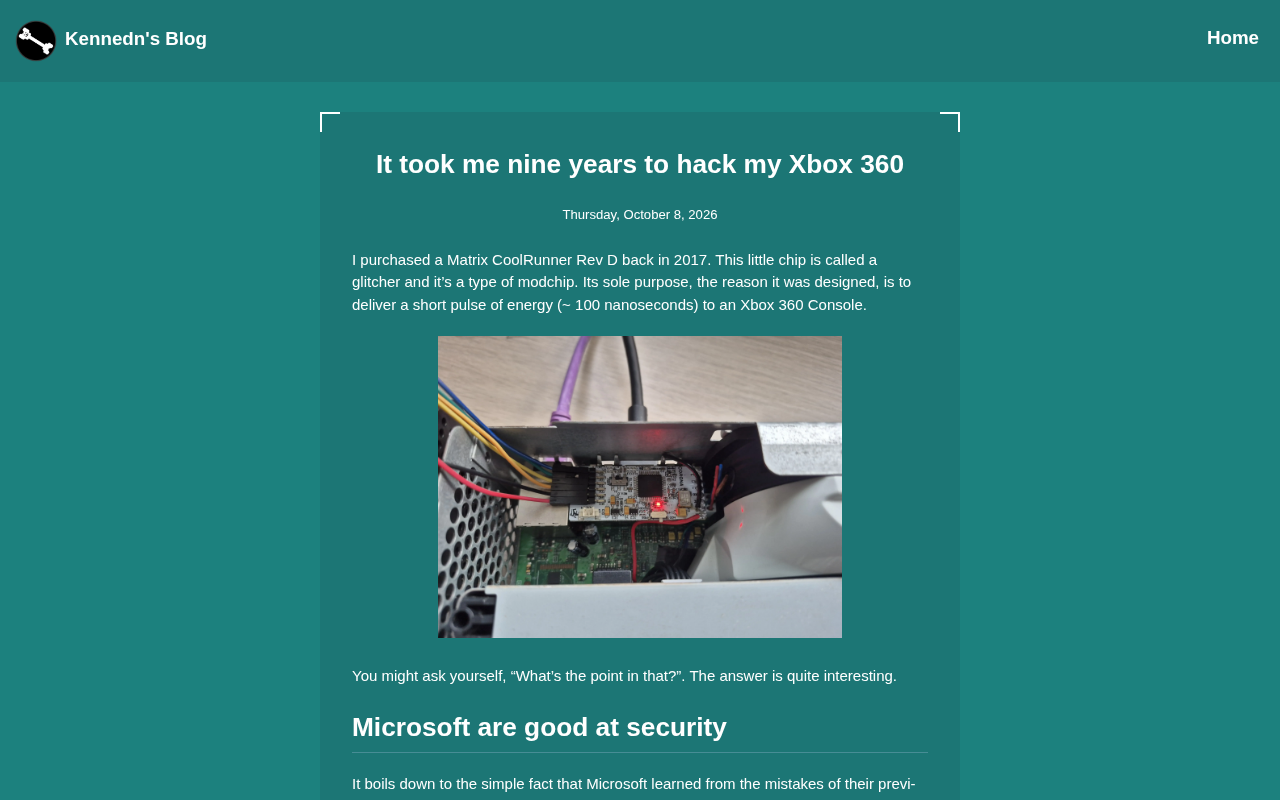
A developer spent nine years cracking the Xbox 360, showing that security offense and defense rely on long-term commitment and community accumulation.
A developer spent nine years successfully cracking Microsoft's Xbox 360 console, sparking heated discussion on Hacker News. With multiple layers of protection including signature verification, a hardware secure boot chain, and firmware obfuscation, the Xbox 360 makes every attempt by individual researchers potentially get stuck on undisclosed private keys or hardware behaviors. The author believes the real bottleneck in cracking is often not the technology itself, but information gaps and missing toolchains. This case is highly similar to the attack-defense logic of today's AI security and model reverse engineering.
A developer spent a full nine years trying to break through Microsoft's Xbox 360 security defenses. The story sparked extensive discussion on Hacker News — not just because of the astonishing time span, but because it reveals a core truth: reverse engineering and hardware hacking have never been about a flash of inspiration, but about long-term patience and iteration.
Why Is the Xbox 360 So Hard to Crack?
The Xbox 360 is a console in which Microsoft invested heavily in security design. It employs multiple layers of protection, including signature verification, a hardware-level secure boot chain, and obfuscated firmware. For an individual researcher, this means every attempt could get stuck on some undisclosed private key or undocumented hardware behavior.
The author didn't reveal too many specific technical details in the original post, but from the nine-year time span, it's clear that the cracking process must have involved repeated failures, building toolchains, and digesting and building upon existing public research. This also explains why the community holds such achievements in such high regard — it represents one person's prolonged campaign, not a team effort.
Secure Boot Chain is a common protection mechanism in modern computing devices. Its core idea is: from the moment the device powers on, every piece of code that gets executed must pass cryptographic signature verification by the previous level of code before it can continue executing. The Xbox 360's boot chain starts from a read-only boot ROM in hardware, progressively verifying subsequently loaded bootloaders, the system kernel, and even game executables. This means an attacker cannot simply replace a firmware module, because any modification not signed with Microsoft's private key will cause verification to fail and the device to refuse to boot. To break through this chain, an attacker must find logic flaws in the signature verification implementation, exploit hardware-level physical side channels (such as voltage glitching or bus snooping), or manage to extract Microsoft's internal signing private key — the latter being considered nearly impossible during the Xbox 360's lifecycle. It is precisely this layer-upon-layer design that makes it difficult for individual researchers to extend a single discovered flaw into a complete attack path.
Code Obfuscation is a technique that protects intellectual property by increasing the difficulty of reading and understanding code. In the Xbox 360's firmware and bootloader, Microsoft extensively used control flow flattening, bogus branches, instruction substitution, and other techniques, making disassembled pseudocode nearly impossible to understand directly. For reverse engineers, the greatest obstacle posed by obfuscation is not the inability to run the code, but the inability to build an accurate program semantic model within a reasonable timeframe — what you see are thousands of tangled jump instructions, yet it's hard to determine which segment is the actual verification logic. To bypass obfuscation, researchers typically need to combine dynamic debugging (single-stepping on real hardware or a high-precision emulator while recording state changes) with static analysis (de-flattening and restoring control flow graphs), a process that itself can take years. The Xbox 360's firmware obfuscation intensity was among the industry's top level at the time, which is a non-negligible source of time cost in the nine-year cracking cycle.
What Happened Over Nine Years?
What does nine years mean? It means a generation of consoles going from its peak to retirement, the rise and fall of related forums, and the continual evolution of the researcher's own skill set.
From the Hacker News comments, the community's focus centered on several aspects: first, admiration for the author's perseverance; second, a re-examination of the Xbox 360's security architecture; and third, the inspiration such long-term projects offer for individual learning paths. Some pointed out that often the bottleneck in cracking is not the technology itself, but the information gap — when key documents or tools already exist, but no one has connected them together.
The author's experience also indirectly demonstrates that open-source tools and community accumulation are key variables determining how far an individual researcher can go. Without prior public analysis, nine years might not have been enough.
Implications for AI and Security
On the surface, this story is about cracking a game console, but it shares similar underlying logic with today's AI security and model reverse engineering.
First, security is a dynamic game process. Defenders continuously harden their systems while attackers continuously seek side channels or implementation flaws. The history of cracking the Xbox 360 mirrors today's attack-defense rhythm of large model jailbreaking and weight extraction.
Second, the value of long-term projects is severely underestimated. In the fast-iterating AI industry, few are willing to spend nine years on one thing. But it is precisely this kind of deep investment that can reach details others cannot.
Third, community collaboration and individual persistence are not contradictory. The author's eventual success was likely built at the intersection of public research and personal experimentation, which applies equally to the open-source AI tool ecosystem.
Side-Channel Attacks refer to attacks that don't directly target the cryptographic algorithm itself, but instead infer keys or sensitive data by analyzing physical information leaked during the system's computation process (such as power consumption, electromagnetic radiation, execution time, cache hit rates, etc.). In the context of Xbox 360 cracking, researchers might monitor power consumption fluctuations during signature verification to infer private key bits, or exploit cache timing differences to determine whether a particular verification code has been executed. The frightening aspect of such attacks is that even if a cryptographic algorithm is mathematically flawless, its physical implementation can still betray its secrets. Today's large model security faces similar threats: attackers can analyze inference latency, VRAM usage patterns, or the token probability distributions returned by APIs to infer model architecture, training data characteristics, or even weight information. The Xbox 360 case reminds us that security design must consider both the algorithm layer and the physical implementation layer — negligence at any layer can become a breach point for the entire defense.
Conclusion
Cracking an Xbox 360 over nine years sounds like a geek's obsession, but it's more of a public lesson about patience, information integration, and security thinking. For readers engaged in AI security, reverse engineering, or systems research, the greatest value of this story is not "how to crack it," but "how to use enough time to break down a complex problem to the point where it can be conquered."
One-line Summary
A developer spent nine years cracking the Xbox 360, revealing that security offense and defense rely on long-term commitment and community accumulation.
Paragraph Summary
A developer spent nine years successfully cracking Microsoft's Xbox 360 console, sparking heated discussion on Hacker News. With multiple layers of protection including signature verification, a hardware secure boot chain, and firmware obfuscation, the Xbox 360 makes every attempt by individual researchers potentially get stuck on undisclosed private keys or hardware behaviors. The author believes the real bottleneck in cracking is often not the technology itself, but information gaps and missing toolchains — the combination of community public research and individual long-term persistence is key to breaking through complex systems. This case is highly similar to the attack-defense logic of today's AI security and model reverse engineering: security is a dynamic game, the value of long-term projects is underestimated, and community collaboration and individual exploration are not contradictory.
Related articles

AI Compute Is the New Oil, But the Market Mechanism Has Yet to Take Shape
Hacker News compares AI compute to the new oil, noting the lack of price discovery, concentrated supply, and no hedging tools. The article analyzes structural issues in compute trading and explores a possible three-tier market of spot, contracts, and derivatives, plus the real impact on AI practitioners' cost management.

Running Full iOS 16.5 Firmware on Android Devices: Technical Demo or Marketing Gimmick?
A Hacker News post claims full iOS 16.5 firmware can run on Android, with 315 upvotes. This analysis argues it is more likely a web UI simulation than a true firmware port, and explores the value and risks of such projects.

Etsy Cracks Down on AI Slop: Addressing Buyer and Seller Anxieties
Etsy introduces stricter rules limiting AI-generated content in listings, addressing buyer confusion over AI products and seller fears of original work being diluted by AI slop.