Nirva Raises $33M: How a $249 AI Pendant Listens Only to You

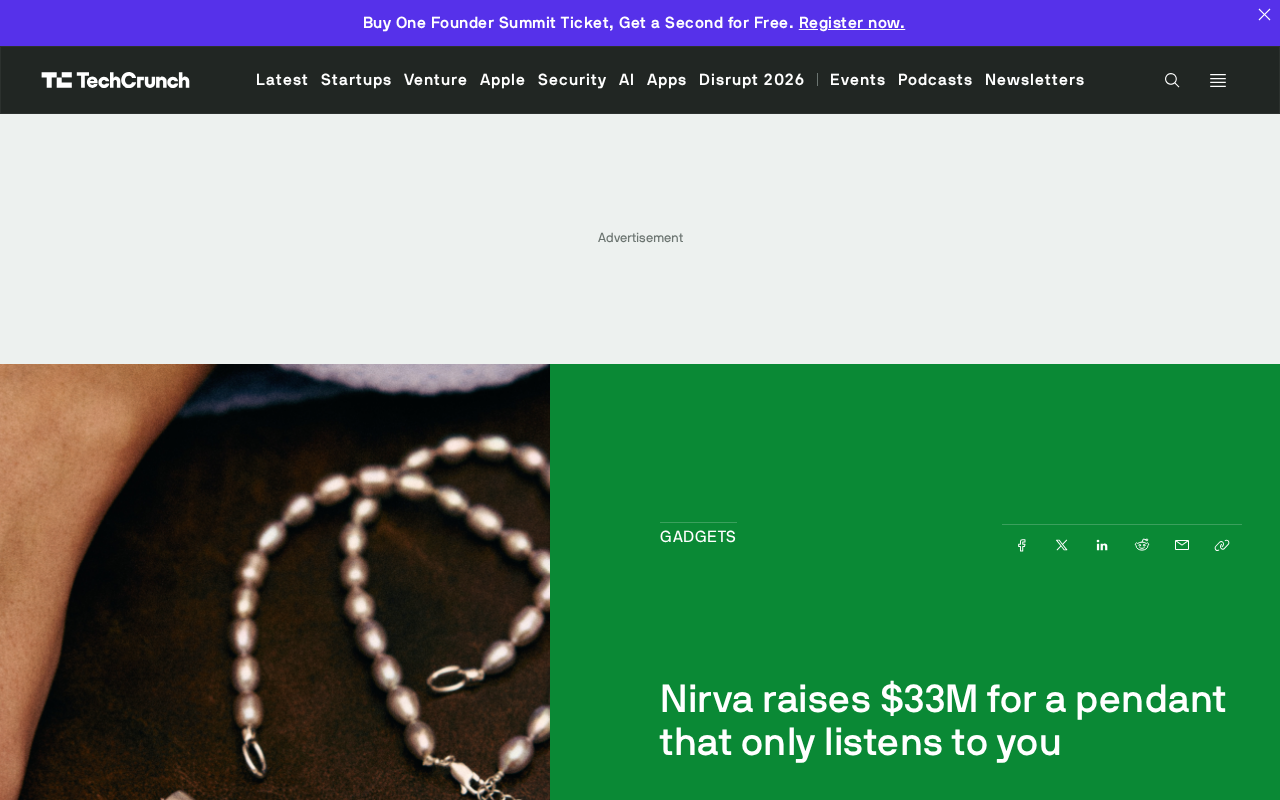
Nirva raises $33M for a $249 AI pendant that responds only to the wearer's voiceprint.
Wearable AI hardware company Nirva has raised $33 million to develop and mass-produce its ambient AI pendant. Priced at $249 with shipping planned this year, the device's key differentiator is voiceprint recognition that responds only to the wearer, filtering out bystanders and ambient noise. The article examines its privacy pitch, pricing strategy, and the shifting competitive focus in wearable AI hardware from features to trust.
The wearable AI hardware race has a new major funding round. Nirva has announced $33 million in funding to advance the development and mass production of its ambient AI pendant. The device is priced at $249 and is expected to ship this year.
Core Selling Point: Responds Only to the Wearer's Voice
The most striking differentiator for the Nirva pendant is that it "listens only to you." Unlike most ambient devices on the market that constantly capture audio, it acoustically locks onto the wearer's voiceprint and filters out bystanders and environmental noise. This addresses a real pain point—not being disrupted by other people's conversations in cafés or meeting rooms—while also responding to the public's biggest privacy concern about always-on microphones.
According to the original report, Nirva promises the pendant will respond only to the wearer's voice, turning the "always-on" privacy anxiety into a controllable design constraint. Whether this trade-off holds up will depend on actual pickup accuracy and false-trigger rates.
A voiceprint refers to the acoustic features formed by the physiological structure of the vocal organs and long-term pronunciation habits, giving each individual a distinguishable signature. It is typically extracted and modeled using methods such as Mel-frequency cepstral coefficients (MFCC), i-vectors, or deep speaker embeddings. Modern speaker recognition systems can achieve equal error rates below 1% under ideal conditions, but degrade significantly in real environments due to reverberation, noise, distance, and emotion. The challenge for a wearable pendant is that the microphone sits roughly 20–40 cm from the wearer's mouth, yielding a far lower signal-to-noise ratio than a phone held to the ear during a call, while also requiring real-time cascaded wake-word and speaker verification on a low-power chip. The industry commonly uses two types of verification: "text-dependent" and "text-independent." The former is more accurate but requires the user to speak a fixed phrase; the latter offers a more natural experience but makes false acceptance rates harder to suppress. Nirva's claimed "responds only to the wearer" is essentially a continuously running speaker verification task, and its usability depends on whether false rejection and false acceptance rates can both be kept within tolerable limits for daily use.
$249 Pricing and Year-End Shipping Timeline
Nirva has set the price at $249 and plans to begin shipping before the end of the year. The $33 million in funding provides ammunition for mass production, supply chain, and software iteration. For ambient AI hardware, the bulk of costs often lies not in the hardware itself but in cloud inference, speech model training, and ongoing service maintenance—so this capital is likely to lean toward software and cloud operations.
The business model for ambient AI hardware differs fundamentally from traditional consumer electronics: hardware is often priced near cost or even at a loss, with real costs incurred after the device is sold. A single voice interaction typically passes through four stages—on-device wake-up, cloud-based automatic speech recognition (ASR), large language model inference, and text-to-speech (TTS)—with token costs for LLM inference and audio-duration billing for ASR constituting ongoing expenses. If a device triggers 50 times a day and each interaction consumes thousands of tokens, annual cloud costs per user could reach tens of dollars, far exceeding one-time hardware margins. As a result, such products generally require subscription models or usage tiering to cover marginal costs—otherwise, the more users, the greater the losses. A substantial portion of Nirva's $33 million is likely allocated to model distillation, device-cloud collaborative inference, and inference infrastructure optimization, precisely to bring per-interaction costs down to a sustainable level—a key variable in determining whether its $249 price can hold up long term.
The Next Battleground for Wearable AI: Trust, Not Features
From AI Pin to various recording pendants, the functional narrative for wearable AI hardware has become highly homogenized. What truly sets products apart is whether users are willing to keep them on all the time. By making "listens only to you" its first-principles selling point, Nirva is essentially selling trust. Information across sources consistently points to one conclusion: unless such devices can clearly define the boundaries of audio capture, no amount of functionality will get them into everyday wear scenarios.
For the industry, Nirva's funding is a signal that capital is still betting on "ambient computing" entry points, but the screening criteria have shifted from specs to privacy architecture and contextual restraint. Whether the pendant can deliver on its year-end shipping promise and validate the real-world experience of voiceprint filtering will determine the persuasiveness of this product line.
"Ambient computing" refers to a paradigm in which computing power is embedded in the environment and responds to user intent unobtrusively. Its ideal form is a device that provides services without requiring active operation, which means sensors like microphones and cameras need to be always on. This creates a structural tension with privacy protection: always-on audio capture means the device is physically capable of recording third-party conversations, and even if the software promises not to upload or store data, bystanders have no way to verify. Regulators worldwide are tightening this space—for example, the EU AI Act imposes specific restrictions on emotion recognition and biometric categorization, and several U.S. states require devices that record audio to fulfill two-party consent obligations. Feasible technical mitigations include on-device wake-up and local voiceprint filtering (raw audio never leaves the device), physical mute switches, LED recording indicators, and auditable local logs. If Nirva's voiceprint filtering can be completed on-device, it would simultaneously reduce cloud costs and compliance risk—a technical prerequisite for turning its privacy narrative into a product moat.
One-line Summary
Nirva raises $33M, entering the wearable AI pendant race with a device that responds only to the wearer's voiceprint.
Paragraph Summary
Wearable AI hardware company Nirva has announced $33 million in funding to develop and mass-produce its ambient AI pendant. Priced at $249 and slated to ship this year, its core differentiator is voiceprint recognition that responds only to the wearer's voice, filtering out bystanders and environmental noise—addressing both audio interference and privacy concerns. The article notes that functional narratives in wearable AI hardware have become highly homogenized, with competition shifting from specs and features to privacy architecture, contextual restraint, and user trust. The funding also signals that capital remains bullish on "ambient computing" entry points, though screening criteria have changed. Whether the pendant can deliver on its shipping promise and how its voiceprint filtering performs in real-world accuracy and false-trigger rates will determine the product line's persuasiveness.
Related articles

Build an AI Super Employee System at Zero Cost: A Full Breakdown of Automated Agent Workflows
A deep breakdown of the AI super employee system demoed on Bilibili: agent orchestration, digital human voiceovers, map and enterprise lead generation, 24/7 customer service, and legal modules. We analyze the business logic and compliance risks behind zero-cost signup to help entrepreneurs judge the real ROI of this AI digital employee system.

The Essential Difference Between Chatbots and AI Agents: Crossing from Conversation to Execution
What's the difference between a chatbot and an AI agent? Based on the MCP series on the Learn Tech channel, this article uses examples like booking flights and summarizing notes to explain: a chatbot only gives answers, while an agent actually completes tasks through a think-act-observe loop. It breaks down the four core components—model, tools, memory, and goal—as well as MCP's role as a bridge, and discusses agents' applicable boundaries and permission risks.

Free GitHub Repo: 342 Hours of AI Courses, from Math to MCP Servers
A free GitHub repo offers 342 hours of AI courses: 523 lessons across 20 phases, from math fundamentals to agent building and MCP servers. Nearly 100,000 learners have started.