Nitter Faces Funding and Legal Troubles, Open-Source Anonymous Frontend Appeals for Help
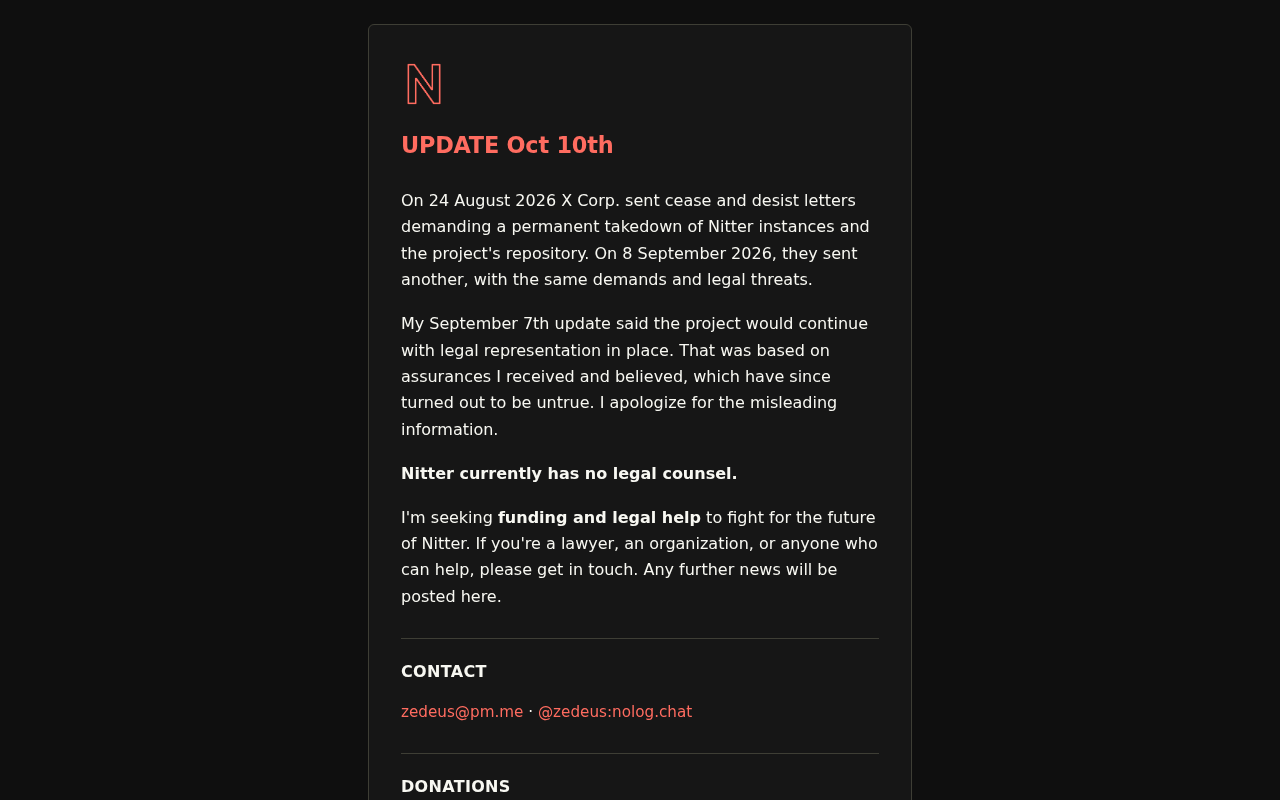
Open-source anonymous frontend Nitter publicly appeals for help amid funding drought and legal pressure, reflecting the open-source sustainability dilemma.
The open-source project Nitter recently released an announcement admitting it faces a dual crisis of dwindling funds and legal pressure, publicly seeking community financial and legal assistance. Nitter is an alternative frontend that allows users to browse certain social platforms without logging in, executing JavaScript, or being tracked, making it an important tool for journalists, researchers, and privacy advocates. However, such projects relying on reverse engineering inherently operate in a legal gray area, and platform pressure may directly threaten their survival. On the funding side, server maintenance, legal matters, and traffic growth all require continuous investment, while open-source projects lack stable business models, making donations insufficient for long-term operations. The community response has been sympathetic, but fundamental solutions remain unclear. Nitter's fate is not just about one tool—it reflects the ongoing tension between the open web and closed platforms, as well as the structural contradiction of "many users, few payers" in the open-source ecosystem.
The open-source project Nitter was once the go-to tool for millions of users to bypass platform restrictions and browse social media anonymously. Recently, the project released an update announcement, admitting it is facing a dual crisis of dwindling funds and legal pressure, and publicly seeking financial and legal assistance from the community. This news has sparked widespread discussion in the tech community and once again brought the issue of open-source project sustainability to the forefront.
What Is Nitter and Why It Matters
Nitter is an open-source alternative frontend that allows users to browse content on certain social platforms without logging in, executing JavaScript, or being tracked. It scrapes public data and re-renders it, offering a lighter, more privacy-focused way to access content. Amid growing privacy awareness and discussions about data sovereignty, Nitter became an important tool for journalists, researchers, and ordinary users alike.
However, projects that rely on reverse engineering or unofficial interfaces inherently operate in a legal and technical gray area. When platforms adjust their access policies or restrict anonymous access, it directly impacts Nitter's usability. The "legal help" mentioned in the announcement is likely related to pressure from the platform or potential legal disputes.
Alternative Frontend refers to open-source projects that reverse-engineer or use public APIs to reimplement a lightweight, privacy-focused access interface for a centralized platform. These projects typically don't store user data or run tracking scripts; instead, they scrape and re-render public content in real time, allowing users to browse information without logging in or being tracked by platform cookies. Common examples include Nitter, Invidious (a YouTube alternative frontend), Bibliogram (an Instagram alternative frontend), and others. They often rely on undocumented or unofficial platform interfaces, making their stability highly susceptible to platform policy changes. Once a platform changes its interface, adds anti-scraping mechanisms, or requires login, the alternative frontend may stop working. Additionally, these projects often occupy a legal gray area: platforms typically apply pressure citing violations of terms of service, infringement of database rights, or disruption of server operations, while project maintainers argue based on principles of user privacy and freedom of information.
Funding Drought: The Eternal Challenge of Open-Source Projects
According to the announcement, the Nitter project is currently facing a severe funding shortage. Maintaining servers, handling traffic growth, and dealing with legal matters all require real money, yet open-source projects typically lack a stable business model. Donations and sponsorships often only provide temporary relief and are difficult to sustain long-term operations.
This is not a predicament unique to Nitter. In recent years, multiple well-known open-source projects have stopped updating or sought commercialization due to funding issues. Nitter's appeal for help once again exposes the structural contradiction in the open-source ecosystem: "many users, few payers." When a project becomes public infrastructure, its maintainers' labor and costs are difficult to reasonably compensate, ultimately harming the entire community.
Open-source project sustainability refers to whether a project can obtain sufficient funding, manpower, and institutional support for long-term maintenance to continuously fix vulnerabilities, update features, and address legal and operational risks. Many critical open-source projects are maintained by a small number of unpaid volunteers while supporting enormous commercial ecosystems, creating an imbalance of "many users, few payers." Common funding models include: individual donations (such as GitHub Sponsors, Open Collective), corporate sponsorship, foundation grants (such as the Apache Foundation, Linux Foundation), commercial support versions or hosted services, and recently emerging public funding pools (such as the Sovereign Tech Fund). However, these models often struggle to cover server costs, legal fees, and full-time maintainer salaries, especially when projects involve conflicts of interest with large platforms, making corporate sponsorship even less likely. Nitter's predicament is a microcosm of this structural contradiction.
Legal Pressure: Compliance Risks of Anonymous Frontends
The announcement explicitly mentions seeking "legal help," suggesting that Nitter may be facing legal action or threats from the platform. Anonymous frontends provide services by scraping public data, but whether their actions constitute infringement or violate platform terms of service is disputed across different jurisdictions.
Platforms typically argue that such scraping violates their terms and may affect service stability, while project maintainers emphasize user privacy and freedom of access. The outcome of these legal battles will directly impact the survival space for similar projects. Nitter's situation may become a bellwether for the anonymous frontend field.
Web Scraping and Database Rights are at the core of legal disputes surrounding anonymous frontends. Platforms typically argue that unauthorized scraping of public data violates their terms of service and may constitute substantial extraction from a database, infringing database rights (especially in jurisdictions like the EU). Additionally, platforms may invoke laws such as the Computer Fraud and Abuse Act (CFAA), alleging that scraping bypasses technical protection measures. Project maintainers often argue that "public data is not protected by copyright," "users have the right to anonymous access," and "scraping is only for personal reading." In recent years, the U.S. Supreme Court narrowed the scope of the CFAA in the Van Buren case, but laws still vary widely across states and countries. For projects like Nitter, legal risks come not only from platform lawsuits but also from receiving cease-and-desist letters and hosting providers being pressured to take services offline.
Community Reaction and Future Outlook
In the tech community, Nitter's appeal for help has sparked both sympathy and concern. Many users have expressed willingness to donate, and some have called for establishing more sustainable open-source funding models. But the more fundamental question is: when a project directly conflicts with the interests of large platforms, can community donations alone solve the problem?
Based on current information, Nitter's future is full of uncertainty. If funding and legal issues cannot be resolved, the project may be forced to scale back services or even shut down. For users who depend on it, this is undoubtedly bad news. For the entire open-source community, it is another profound reminder about sustainability and legal risks.
Regardless of the outcome, Nitter's case is worth documenting and discussing. It is not just the fate of a single tool—it reflects the ongoing tension between the open web and closed platforms.
One-line Summary
Open-source anonymous frontend Nitter publicly appeals for help amid funding drought and legal pressure, reflecting the sustainability dilemma of open source.
Paragraph Summary
The open-source project Nitter recently released an announcement admitting it faces a dual crisis of dwindling funds and legal pressure, and is publicly seeking community financial and legal assistance. Nitter is an alternative frontend that allows users to browse content on certain social platforms without logging in, executing JavaScript, or being tracked, making it an important tool for journalists, researchers, and privacy advocates. However, such projects relying on reverse engineering inherently operate in a legal gray area, and platform pressure may directly threaten their survival. On the funding side, server maintenance, legal matters, and traffic growth all require continuous investment, while open-source projects lack stable business models, making donations insufficient for long-term operations. The community response has been sympathetic, but fundamental solutions remain unclear. Nitter's fate is not just about one tool—it reflects the ongoing tension between the open web and closed platforms, as well as the structural contradiction of "many users, few payers" in the open-source ecosystem.
Related articles

GPT-Next Leak, Gemini 4 Argon Imminent: AI News Roundup
GPT-Next leak suggests extreme efficiency; OpenAI's 28-day shipping pledge boosts speed 50%; Gemini 4 Argon nears release; Anthropic subscription value report sparks debate.

GPT-Next Leaked, Gemini 4 Argon Speeds Up, Fable 5.5 May Launch Today
OpenAI's GPT-Next model leaks, expected to be extremely low-cost and possibly part of the 28-day release plan; Gemini 4 Argon internal testing accelerates, NanoBanana 2.1 is live; Semi Analysis tests show Claude Max's equivalent API value is about 5 times that of ChatGPT Pro; Fable 5.5 may launch today.

Gemini 4 Argon Launches Globally: Key Highlights from the AI Daily Brief
Google opens Gemini 4 Argon globally across Pro and Ultra subscriptions and the API, and demonstrates robot control. This article rounds up open-source models, Agent infrastructure, cost transparency, and safety governance updates.