NLP/ML PhD Job Search: Paid Resource Recommendations and Preparation Strategies for Research Scientist Interviews

A comprehensive guide to paid interview prep resources for NLP/ML PhDs targeting Research Scientist roles.
This article provides NLP/ML PhD students with a strategic guide to paid resources for Research Scientist interview preparation. It covers the four core interview modules—coding, ML fundamentals, system design, and research interviews—with specific resource recommendations including LeetCode Premium, mock interview platforms, ML system design books, and structured courses, along with practical budget allocation advice.
From Academia to Industry: The Unique Challenges of Research Scientist Interviews
For NLP/ML PhD students approaching graduation, pursuing a Research Scientist position in industry is an attractive career path. The rise of Research Scientist roles in industry is closely tied to the deep learning revolution. The breakthrough performance of AlexNet in the 2012 ImageNet competition kicked off the industrialization of deep learning, after which tech giants like Google, Meta, and Microsoft established dedicated AI research labs (such as Google DeepMind, Meta FAIR, and Microsoft Research), recruiting large numbers of PhD-level researchers. The key difference between these roles and traditional software engineering positions is that Research Scientists primarily drive cutting-edge research and publish at top conferences, while also translating research outcomes into technical innovations in products. Compensation typically exceeds that of engineers at the same level, but interview difficulty is correspondingly higher, with competitors mostly being PhD graduates from top universities.
However, the interview process for these roles is often more complex than expected—it not only examines research depth but also comprehensively evaluates coding ability, system design thinking, and machine learning fundamentals.
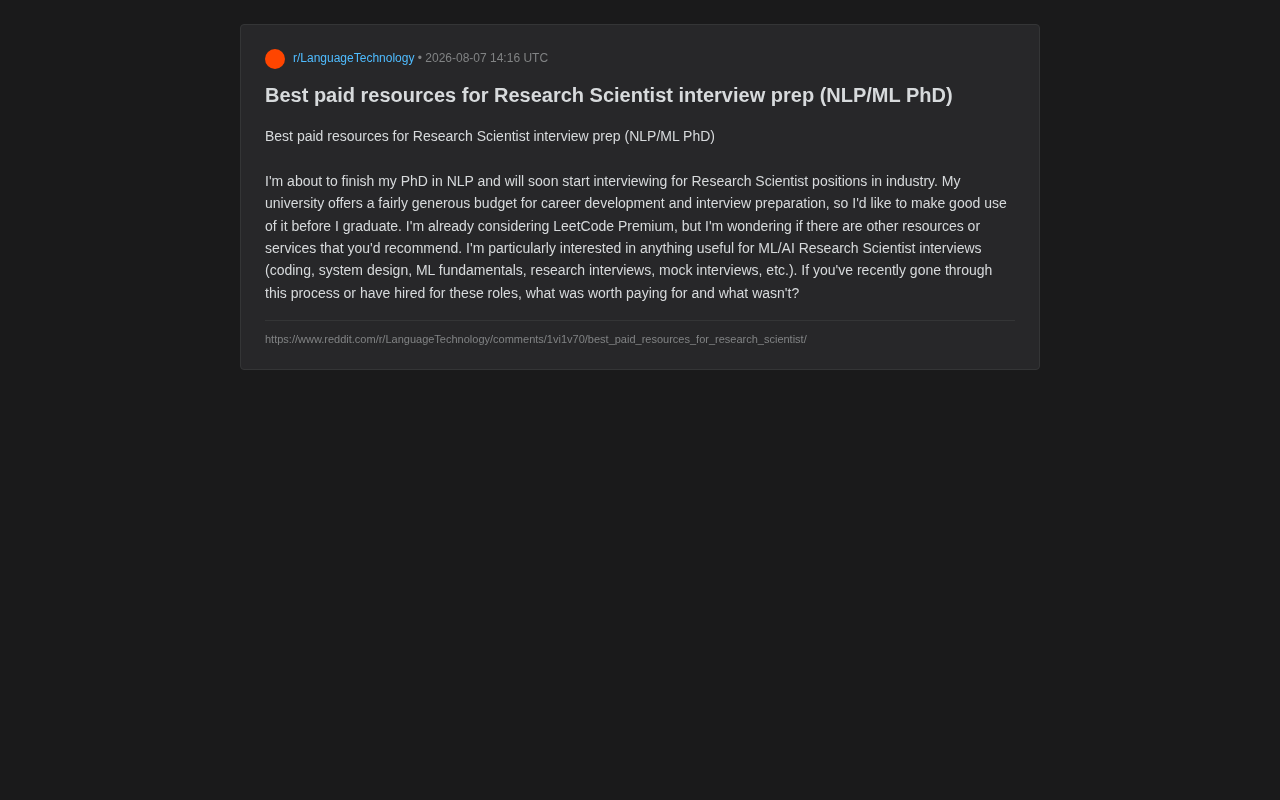
A Reddit user about to complete their NLP PhD recently posted in the community seeking advice on paid resources for interview preparation. They mentioned that their university provides a generous professional development budget and hoped to make the most of it before graduation. This topic sparked widespread discussion and reflected a common dilemma many PhD students face when transitioning to industry: With budget in hand, which resources are truly worth investing in?
The Four Core Modules of Research Scientist Interviews
Unlike typical software engineering positions, AI Research Scientist interviews usually cover the following dimensions, each requiring targeted preparation.
Coding
Despite being a research role, the vast majority of top tech companies (such as Google DeepMind, Meta AI, and Microsoft Research) still include algorithmic coding rounds. This is often a weak spot for PhD students, as years of focused research work means many have become rusty with data structures and algorithms practice.
LeetCode Premium is almost everyone's top choice and a resource the original poster was already considering. LeetCode is an online coding problem platform that has gradually become the de facto standard for tech company interview preparation in North America since around 2015. Its Premium version (annual fee of approximately $159-299) offers features like company-specific high-frequency problems, video explanations, and contest problems. The algorithm interview culture originated from Google's structured interview methodology promoted in the early 2000s—using standardized coding problems to evaluate candidates' problem decomposition ability, code implementation skills, and time/space complexity analysis. Although academia debates whether this interview approach truly reflects job performance, it remains a required component at the vast majority of top tech companies.
Its value lies in providing company-categorized high-frequency real problems, official solutions, and a simulated environment. For research roles, you typically don't need to grind to competition-level difficulty, but you should be proficient with medium-difficulty problems covering common types like dynamic programming, graphs, and string processing. It's recommended as a foundational investment with excellent cost-effectiveness.
ML Fundamentals
This is the centerpiece of Research Scientist interviews and the key differentiator from engineering roles. Interviewers will deeply examine your understanding of classical models, optimization methods, probability and statistics, and deep learning principles. For the NLP track, Transformer architecture, attention mechanisms, and training and fine-tuning of large language models are all hot topics.
The Transformer is a neural network architecture proposed by the Google team in the 2017 paper "Attention Is All You Need," which completely replaced the previously dominant Recurrent Neural Networks (RNN) and Long Short-Term Memory networks (LSTM) in NLP. Its core innovation is the Self-Attention mechanism, which allows the model to attend to all other positions simultaneously when processing each position in a sequence, thereby capturing long-range dependencies and enabling efficient parallel computation. Large Language Models (LLMs) based on Transformers—such as the GPT series, LLaMA, and PaLM—demonstrate remarkable language understanding and generation capabilities through pre-training on massive text data, followed by alignment with human preferences via techniques like Instruction Tuning and Reinforcement Learning from Human Feedback (RLHF). Common interview topics include the computation flow of multi-head attention, design choices for positional encoding, KV Cache for inference optimization, and the principles of parameter-efficient fine-tuning methods like LoRA.
Although PhD students are strong in their specific subfields, the breadth of ML fundamentals often requires systematic review. Paid resources in this area are relatively scattered, but structured ML interview courses and systematic review of classic textbooks are worth attention.
System Design
With the proliferation of MLOps and large-scale model deployment, an increasing number of research positions now evaluate ML system design capabilities—how to design a recommendation system, how to build large-scale training pipelines, how to optimize inference latency, etc. This presents a major challenge for candidates with purely academic backgrounds.
MLOps (Machine Learning Operations) is a practice framework that applies DevOps principles to machine learning lifecycle management, covering data management, model training, experiment tracking, model deployment, monitoring, and continuous iteration. As LLM parameter scales have grown from billions to hundreds of billions, model training and deployment have themselves become complex systems engineering problems: distributed training needs to handle data parallelism, model parallelism (tensor parallelism, pipeline parallelism), and ZeRO optimization strategies; inference deployment involves optimization techniques like model quantization (e.g., INT8/INT4), Speculative Decoding, and Continuous Batching. This is why Research Scientist interviews increasingly emphasize system design capabilities—researchers need to understand how their algorithms actually land in large-scale engineering systems.
Research Interview
This is the round that best showcases a candidate's core competitiveness, typically including paper presentations, discussions of research taste, and exploration of open-ended questions. Interviewers want to understand your research methodology, critical thinking, and future research directions.
"Research Taste" is a concept widely used in academia and industry research labs that's difficult to precisely define. It roughly refers to a researcher's eye for selecting problems—the ability to identify truly important and solvable problems rather than merely chasing trends or making incremental improvements. In interviews, this is typically assessed through open-ended discussions: interviewers might propose a vague research direction and observe how candidates decompose it into specific researchable questions; or discuss a controversial paper to see whether candidates can offer deep critiques and improvement ideas. The "important problem awareness" emphasized by Richard Hamming in his famous talk "You and Your Research" is the core embodiment of research taste.
This component is difficult to cram with paid resources and relies more on genuine research experience.
Overview of Paid Resources Worth Investing In
Combining community experience and industry practice, the following resources have strong reputations for Research Scientist interview preparation.
Mock Interview Platforms
Mock interview services are often undervalued yet offer some of the highest returns on investment. Platforms like interviewing.io and Pramp (partially free) allow you to conduct one-on-one practice sessions with real industry professionals and receive immediate feedback. For PhD students who have been away from the interview environment for a long time, using mock interviews to overcome nervousness and expose knowledge gaps offers far more value than grinding problems alone.
The value of mock interviews has solid cognitive science backing. Research shows that the "Testing Effect"—where actively retrieving knowledge consolidates memory more effectively than passive review—is one of the most effective learning strategies. Mock interviews also help candidates cope with "Social Evaluative Threat," the core source of interview anxiety. Platforms like interviewing.io typically employ anonymous mechanisms, allowing candidates to gradually adapt to being evaluated in a low-pressure psychological environment. Furthermore, "whiteboard coding" or "verbal derivation" in interviews is fundamentally a different cognitive task from independent thinking—it requires simultaneous problem-solving and clear articulation, a dual-task load that requires dedicated training to handle comfortably.
If your school's budget is generous, you might even consider paying for sessions with senior engineers or researchers who have hiring experience at major companies for specialized coaching.
Structured Courses and Problem Banks
Beyond LeetCode Premium, some paid platforms specifically targeting ML interviews (such as Educative's ML system design courses and certain Coursera specializations) provide systematic knowledge frameworks suitable for quickly identifying and filling gaps.
Books and Specialized Materials
Books like Machine Learning System Design Interview and Designing Machine Learning Systems are highly regarded in the industry. They're inexpensive yet provide solid framework knowledge. Compared to expensive subscription services, these one-time investments offer better cost-effectiveness.
What's Not Worth Spending On?
When utilizing your budget, be wary of flashy but impractical spending traps.
- Overly generalized paid communities: Many so-called "referral groups" or "interview crash courses" offer limited actual value, with information readily available through public channels.
- Generic courses not tailored for research roles: Interview courses aimed at general software engineers offer limited help for Research Scientists, especially for research interviews and deep ML questions.
- Redundant problem bank subscriptions: Purchasing multiple overlapping practice platforms simultaneously is a common waste—pick one or two core platforms and go deep.
Budget Allocation Recommendations for PhD Students
For PhD students transitioning from academia to industry, the optimal budget allocation strategy might be:
- Foundation layer: LeetCode Premium + one or two ML system design books, covering core needs for coding and system design.
- Enhancement layer: Several high-quality paid mock interviews, focusing on polishing communication skills and on-the-spot responses.
- Bonus layer: Targeted preparation for your target companies—thoroughly study their published papers and technical blogs to make research interview discussions more focused.
It's worth emphasizing that what Research Scientist positions value most is always research ability itself. Paid resources can help you shore up engineering weaknesses and familiarize yourself with interview rhythms, but what truly impresses interviewers is often your deep understanding of research problems and unique insights. While making the most of your school's budget, don't forget this point.
Key Takeaways
Related articles

Fei-Fei Li on AI: Visual Intelligence, the Boundaries of Creativity, and Human Agency
Stanford professor Fei-Fei Li discusses AI and visual science on Huberman Lab, explaining how ImageNet ignited modern AI, AI's capability boundaries, healthcare applications, and why human agency is the central question in AI development.

DeepSeek Harness Hands-On Review: Core Advantages of a Plugin-Based Agent Framework
Hands-on review of DeepSeek Harness open-source Agent framework, analyzing its plugin architecture, coding capabilities, deployment, and comparison with Claude Code.

Building a 500K Domain Search Engine for $10: Lessons from an Indie Developer's Weekend Project
An indie developer built a 500K domain vertical search engine in one weekend for $10. We analyze the tech stack, vertical search opportunities, and rapid validation methodology.