No API Keys Needed: Connector Practices for Directly Linking Five Major AI Models to Enterprise Systems

Five consumer AI apps connect to enterprise systems without API keys via a local connector.
Eterna founder Jesse Gamble showed five consumer-grade AI apps—ChatGPT, Claude, Grok, Meta Muse, and Mistral Vibe—connecting to a real business system without API keys via a remote tool source. The connector runs on a Windows PC, exposes seven tools covering 91 operations across 13 domains, and enforces immediate reads, separate write channels, owner approval for irreversible actions, and fully local audit logs. It offers a low-cost validation path but has single-point-of-failure and permission-granularity limitations.
No API Keys Needed: Consumer-Grade AI Apps Connect Directly to Enterprise Systems
Eterna founder Jesse Gamble recently demonstrated an interesting experiment: getting five AI products—ChatGPT, Claude, Grok, Meta Muse, and Mistral Vibe—to connect to a real business system without using API keys at all. Each AI connected to Eterna's server as an ordinary consumer-grade app through a remote tool source. According to Gamble, all five products were tested using free accounts, including Mistral's free account; however, some other vendors require a paid tier to add remote connectors.
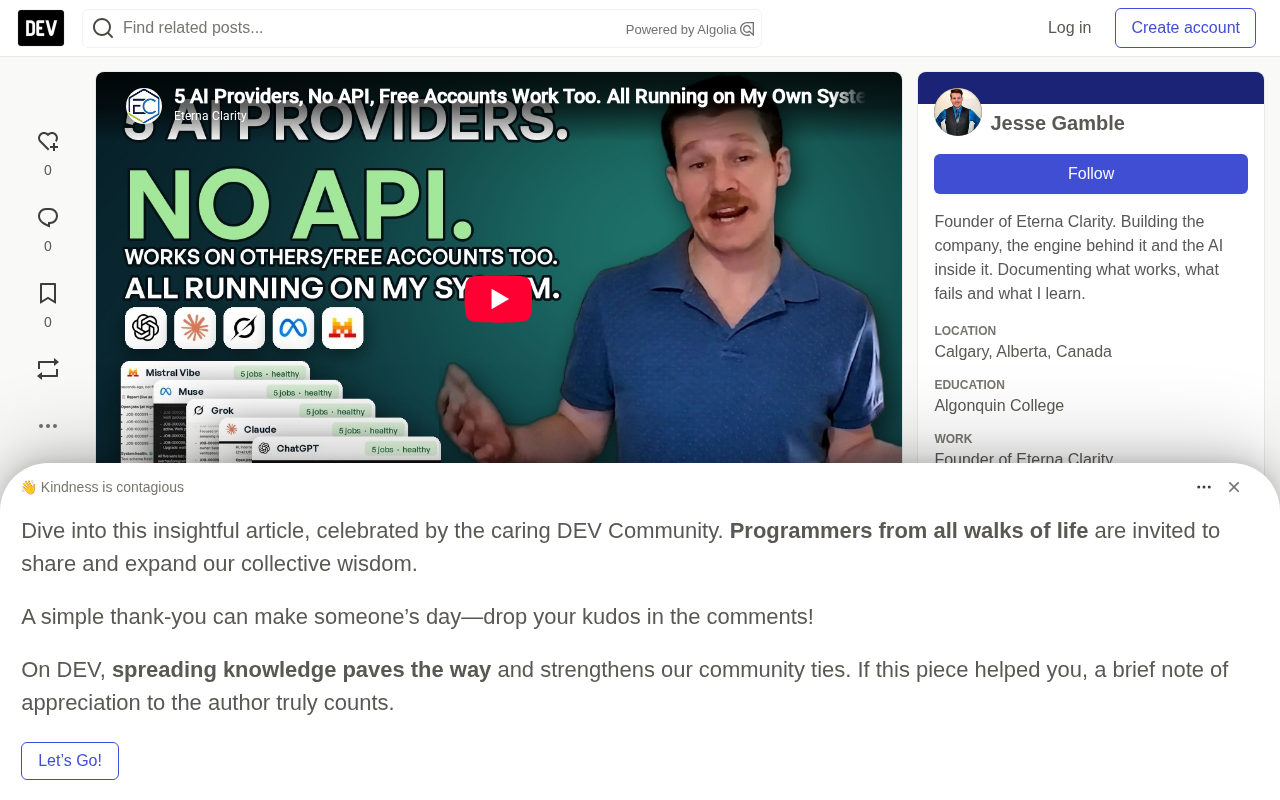
The core value of this experiment isn't "getting AI to connect to a system"—that's long been old news—but rather that it bypasses the traditional integration barrier of API keys while moving the security boundary from the AI vendor's side back into the enterprise's own hands.
How the Connector Works: Seven Tools Encapsulating 91 Operations
The connector runs on a Windows PC and exposes seven tools: operating.resolve, get_capabilities, execute_read, execute_write, get_result, cancel_operation, and operating.finalize. These seven tools encapsulate 91 specific operations spanning 13 business domains.
The test method was straightforward: each of the five AIs started a fresh conversation and received the exact same prompt—load the system and report incomplete work orders and system health status. The result was that all five models returned the same five incomplete work orders and all reported system health. This consistency shows that the connector provides a stable abstraction layer at the tool-calling level, effectively smoothing out differences between models.
Worth noting is the architectural division of labor. Gamble explicitly mentioned that "the workspace does the heavy lifting, keeping the model side low-cost." In other words, complex business logic and operation orchestration live in the enterprise-local workspace, while the AI model is only responsible for understanding intent and selecting tools. This both lowers the demands on model capability and reduces dependence on high-priced model tiers.
Remote Tool Source refers to a pattern in which an AI app does not call local functions directly but instead discovers and invokes tools through a standardized remote service endpoint. In this experiment, the connector runs as a remote tool source on a Windows PC, and the AI products connect to that endpoint as clients. Unlike traditional API key integration, this pattern leverages the "connector" or "plugin" features built into consumer-grade AI apps, which typically establish connections through OAuth or a simple authorization flow rather than requiring developer-level keys. The principle is that when the AI model identifies in conversation that it needs to call a tool, it sends a request to the remote tool source, retrieves the tool list and descriptions, and then invokes them as needed. The advantage of this approach is that enterprises don't need to register apps or manage keys on AI vendor platforms—they only need to expose a compliant remote tool endpoint to let multiple AI products connect. The downside is that the discovery and invocation protocols for connectors are defined by each AI vendor, so enterprises need to adapt to different interface standards, and the connector features of consumer-grade apps may be limited by vendor policies.
Security Model: Reads Execute Immediately, Writes Require Approval
The most valuable part of the whole scheme is its security design. Gamble summarized it in a few clear rules:
- Read operations execute immediately: Query-type calls require no additional confirmation, ensuring response efficiency.
- Write operations go through a separate tool: Any write is handled through a dedicated
execute_writechannel, isolated from the read path. - Irreversible operations are denied by default: Unless the owner explicitly approves, operations with irreversible consequences are rejected outright.
- Full audit logs stay local: Every call is recorded in an audit log on the PC, and the record of operations follows the enterprise rather than the AI provider.
That last point is especially critical. In mainstream integration schemes, call records often accumulate on the AI vendor's platform, and enterprises wanting to audit must go back to the vendor to request data. Keeping logs local means the enterprise has full behavioral traceability over its own systems—a genuine advantage for compliance-sensitive businesses.
Localized audit logs means storing system calls and operation records on the enterprise's own infrastructure rather than in the AI vendor's cloud. In traditional SaaS integration, AI vendors typically record user-model interaction logs, but enterprises find it difficult to obtain these logs for internal auditing. Localized audit logs mean every tool call, parameter, result, and timestamp is written to enterprise-controlled storage, allowing the enterprise to independently perform security analysis, compliance checks, and troubleshooting. This design aligns with data sovereignty principles and is especially suitable for industries subject to regulations such as GDPR and HIPAA. However, local logs also bring storage and management costs, and enterprises need to ensure log integrity, tamper resistance, and long-term retention policies. In addition, logs may contain sensitive business data and require anonymization or encryption.
Implications and Limitations for Enterprises
This experiment demonstrates a pragmatic AI integration path for small and medium-sized businesses: no need to wait for vendors to open APIs, no need to purchase enterprise-tier seats—just use consumer-grade apps plus a local connector to get things running. For teams with limited budgets that want to validate AI operating real business systems, this is a low-cost way to experiment.
The limitations are also obvious. The connector relies on an always-on Windows PC, and the single-point-of-failure risk cannot be ignored; the rate limits and stability of free accounts can't compare with paid APIs; moreover, different vendors vary in their support for remote connectors, with some requiring a paid tier to enable them—meaning "completely free" doesn't universally hold. Gamble himself acknowledged this.
Another thing to treat cautiously is permission granularity. Seven tools encapsulating 91 operations means a single tool call may trigger a broad scope of operations. How to refine this to least privilege in actual deployment is a question that must be answered when adopting such a scheme.
Single Point of Failure refers to a situation where the failure of one component in a system makes the entire system unavailable. In this scheme, the connector runs on an always-on Windows PC, and that PC becomes the sole bridge between the business system and multiple AIs. If the PC goes down, the network is interrupted, or the connector process crashes, all AI apps will be unable to access the business system. For critical business scenarios, this architecture lacks redundancy and carries high risk. Mitigation measures include using high-availability clusters, failover mechanisms, or cloud-hosted connectors, but these add cost and complexity. Enterprises need to assess whether to accept this risk based on business continuity requirements, or treat it as a temporary solution during the prototype validation phase.
Conclusion
Eterna's test provides a valuable reference sample: using a local connector as an intermediary layer between business systems and multiple AIs, with separation of reads and writes, approval required for irreversible operations, and audit logs owned by the enterprise. This approach doesn't depend on any single AI vendor's openness and isn't tied to a specific model. For teams currently evaluating paths to AI implementation, it's worth studying as a starting point for architecture design.
According to Gamble, developing similar custom enterprise systems is exactly the business direction of his team's Custom Systems practice.
Principle of Least Privilege requires that a system grant only the minimum access permissions necessary to perform a task. In this scheme, seven tools encapsulate 91 operations, so a single tool call may cover a broad scope of operations. For example, execute_write may allow writing to multiple business objects without fine-grained permission control. In actual deployment, enterprises should split tools by role and scenario, limit the data scope and operation types each tool can act on, and combine this with approval workflows to ensure write operations are properly authorized. Achieving least privilege requires the connector to support fine-grained policy configuration; otherwise, it may introduce over-authorization risk.
One-line Summary
Five consumer-grade AI apps connect directly to enterprise systems without API keys, achieving read/write separation and localized auditing through a local connector.
Paragraph Summary
Eterna founder Jesse Gamble demonstrated an experiment in which five consumer-grade AI apps—ChatGPT, Claude, Grok, Meta Muse, and Mistral Vibe—connected to a real business system via a remote tool source without using API keys. The connector runs on a Windows PC, exposes seven tools, and encapsulates 91 operations across 13 business domains. In testing, all five models returned consistent results, showing that the tool-calling layer provides a stable abstraction. The security model includes immediate execution of read operations, a separate channel for write operations, owner approval for irreversible operations, and all audit logs kept locally. The scheme offers enterprises a low-cost validation path but has limitations such as single points of failure, free-account restrictions, and permission granularity.
Related articles

RAG Getting Started in Practice: From Principles to Building an Enterprise Knowledge Base
Bilibili RAG course highlights: from retrieval-augmented generation principles, document chunking and vectorization, to five accuracy factors and enterprise knowledge base boundaries, with fine-tuning vs RAG selection advice.

AI Model Selection Guide: DeepSeek vs. Qwen3 in Practice
How should AI developers choose models? Based on a Bilibili tutorial, this article breaks down the Function Calling differences between DeepSeek V3 and R1, Qwen3's programmatic thinking mode switching and agent capabilities, and outlines a multi-model learning path and practical selection logic.

Anchoring, Loss Aversion, and Nudges: 5 Psychological Tactics Retailers Use to Make You Spend
Behavioral economics reveals how retailers use anchoring, framing, loss aversion, and nudge theory to manipulate your spending decisions. This article breaks down 5 common psychological tactics and offers counterstrategies like slowing down decisions and setting your own anchors to see through the pricing design behind discounts.