No Optimal Configuration: Context- and Cost-Aware Tuning of LLM Pipelines
Systematic study: structural choices in LLM pipelines affect accuracy more than numerical tuning; dual settings plus an LLM judge significantly improve accuracy.
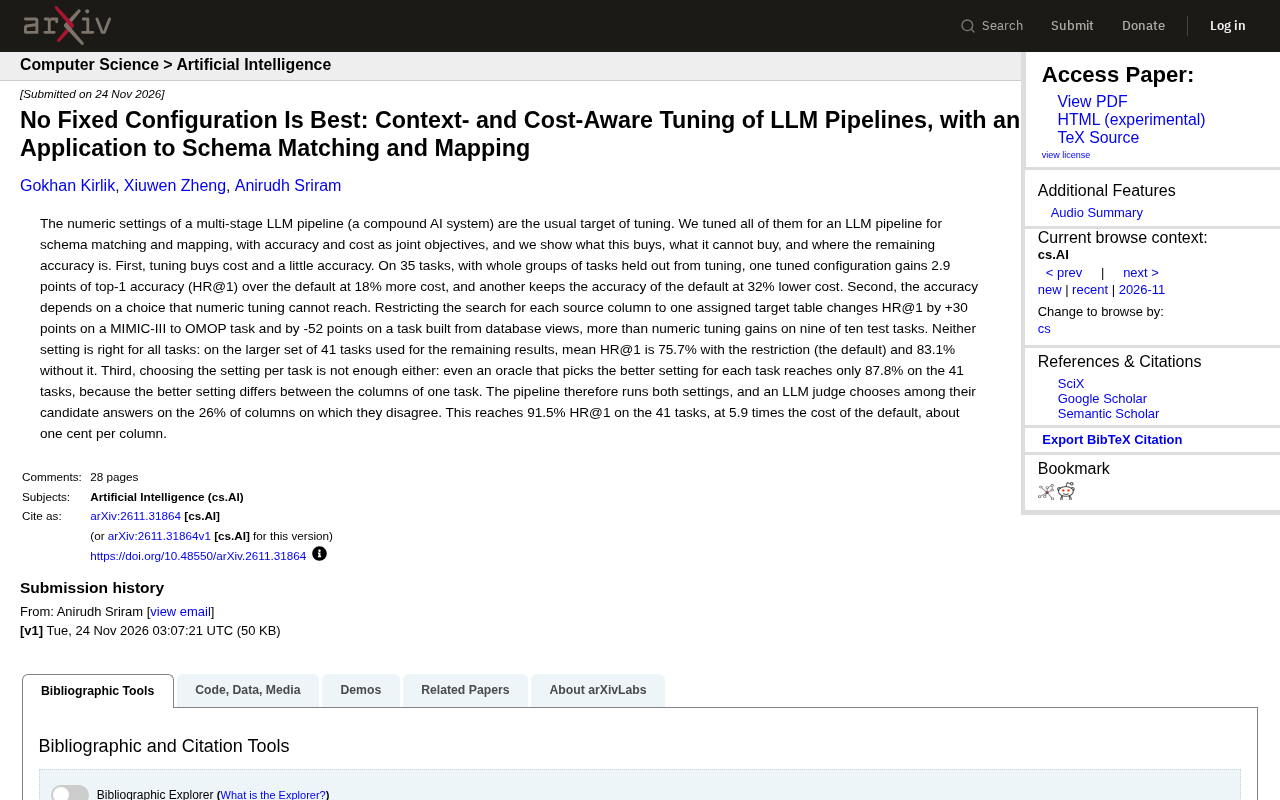
A systematic study of schema matching and mapping tasks evaluated tuning strategies for multi-stage LLM pipelines on 35 tasks. Numerical tuning mainly yields cost benefits: one configuration cuts cost by 32% while maintaining default accuracy, another trades 18% extra cost for a 2.9 pp HR@1 gain. However, structural choices—whether to constrain a target table per source column—far outweigh numerical tuning, producing +30 or -52 pp HR@1 changes across tasks, and no single setting is optimal. Even per-task optimal selection is insufficient due to column-level heterogeneity, with a task-level oracle reaching only 87.8% HR@1 on 41 tasks. The team designed a dual-setting parallel strategy with an LLM judge selecting among 26% disagreement columns, achieving 91.5% HR@1 at 5.9x default cost—about one cent per column.
Tuning Brought What: Cost and a Modest Accuracy Gain
The numerical parameters of multi-stage LLM pipelines (compound AI systems) are usually the primary target of tuning. But a systematic study of a schema matching and mapping task shows that numerical tuning yields limited gains, while structural choices that numerical tuning cannot reach—such as whether to constrain a target table for each source column—have a much larger impact on accuracy. The study ran experiments on 35 tasks and provides clear conclusions about cost, accuracy, and the sources of remaining accuracy.
The research team jointly tuned all numerical settings of the schema matching pipeline, with accuracy and cost as dual objectives. On 35 tasks, evaluated for generalization using a leave-one-task-out scheme, they obtained two valuable configurations: one raised top-1 accuracy (HR@1) by 2.9 percentage points over the default configuration at the cost of an 18% cost increase; the other maintained the default configuration's accuracy while reducing cost by 32%.
This means the main value of numerical tuning lies in cost control—you can significantly reduce cost without losing accuracy, or trade a moderate cost increase for a small accuracy gain. But the researchers explicitly note that the accuracy improvement tuning can buy is limited.
HR@1 (Hit Rate at 1) is a common evaluation metric in retrieval and matching tasks, referring to the proportion of samples where the model's top-ranked prediction hits the correct answer. In schema matching and mapping tasks, HR@1 directly reflects "top-choice correctness": if among the candidate targets the system returns for a source column, the top-ranked candidate happens to be the human-annotated correct target, that column counts as a hit. Compared with recall or MRR, HR@1 emphasizes top-1 precision and is friendlier to downstream automation. Since schema matching often requires human review, the higher the HR@1, the fewer columns need manual intervention, making this metric especially critical in cost-sensitive pipelines.
Leave-one-task-out is a cross-validation approach for evaluating generalization ability: each time, one complete task is held out as the test set while the remaining tasks are used for tuning or training, cycling through all tasks. Unlike randomly holding out samples, this approach tests how a configuration performs on unseen tasks, avoids data leakage within the same task, and better reflects the scenario of facing new mapping tasks in actual deployment.
The Key Choice That Numerical Tuning Cannot Reach
The study reveals a deeper issue: accuracy depends heavily on a choice that numerical tuning cannot reach—whether to constrain a designated target table for each source column. The impact of this structural decision far exceeds that of numerical tuning.
On a mapping task from MIMIC-III to OMOP, restricting each source column's search scope to a designated target table raised HR@1 by 30 percentage points; but on another task built on database views, the same restriction lowered HR@1 by 52 percentage points. This fluctuation exceeds the gains from numerical tuning on nine of ten tested tasks.
More critically, no single setting is optimal for all tasks. On the larger 41-task set used for subsequent results, the average HR@1 was 75.7% with the restriction (the default setting) and 83.1% without it. The researchers emphasize: "Neither setting is correct for all tasks."
MIMIC-III and OMOP are two widely used healthcare data standards. MIMIC-III is an intensive care database released by MIT and Beth Israel Deaconess Medical Center, containing large volumes of clinical records such as patients, admissions, diagnoses, and medications; OMOP is a common data model proposed by the Observational Health Data Sciences and Informatics (OHDSI) organization, designed to unify healthcare data from different sources into a standardized structure for cross-institutional research. Mapping MIMIC-III to OMOP is a typical schema matching task: columns in the source tables (such as patient IDs, medication codes, and diagnosis codes) must be matched to target columns in OMOP standard tables. In such tasks, whether to constrain a target table for each source column significantly changes the search space and matching difficulty.
A database view is a virtual table defined by a SQL query, whose columns are derived from underlying tables through joins, filters, and computations rather than directly corresponding to a single physical table. In mapping tasks built on views, source columns may come from combinations of multiple underlying tables, and forcing a single target table can exclude correct candidates—which explains why the same restriction strategy caused a sharp drop in HR@1 on that task.
Choosing Settings per Task Is Not Enough Either
Intuitively, since different tasks suit different settings, choosing the better setting for each task should solve the problem. But the study proves this is not enough either. Even with an "oracle" that picks the better setting for each task, only 87.8% HR@1 could be achieved on the 41 tasks.
The reason is that the better setting also varies across columns within the same task. In a given task, some columns are better suited to restricted search while others are not. This column-level heterogeneity makes task-level selection strategies unable to reach optimality.
Dual-Setting Parallelism with an LLM Judge
Based on these findings, the research team designed a new strategy: run both settings in parallel, then have an LLM judge choose the candidate answer on columns where the two settings disagree.
The two settings disagree on 26% of columns, and the LLM judge only makes selections on these disagreement columns. This approach achieved 91.5% HR@1 on the 41 tasks, at 5.9 times the cost of the default configuration—about one cent per column.
This result shows that acknowledging "no fixed configuration is optimal" and designing the system accordingly is more effective than trying to find a universal configuration. Although cost rises significantly, it brings a substantial accuracy improvement, and the cost remains at an acceptable magnitude.
LLM-as-a-judge refers to the method of using a large language model to evaluate or select candidate answers. In this study, the judge model does not regenerate answers; instead, on columns where the two settings disagree, it compares the two candidate targets and selects the more reasonable one. The advantage of this approach is that disagreement columns account for only 26%, so judge calls are limited and costs are controllable; meanwhile, the judge can make judgments based on column names, context, and the semantics of candidate targets, compensating for the shortcomings of fixed rules. It should be noted that LLM judges may themselves introduce bias, and their judgment quality depends on prompt design and model capability; the accuracy improvement in the study also includes the contribution of the judge's selections.
Implications for LLM Pipeline Design
This study offers several important lessons for the tuning practice of compound AI systems. Numerical tuning should be viewed as a cost optimization tool, not the primary means of improving accuracy. What truly affects accuracy are structural, context-dependent choices, which often cannot be reached by automatic tuning.
Second, context-aware tuning needs to be fine-grained to the column level rather than the task level. Only when the system can identify when to apply which setting and introduce a judgment mechanism at points of disagreement can it approach better accuracy.
Finally, the trade-off between cost and accuracy is not singular. The study demonstrates multiple operating points ranging from a 32% cost reduction to 91.5% accuracy, and the cost of about one cent per column provides a feasible economic reference for high-accuracy scenarios. For accuracy-sensitive tasks such as schema matching, this context- and cost-aware tuning strategy is worth learning from.
One-line Summary
A systematic study shows that structural choices in LLM pipelines have a greater impact on accuracy than numerical tuning, and dual settings plus an LLM judge can significantly improve accuracy.
Paragraph Summary
A systematic study of schema matching and mapping tasks evaluated tuning strategies for multi-stage LLM pipelines on 35 tasks. The study found that numerical tuning mainly brings cost benefits: one configuration maintains default accuracy while reducing cost by 32%, and another trades an 18% cost increase for a 2.9 percentage point HR@1 gain. However, structural choices—whether to constrain a target table for each source column—have a far greater impact on accuracy than numerical tuning, producing HR@1 changes of +30 or -52 percentage points across different tasks, and no single setting is optimal for all tasks. Even choosing the optimal setting per task is not enough, because the better setting varies across columns within the same task; a task-level oracle achieved only 87.8% HR@1 on 41 tasks. To address this, the research team designed a dual-setting parallel strategy with an LLM judge that selects among the 26% disagreement columns, achieving 91.5% HR@1 on 41 tasks at 5.9 times the default cost—about one cent per column.
Related articles

David Fincher's New Film Accused of Being AI-Generated? The Truth Behind the Controversy
David Fincher's new film *The Further Misadventures of Cliff Booth* is accused of using AI, with a carriage shot in the trailer sparking controversy. Netflix's acquisition of Ben Affleck's AI company and Fincher's own openness to AI keep suspicions alive. This article sorts out the controversy and the views of all sides.

FCC Clears SpaceX's Space-Based AI Data Centers: A Debate Over Regulatory Boundaries
The FCC approved SpaceX's plan to deploy AI data centers in space but dismissed opponents' key concerns about scientific research impacts as beyond its regulatory authority. This article analyzes the regulatory boundary issues behind the decision, the deeper tensions of space-based AI infrastructure, and its implications for the industry.

Why Are Latinos Nearly Half of the U.S. Border Patrol?
Latinos hold nearly half of the U.S. Border Patrol and about 30% of ICE. Vox's Khalil Green explores their motivations, identity tensions, and why enforcement work ≠ MAGA.