Not All Audio-Visual Pairs Align: CGAAL Uses Captions to Guide Contrastive Learning

CGAAL uses captions to estimate audio-visual alignment and weight positive samples, fixing pseudo-positives in contrastive learning.
Multimodal contrastive learning assumes paired audio and video are semantically consistent, but real-world voice-over and background music cause misalignment, while standard contrastive loss forcibly pulls these pseudo-positives together. The paper *Not All Pairs Align* proposes CGAAL, a model-agnostic objective that uses modality captions to estimate semantic agreement as an agreement score and weights each positive pair—highly aligned pairs get stronger contrastive signals, poorly aligned ones are attenuated. A two-stage strategy—warm-up with the standard objective, then gradual thresholding—introduces alignment-aware weighting. Applied to three baselines, it consistently improves audio-visual retrieval, validating that pairing does not equal alignment.
The Overlooked Assumption in Audio-Visual Contrastive Learning
Multimodal contrastive learning typically assumes a premise: paired audio and video describe the same thing. In datasets collected in controlled environments, this assumption largely holds. But the real world is not like that—the sound in a video may come from off-screen, may be background music, or may be irrelevant ambient noise. In such cases, audio and visuals are far apart semantically, yet standard contrastive loss forcibly pulls them together as equally aligned positive pairs.
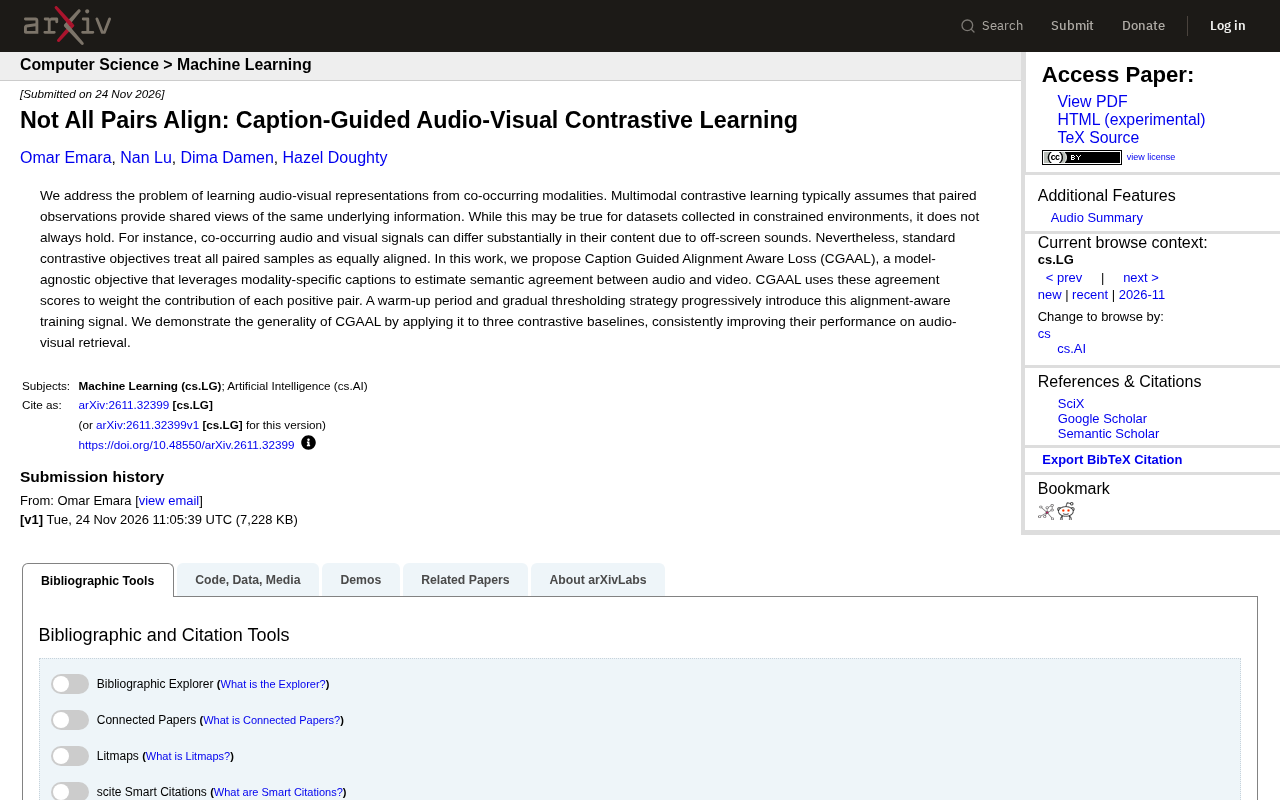
A recent arXiv paper, Not All Pairs Align: Caption-Guided Audio-Visual Contrastive Learning, directly targets this blind spot. The authors propose Caption Guided Alignment Aware Loss (CGAAL), a model-agnostic objective that uses modality-specific captions to estimate the degree of semantic agreement between audio and video, and weights each positive pair accordingly.
Multimodal contrastive learning is a class of self-supervised representation learning methods whose core idea is to treat different modalities of the same instance (e.g., audio and video) as positive pairs and modality combinations of different instances as negative pairs, using a contrastive loss (such as InfoNCE) to pull positive pairs closer and push negative pairs apart, thereby learning a semantically aligned cross-modal space. CLIP is its most famous representative (image-text pairs), while audio-visual contrastive learning transfers this paradigm to audio-visual data. Such methods rely on an implicit premise: paired data truly correspond semantically. However, phenomena such as voice-over, background music, and dubbing replacement are common in real videos, making this premise frequently fail, with large numbers of semantically misaligned "pseudo-positive samples" mixed into the positive pairs.
Core Idea: Making Alignment a Learnable Weight
The key design of CGAAL is "alignment awareness." Traditional contrastive loss treats all positive samples equally, whereas CGAAL introduces captions as a third-party signal, describing audio content and video content separately, then estimating the semantic agreement between the two through some mechanism to obtain an agreement score. The higher this score, the better the audio-visual content of the pair matches; the lower the score, the more it signals misalignment such as voice-over.
This agreement score is then used as a weight for positive pairs: highly aligned pairs receive a stronger contrastive signal, while poorly aligned pairs are attenuated. This way the model is not led astray by large numbers of semantically misaligned "pseudo-positive samples."
According to the paper, CGAAL is model-agnostic, meaning it can be applied to different contrastive learning baselines without changing the baseline model's architecture.
Model-agnostic refers to a method that does not depend on a specific network architecture or baseline implementation and can be applied as a general module to different models. In contrastive learning, a model-agnostic objective operates only at the loss level—for example, reweighting or filtering each sample pair—without changing architectural details such as the encoder or fusion method. CGAAL is exactly this kind of design: it estimates alignment via captions and adjusts positive-sample weights, so it can be directly inserted into different audio-visual contrastive baselines (such as those based on dual-stream encoders or cross-modal attention) without reconstructing the model itself. This low intrusiveness makes it easy to reuse and also makes the consistent gains in experiments more convincing—the gains come from the weighting mechanism, not from an accidental fit to a particular architecture.
Training Strategy: Warm-up and Gradual Thresholding
Enabling the weighting mechanism at full strength from the very start of training may cause instability. The authors therefore design a two-stage strategy.
Warm-up Period
In the early stage of training, the model first learns under the standard contrastive objective for a period to build basic audio-visual representation capability. This stage does not apply the alignment-aware signal, effectively giving the model a relatively stable starting point.
Gradual Thresholding
After warm-up, alignment-aware weighting is not introduced all at once but gradually via a gradual thresholding strategy. The threshold may serve to filter out sample pairs with excessively low agreement, and the gradual approach increases this filtering strength over time, avoiding insufficient effective samples in early training due to over-filtering.
Together, these two designs ensure smooth injection of the alignment-aware training signal.
Gradual thresholding is a training scheduling technique: gradually tightening filtering or weighting conditions during training rather than fixing them at once. A common practice is to let the threshold become progressively stricter with training steps, or to let the strength of alignment weighting grow smoothly from 0 to a target value. The motivation is to avoid premature removal of samples when the model's representations are not yet reliable in early training, which would lead to insufficient effective positive samples and sparse gradient signals. Combined with the warm-up period, gradual thresholding allows the alignment-aware signal to be injected smoothly, reducing training instability. Similar ideas appear in curriculum learning, pseudo-label filtering, and hard negative mining.
Experimental Validation: Consistent Gains Across Three Baselines
The paper's core experimental conclusion is that after applying CGAAL to three contrastive learning baselines, they all achieve consistent improvements in audio-visual retrieval performance. This "consistency" matters—it shows that the gains are not an accidental product of a particular architecture but come from the general mechanism of alignment weighting itself.
Audio-visual retrieval is a classic downstream task for testing representation quality: given an audio clip, retrieve the corresponding video, or vice versa. If the model has learned truly cross-modally corresponding semantics, retrieval accuracy will improve; if it is disturbed by misaligned samples, retrieval performance will suffer. CGAAL's stable gains on this task indirectly validate the judgment that "not all pairs deserve equal treatment."
Audio-visual retrieval is a classic downstream task for evaluating cross-modal representation quality, typically including two directions: audio-to-video (A→V) and video-to-audio (V→A): given a query audio, rank candidate videos by representation similarity to retrieve the semantically corresponding video, and vice versa. The commonly used metric is Recall@K (such as R@1, R@5, R@10), i.e., the proportion of cases where the correct match appears in the top K results. If the model has learned truly cross-modally corresponding semantics, correct pairs will be closer in the similarity space, and retrieval metrics will improve accordingly; if representations are disturbed by semantically misaligned pseudo-positive samples, retrieval performance will decline. Therefore, this task can indirectly test whether alignment weighting effectively improves representation quality.
Takeaways Worth Noting
This work reveals a widely overlooked data quality issue: "pairing" in multimodal datasets does not equal "alignment." Scenarios such as voice-over, background sound, and dubbing replacement are extremely common in real videos, and most contrastive learning methods are completely unprepared for them.
Using captions as an estimator of alignment is a lightweight and practical choice. Captions themselves carry modality-specific semantic descriptions, which are closer to human judgment than directly comparing audio and video features. Of course, this also means the method's effectiveness depends on caption quality, and how to generalize it to data lacking captions is a direction worth observing in follow-up work.
For researchers and engineers working on multimodal retrieval and audio-visual understanding, CGAAL offers a plug-and-play training technique rather than a complex solution requiring model reconstruction. This low intrusiveness is one reason it works across multiple baselines.
One-line Summary
CGAAL uses captions to estimate audio-visual alignment and weight positive samples, addressing the pseudo-positive problem in contrastive learning.
Paragraph Summary
Multimodal contrastive learning assumes that paired audio and video are semantically consistent, but in real videos, voice-over, background music, and the like cause audio-visual misalignment, while standard contrastive loss forcibly pulls these pseudo-positive samples together. The paper Not All Pairs Align proposes Caption Guided Alignment Aware Loss (CGAAL), a model-agnostic objective: it uses modality-specific captions to describe audio and video content separately, estimates their semantic agreement as an agreement score, and weights each positive pair accordingly—highly aligned pairs receive a stronger contrastive signal, while poorly aligned ones are attenuated. To avoid training instability, the authors design a two-stage strategy: first warm up with the standard contrastive objective, then gradually introduce alignment-aware weighting via gradual thresholding. Applying CGAAL to three contrastive learning baselines yields consistent improvements in audio-visual retrieval performance, validating the overlooked data quality issue that "pairing does not equal alignment."
Related articles

Pure-Code Video Generation Tested: Which AI Model Actually Follows Instructions?
A Bilibili creator tested three AI models' pure-code video generation with unified prompts and three revisions each: Xiaonaomao has a high ceiling but lacks stability, GPT 6.2 Extra models well but only follows half the instructions, and OPAS 5.5 remains the benchmark.

GPT-6 Six-Tier Hands-On Test: Astra Ultra Dominates but Bills Double
GPT-6 six-tier test: Astra Ultra sweeps 3:0 in 3D tasks thanks to sub-agents and runs 14% faster, but hidden backend bills make its real cost 2.6x single-threaded.

GPT-6.2 Astra vs Fable 5.2: Huge Cost-Efficiency Gap Across 12 Real-World Tests
Bilibili creator tests GPT-6.2 Astra vs Fable 5.2 across 12 real tasks: Fable wins 7-5 but costs 7.2x more and takes nearly 5x longer. Token efficiency emerges as the key selection metric.