Nothing Ear Note Launched: Earbuds + Charging Case Deliver AI Transcription
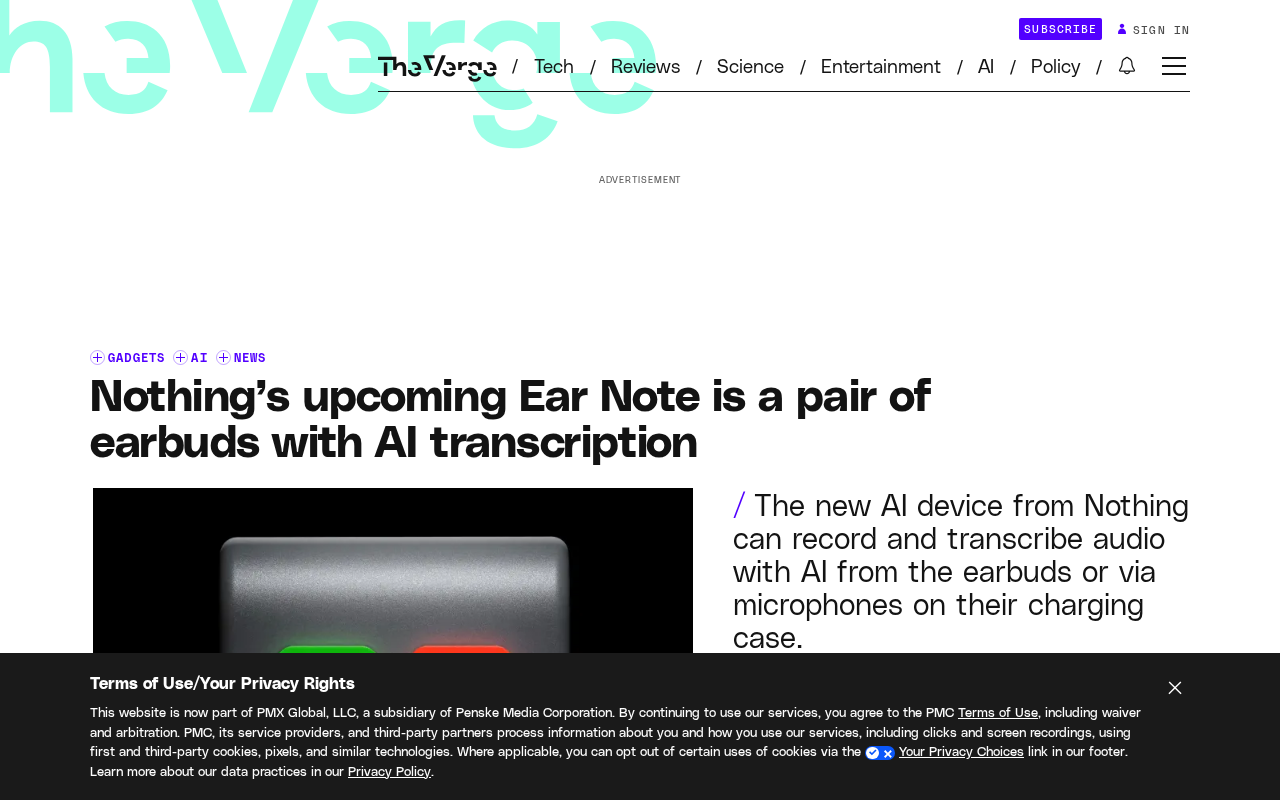
Nothing launches Ear Note, using a microphone-equipped charging case for recording and AI transcription.
Nothing is about to launch Ear Note, consisting of earbuds and a microphone-equipped charging case. Its uniqueness lies in the functional split: earbuds handle audio playback while the case serves as the hardware core for recording and transcription—users simply set the case down to record. The companion app manages recordings, edits transcripts, and invokes AI summaries, forming a "hardware capture + software organization" combination. Similar to Apple Watch's transcription and Amazon Bee, it positions as a lightweight AI recording tool. Nothing's differentiation may lie in price and design, but transcription accuracy, supported languages, pricing, and release date remain undisclosed.
Nothing is stuffing AI transcription capabilities into an earbuds case. According to official information, its upcoming new device is called Ear Note, consisting of a pair of earbuds and a charging case with a built-in microphone, capable of recording and transcribing conversations. The companion app manages recordings, transcribed text, and AI-generated summaries.
Product Form Factor: Earbuds for Wearing, Transcription Handled by the Case
What makes Ear Note unique is its functional split: the earbuds handle everyday audio playback, while the microphone-equipped charging case becomes the hardware core for recording and transcription. This design means users don't need a complex pickup array integrated into the earbuds—the charging case itself is an independent recording terminal.
Nothing CEO Carl Pei personally demonstrated the device. From the demo, Ear Note's usage logic leans toward "set the case down and it records," rather than relying on the earbuds themselves for continuous audio pickup. For scenarios like meetings and classes that require long recording sessions, this may be more practical than built-in earbud microphones.
Companion App: One-Stop Management of Recording, Transcription, and Summaries
The app paired with Ear Note handles the back-end work. Users can view recording files, edit transcribed text, and invoke AI to generate summaries within the app. This "hardware capture + software organization" combination is similar in approach to Apple's recently launched transcription feature on the Watch, and also brings to mind wearable recording devices like Amazon Bee.
Nothing did not disclose in its materials the transcription accuracy rate, the number of supported languages, or the specific model used for summary generation. What is certain, however, is that AI summaries are presented as a core selling point rather than an add-on feature.
Speech-to-Text refers to the technology that automatically converts spoken content in audio into written text, typically implemented based on end-to-end deep learning models (such as Whisper-style architectures). Its core metrics include word error rate (WER), the number of supported languages, robustness to background noise and accents, and real-time performance (latency). In actual products, transcription is also divided into online and offline modes: online mode relies on cloud computing power, typically with higher accuracy but requiring a network connection; offline mode performs inference locally on the device, offering better privacy but limited by chip computing power. The transcribed text is then fed into a large language model for post-processing such as summarization and extracting to-do items—this is precisely the technical foundation for Ear Note positioning "AI summaries" as a core selling point.
Market Positioning: Competition in Lightweight AI Recording Tools Heats Up
Ear Note is entering a track that is getting crowded. Apple has added transcription capabilities to the Watch, Amazon's Bee wearable focuses on conversation recording, and Nothing has chosen to enter through earbuds and charging case. What all three have in common: they don't pursue the hardware specs of professional voice recorders, but instead use consumer-grade devices + AI post-processing to lower the barrier to recording.
Nothing's differentiation may lie in price and design. The brand is known for its transparent casing and highly recognizable industrial design. If Ear Note continues this style, it will have an aesthetic advantage among similar products. However, the materials do not provide pricing or release date, and these two pieces of information will directly affect its competitiveness.
Amazon Bee is a wearable conversation recording device launched by Amazon, shaped like a clip-on microphone or wristband, wearable on clothing, continuously capturing surrounding speech, and performing transcription and summarization through a companion app. Its positioning differs from professional voice recorders, emphasizing "imperceptible wearing, everyday recording," relying on cloud AI to complete speech-to-text and key point extraction. Bee's emergence has to some extent defined the "consumer-grade AI recorder" category: hardware is only responsible for capture, and the value is mainly reflected by the back-end transcription and summarization capabilities. Nothing Ear Note shares a similar approach, but moves the capture end from an independent wearable device to the earbuds charging case, attempting to leverage the earbuds' existing user base to lower the barrier to use.
Key Questions to Be Verified
Ear Note's actual experience depends on several details not yet disclosed: how high the transcription latency is, whether it works offline, the quality of AI summaries, and whether recordings are stored locally or in the cloud. Carl Pei's demo showed that the features exist, but did not demonstrate stability under large-scale use.
For users interested in AI hardware, Ear Note is worth watching, but before full reviews are available, it's advisable to hold off.
The storage location and privacy handling of recording data are key variables for such devices. If recordings are uploaded to the cloud, manufacturers need to clarify data retention periods, whether data is used for model training, and encryption methods; if processed locally, it is limited by device computing power, and transcription quality and supported languages may be compromised. Additionally, whether it works offline is an important dividing line: cloud-dependent solutions may fail in weak-network environments like meeting rooms, while fully local solutions struggle to support high-quality multilingual transcription. These details directly determine Ear Note's usability in long recording scenarios such as classes and meetings, and are also aspects that need to be specifically verified in reviews.
One-line Summary
Nothing launches Ear Note, using a microphone-equipped charging case for recording and AI transcription.
Paragraph Summary
Nothing is about to launch a new device called Ear Note, consisting of a pair of earbuds and a charging case with a built-in microphone. Its uniqueness lies in the functional split: the earbuds handle audio playback, while the charging case serves as the hardware core for recording and transcription—users simply set the case down to record. The companion app manages recording files, edits transcribed text, and invokes AI to generate summaries, forming a "hardware capture + software organization" combination. The product is similar in approach to Apple Watch's transcription feature and Amazon Bee wearable recording device, positioning itself as a lightweight AI recording tool. Nothing's differentiation may lie in price and design, but transcription accuracy, supported languages, pricing, and release date have not been disclosed, and actual experience remains to be verified.
Related articles

Developer Naming Woes: The Technical Names That Drive Us Crazy
Why is technical naming so maddening? From Nginx and Vite to Qt and Sudo, a YouTube creator rants about the chaos of developer naming and pronunciation, revealing the tug-of-war between creators' intentions and community habits, and the cultural roots behind spelling traps like PyPI and GNOME.

Figma Workplace Scandal: Employee Sues CEO for Forcing Confrontation with Harasser
Figma and its CEO are sued by a current employee alleging sexual harassment and discrimination, and forcing the victim to confront her harasser. This article outlines the background, potential impact, and industry reflection.

Jensen Huang and Nvidia: Elite Privilege Behind the Revolving Door of Business and Politics
An opinion piece uses Jensen Huang's reappointment as Nvidia CEO to examine business-government ties and elite impunity, questioning free-market ideals and AI industry governance.