NTangible: Using Data to Predict an Athlete's 'Clutch' Ability

NTangible builds an analytics platform to quantify athletes' clutch factor under pressure, but predictive validity remains unverified.
NTangible is building an analytics platform for college sports organizations to quantify athletes' 'clutch' factor under high pressure—the deviation between actual and expected performance. It targets college sports during a datafication wave, where teams lack the ability to turn data into insight. However, clutch predictability is academically disputed, and NTangible must provide empirical validation. The platform model faces cross-sport adaptation and competition from giants, with first-mover durability depending on technical moats and customer stickiness.
Performance under pressure has always been one of the hardest things to quantify in sports. A player who shoots 80% in practice might miss consecutive shots in a decisive moment; another who is unremarkable in regulation time might sink a buzzer-beater with three seconds left. This trait, known as "clutch" ability, has long been judged only by coaches' intuition and fans' memories.
NTangible wants to change that. The company is building an analytics platform for college sports organizations and other clubs, with a core goal of measuring an athlete's "clutch" factor—the deviation between an athlete's actual performance and expected performance in high-pressure situations.
What Is the 'Clutch' Factor
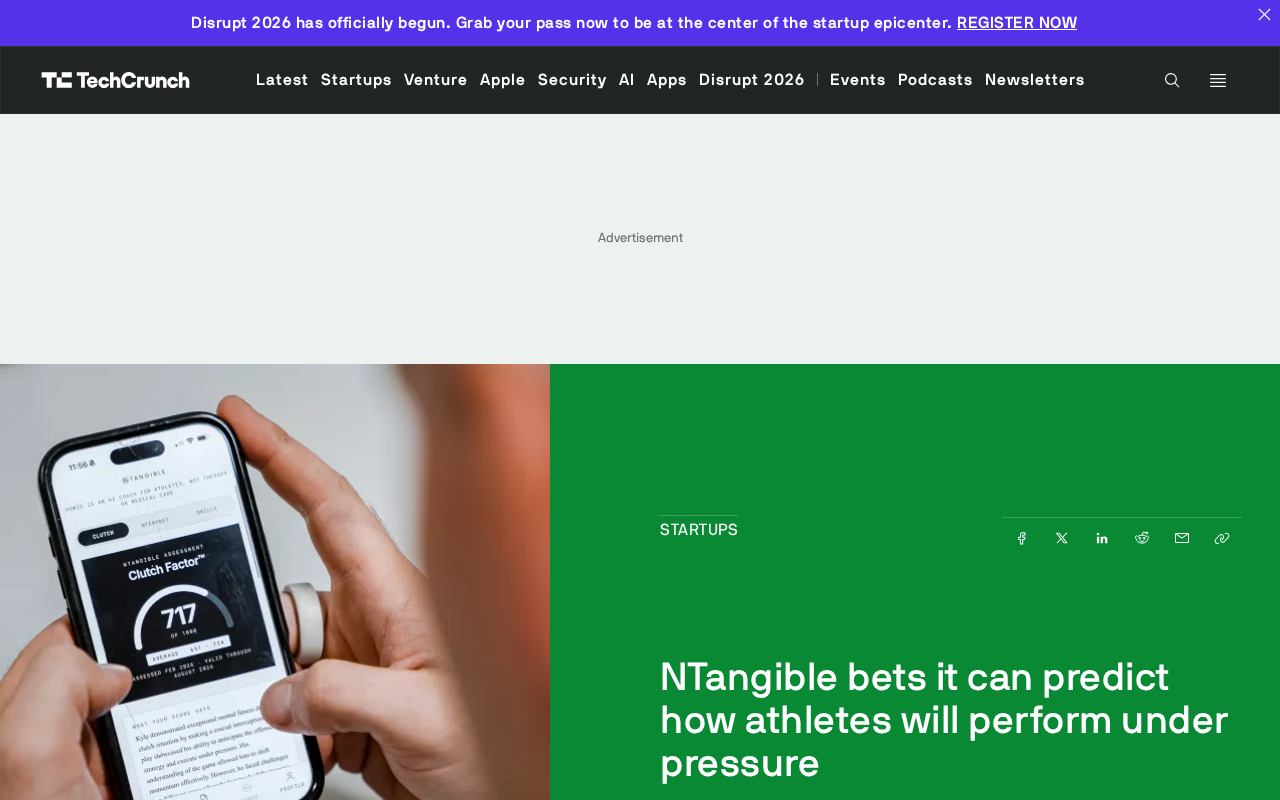
In the world of sports analytics, "clutch" has always been a fuzzy concept. Traditional data can tell you a player's points per game and shooting percentage, but it cannot distinguish the situations in which those numbers were produced. A three-pointer when down by 5 with two minutes left in the fourth quarter and a three-pointer at the start of the first quarter look identical on a stat sheet, but their actual value is worlds apart.
NTangible's approach is to build a contextualized evaluation system. The platform tracks an athlete's performance data in key moments and compares it with baseline performance. If a player performs significantly better under high pressure than at their normal level, their "clutch" factor is high; otherwise, it is low.
The idea is not complicated, but executing it requires solving several problems: How do you define a "key moment"? How do you eliminate the statistical noise caused by insufficient sample size? How do you establish comparable standards across different sports? The answers to these questions form NTangible's technical moat.
Statistical Noise and the Sample Size Problem: When evaluating the "clutch" factor, one of the biggest technical obstacles is insufficient sample size. A player may get only a few dozen truly meaningful clutch opportunities over an entire season, and across those few dozen shots, fluctuations in shooting percentage may be driven entirely by randomness. Suppose a player shoots 45% in clutch moments and 40% overall—that 5-percentage-point difference over 30 attempts is very likely just statistical noise and does not represent true "clutch ability." To solve this problem, methods such as Bayesian shrinkage are typically used to "shrink" a player's clutch performance toward their long-term average in order to reduce estimation bias from small samples. In addition, effective sample size can be increased by expanding the time window (aggregating across seasons) or introducing contextual weights. If NTangible wants to claim that its model has predictive power, it must disclose its specific methods for handling insufficient sample size; otherwise, the so-called "clutch index" may simply be a repackaging of random fluctuations.
The Datafication Wave in College Sports
NTangible's choice of college sports organizations as its entry point is worth pondering. Over the past few years, college sports has been undergoing a data-driven transformation. The spread of player tracking technology, wearable devices, and video analysis tools has allowed teams to collect data at an unprecedented level of granularity. But richer data does not automatically equal richer insight—most teams lack the ability to turn that data into decisions.
This is exactly the gap NTangible is trying to fill. For college team coaches, recruiting decisions often determine a team's competitiveness for years to come. If they can use the "clutch" factor to identify players who can still perform consistently under pressure, they can gain an information advantage in recruiting. Likewise, rotation decisions and tactical setups during games can be based on these data to make more rational judgments.
Interestingly (not mentioned in the original article; this is analysis), similar attempts have already been made in professional sports, such as NBA teams using tracking data to evaluate players' shooting performance under defensive pressure. But the data infrastructure in college sports is relatively weak, and if NTangible can provide an out-of-the-box solution, there is indeed market space.
Player Tracking Technology and Wearable Devices: The player tracking technology mentioned in the article usually refers to optical- or radio-frequency-based positioning systems (such as Hawk-Eye, Catapult, etc.), which can collect physical data such as distance run, speed, acceleration, and heart rate in real time. In college sports, these technologies were previously mainly seen in top-tier football and basketball programs, but in recent years falling costs have made them increasingly widespread. Wearable devices (such as GPS vests and heart rate straps) further provide capabilities for load management and fatigue monitoring. These data streams lay the foundation for contextualized analysis—for example, determining whether a player's performance decline late in a game is caused by fatigue. However, these data alone do not directly reveal "clutch" ability; they need to be fused with event data (shots, passes, turnovers) and game context (score differential, time remaining). If NTangible's platform can integrate multi-source data and extract performance deviations under pressure, its technical moat lies in the precision of data fusion and contextual modeling.
The Validation Challenge for Predictive Ability
The core capability NTangible claims is "predicting" how athletes will perform under pressure, but there is a fundamental challenge here: the predictability of clutch performance is itself a controversial topic.
The sports statistics academic community has debated this for a long time. Some researchers believe clutch ability is a stable personal trait that remains consistent across seasons; others believe that so-called clutch performance is largely random fluctuation amplified by hindsight narratives—the highlight moments of those "clutch players" may simply be statistical coincidences under small samples.
Whether NTangible can prove the predictive power of its model will determine the platform's long-term value. If it merely repackages existing data into a "clutch index," its value is limited; if it can truly identify athletes whose performance changes systematically under pressure, and if that identification remains stable over time, then it has solved a real problem.
Based on currently public information, NTangible's specific methodology and validation results remain unclear. The platform's technical details, model architecture, and validation methods have yet to be disclosed. For potential customers, it is reasonable to demand empirical evidence of predictive power before committing budget.
The Academic Controversy Over Predictability and Empirical Methods: The sports statistics community has long debated whether "clutch ability" exists in a stable form. Supporters often cite players (such as NBA stars Ray Allen and Kobe Bryant) who performed exceptionally well over long periods in key moments, arguing that this is a transferable trait. Opponents point out that these cases involve selection bias—we remember the successful "clutch players" while ignoring the many players who performed averagely or failed in key moments. To test predictability, split-half reliability or year-to-year correlation analysis is usually needed: if a player's clutch performance shows a significant positive correlation between the first and second halves of a season, or between one season and the next, then the ability can be considered stable. In addition, cross-validation can be used to test the model's predictive power on unseen data. If NTangible wants to prove its value, it must disclose such validation results, not merely showcase retrospective cases.
Platformization Path and Competitive Landscape
NTangible positions itself as an analytics platform rather than an internal tool for a single team. This means its business model is to provide services to multiple organizations and spread R&D costs through economies of scale.
The advantage of this path is a larger market, but the challenges are also obvious. Different sports, different teams, and different coaches define and value "clutch" differently. The platform needs enough flexibility to accommodate these differences while maintaining cross-context comparability of its core metrics.
Another variable is how existing sports analytics companies will respond. Large sports data companies have richer data sources and more mature customer relationships, and if clutch analysis proves to have market demand, it is only a matter of time before they follow suit. How long NTangible's first-mover advantage can last depends on how deep its technical moat is and whether it can build sufficiently strong customer stickiness before the giants enter.
For those following sports tech and AI applications, NTangible's direction is worth tracking. It is trying to use data to answer an age-old question: Who can step up under pressure? The answer to this question has tangible value for both team management and athlete evaluation. But until the word "predict" is truly validated, cautious optimism is the more appropriate attitude.
First-Mover Advantage and Technical Moats: In sports analytics, first-mover advantage is often less durable than in industries with strong network effects. Sports data companies (such as Sportradar and Stats Perform) have vast data collection networks and long-term customer contracts, and once they decide to enter the clutch analytics market, they can quickly replicate features and bundle them into sales. NTangible's moat may come from two sources: proprietary contextual models and validation methods, and deep integration relationships with college sports organizations. But the college sports market is relatively fragmented, has long decision cycles, and has limited budgets, which both gives startups opportunities and limits rapid expansion. In addition, different sports (basketball, football, soccer, etc.) define "clutch" very differently, and the platform needs to customize models for each sport, increasing R&D costs while also creating a potential moat. Ultimately, whether NTangible can build enough customer stickiness and data accumulation before the giants enter will determine its long-term viability.
One-line Summary
NTangible is building an analytics platform to quantify athletes' clutch factor under pressure, but its predictive power remains unverified.
Paragraph Summary
NTangible is building an analytics platform for college sports organizations aimed at quantifying athletes' "clutch" factor under high pressure—the deviation between actual and expected performance. It targets college sports by exploiting the gap left by teams' inability to extract insight from data during the datafication wave. However, the predictability of clutch performance is academically disputed, and NTangible must provide empirical evidence of its model's predictive power. Its platform business model faces challenges such as cross-sport adaptation and competition from existing giants, and the durability of its first-mover advantage depends on technical moats and customer stickiness. Overall, the article takes a cautiously optimistic view of NTangible's direction, arguing for a wait-and-see attitude until its "prediction" claims are validated.
Related articles

Bilibili's Hit Dify Tutorial: A Practical Guide to Building 20+ AI Apps from Scratch
A distilled guide to Bilibili's top-rated Dify tutorial: Windows + Docker deployment, MySQL connection, five app types, model integration strategy, and publishing.

Agent Skills Beginner's Guide: From Concepts to Multi-Agent Collaboration in Practice
A comprehensive guide to Agent Skills: core concepts, components, the importance of Description, standardization, beginner learning paths, and multi-agent collaboration.

One Neuron Detects Both Cats and Cars? We Reproduced It and Found a New Explanation
The cat-car neuron reinterpreted: researcher Cammarata argues it distinguishes pointy from round, not cats from cars. We reproduced the experiment and found the new explanation holds on most inputs—but cars are the exception. The interpretability debate continues on language models.