Nvidia Accused of 'Feeding Customers' to Manufacture Shortages: The Other Side of the AI Chip Boom

Nvidia accused of investing in AI startups to help them buy its GPUs, creating a false appearance of chip scarcity.
The article centers on a low-traffic Hacker News post: Nvidia is accused of investing in AI startups and having them use the funds to buy its GPUs, forming a closed funding loop that amplifies demand signals, worsens chip shortages, and boosts pricing power. The author notes that supplier investment in customers is common collaboration in the semiconductor industry; what truly deserves scrutiny is when funding flows and procurement flows highly overlap in a supply-constrained category. If the pattern holds, AI teams without such investment will face raised computing barriers, and competition will shift from products to supply chain relationships. But the accusation remains at the 'accused' level with no verifiable details, and 4 points with zero comments on HN reflects that the community hasn't reached consensus. The author suggests treating it as an industry structure reminder rather than a moral judgment, noting observable indicators include timing between funding and procurement announcements, contract structures, and secondary GPU market prices.
When the 'Shovel Seller' Starts Handing Out Money to the Gold Miners
According to a discussion that surfaced on Hacker News, Nvidia has been accused of funding AI startups to help them buy its own GPUs, thereby artificially creating a chip shortage. The post itself didn't gain much traction on HN—just 4 points and zero comments—but it touches on a sharp question: when a company is both supplier and financier, are market signals still reliable?
This isn't an isolated technical topic; it's a question about the structure of the AI industry chain. Understanding it requires looking away from the chips themselves and toward where the chips flow and how the money flows back.
The Core Logic of the Accusation: A Closed Funding Loop
The structure of the accusation isn't complicated: Nvidia invests in AI startups, those startups use the funds to purchase Nvidia GPUs, demand is amplified, supply appears even tighter, and prices and bargaining power are pushed higher. In this loop, the same money circulates once between the 'investment' and 'revenue' ledgers, but on the market it gets counted as demand twice.
It should be noted that the publicly available information only goes as far as 'accused'—there's a lack of details that can be independently verified. The absence of discussion on HN also suggests the community hasn't yet formed a stable consensus on the topic. Treating it as a reflective industry observation is more appropriate than treating it as a confirmed conclusion.
Circular trading in financial and regulatory contexts refers to situations where two or more parties have mutual flows of funds or business, causing the same money to circulate among related parties and thereby producing inflated revenue or demand on the books. Typical forms include a supplier investing in a customer who then buys back the supplier's products, or related companies purchasing from each other. Such transactions aren't necessarily illegal, but without sufficient disclosure they blur the true signals of market demand. In accounting, related-party transactions usually require separate disclosure, but investment and procurement fall under different financial statement items, and the causal link between them often falls outside mandatory disclosure requirements—which is precisely why external observers find it hard to verify.
Why Circular Trading Deserves Scrutiny
In the semiconductor industry, suppliers investing in downstream customers is nothing new. Chipmakers have long bound major customers through strategic investments, joint R&D, and capacity pre-booking—this is normal industry collaboration. What truly deserves scrutiny is when the flow of funds and the flow of procurement highly overlap, and when this overlap occurs in a category where supply itself is constrained.
GPU production capacity is limited by advanced process nodes, packaging capabilities, and other factors, making rapid expansion difficult in the short term. When part of the demand side comes from the supplier's own money, the demand curve the market sees gets lifted while the supply curve barely moves. The result is an amplified shortage signal—and that's precisely where pricing power comes from. This model isn't financially improper, but it creates noise in the interpretation of market signals.
The physical roots of GPU supply constraints lie in two areas: advanced process nodes and advanced packaging. Current high-end GPUs rely on TSMC's 4N/3N-class processes, while 2.5D advanced packaging capacity such as CoWoS (Chip on Wafer on Substrate) has long been a bottleneck, with expansion cycles measured in quarters or even years. Additionally, HBM high-bandwidth memory supply is concentrated among a few manufacturers. This means that even if demand signals are genuine, the supply curve is nearly vertical in the short term, and any additional demand gets amplified into a price signal. When that additional demand may come from the supplier's own funds, the gap between shortage signals and real supply-demand becomes even harder to discern.
The Real Impact on the AI Startup Ecosystem
If this pattern holds, the first to be affected are AI teams that haven't received Nvidia funding and don't have substantial cash reserves. They face a raised barrier to entry: rising computing costs, narrowing room for negotiation, while competitors may be getting chips 'with rebates.'
This shifts the competitive dimension of AI startups—from a contest of models and products, partly toward relationships with upstream suppliers. For the ecosystem, this means the innovation筛选 mechanism gets distorted by supply chain position—precisely what venture capital is supposed to avoid.
Strategic investment (CVC) and procurement bundling have a long history in the semiconductor industry. Intel, Qualcomm, Samsung, and others all have corporate venture arms that cultivate ecosystems and secure capacity by investing in downstream application companies. Under normal circumstances, such investments aim to support customer growth and generate financial returns, with procurement being one result of the investment rather than its purpose. But when investment amounts are highly correlated with the investee's procurement amounts, or when investment terms implicitly include procurement commitments, strategic investment can evolve into disguised sales financing. The key to distinguishing the two lies in whether investment decisions are independent of procurement behavior, and whether the investee has genuine alternatives.
How to View Such Accusations
Without more sufficient evidence, the more prudent attitude is to treat this as a reminder about industry structure rather than a moral judgment. Suppliers investing in customers can be entirely compliant technically, and disclosure requirements don't necessarily mandate explaining the link between fund usage and procurement behavior.
The truly observable indicators are: the timing relationship between startup funding announcements and computing procurement announcements, the contract structure between investors and investees, and price trends in the secondary GPU market. Most of this information isn't public, so outside judgment can only remain at the level of speculation. This also explains why this news, despite being logically sound, hasn't generated large-scale community discussion.
Conclusion
The scarcity of AI chips is partly determined by physical capacity and partly shaped, perhaps, by funding structures. Distinguishing between the two is important for assessing the true quality of the industry's prosperity. When the 'shovel seller' starts handing out money to the gold miners, the gold rush's excitement gains an extra layer that needs to be discerned.
Related articles
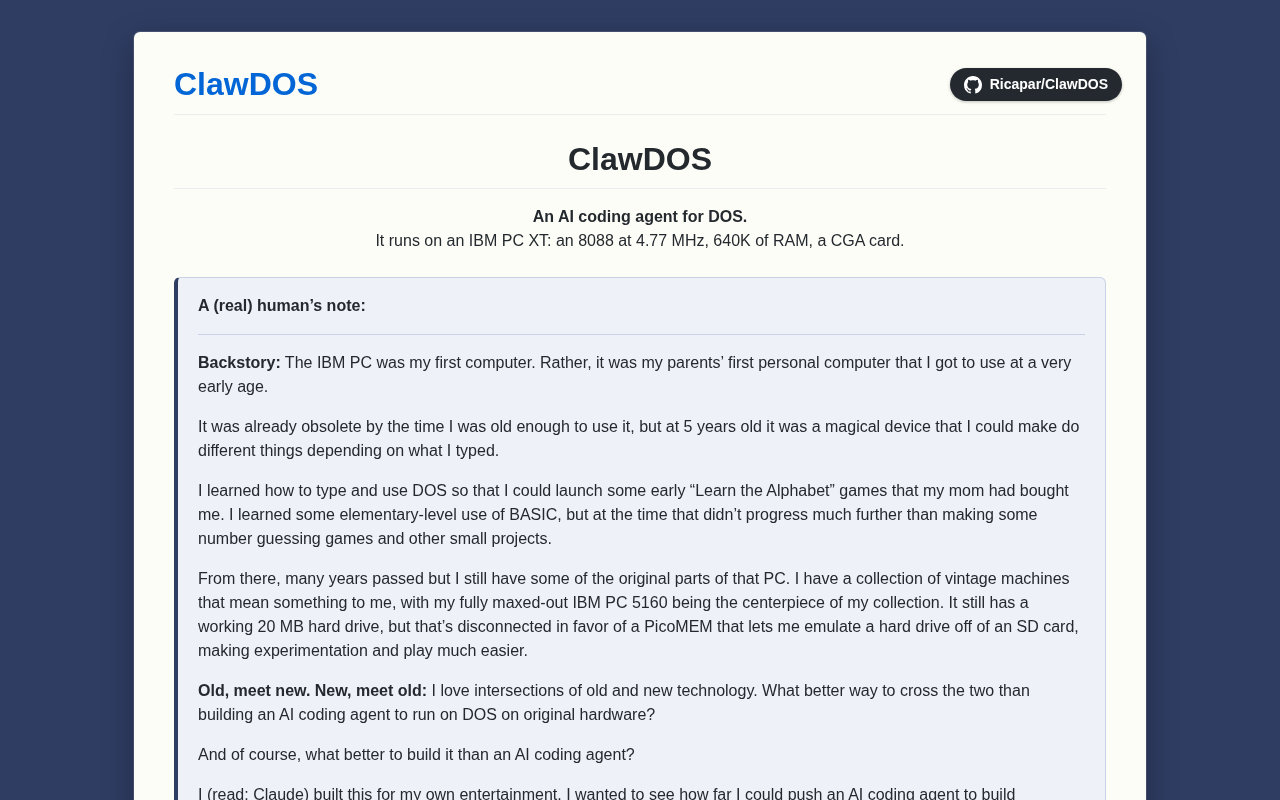
ClawDOS: Bringing AI Coding Capabilities to DOS
ClawDOS is an AI coding agent project for DOS, exploring the possibility of bringing AI coding assistance into resource-constrained retro computing environments. This article analyzes its positioning, use cases, and community response.

Baseten Releases Bison-1 and Groundhog-1, Topping the Decision Model Leaderboard
Baseten releases open-weight decision models bison-1 and groundhog-1 built on Gemma 4; bison-1 scores 76 on the AA Decision Index v2.1 to top the leaderboard. Both support 128k context and image input—here we analyze their capability combination, benchmark significance, and selection advice for developers.

Cline CLI v3.0.75 Released: Yolo Mode Now Default for One-Shot Runs
Cline CLI v3.0.75: one-shot runs now default to yolo mode, --timeout and Ctrl+C can interrupt the first round, read_files is no longer truncated to 8k chars, plus reasoning parameter fixes and 94 new providers.