NVIDIA Isaac for Healthcare: Training Medical Robots with GPU-Accelerated Medical Physics Simulation
NVIDIA Isaac for Healthcare uses GPU simulation and generative world models to solve the data scarcity problem in medical robot training.
The training bottleneck for medical robots isn't image recognition — it's the extreme scarcity of physical interaction data between robots and the human body. NVIDIA Isaac for Healthcare addresses this through three layers: converting patient imaging into digital twins expanded across diverse anatomical distributions; leveraging GPU-accelerated parallel simulation to auto-generate precisely annotated perception data frame by frame; and combining classical physics solvers with Cosmos generative world models for a complete simulation loop covering surgical robots, endoscopy, vascular intervention, and robotic ultrasound.
Medical robots, like surgeons, learn from experience. But there's a fundamental problem — the data needed to train them barely exists. Real clinical data is scarce and fragmented, often locked within individual institutions; building physical prototypes is slow and doesn't scale; and policies learned through imitation still require extensive trial and error before they become truly reliable. NVIDIA's newly launched Isaac for Healthcare medical physics simulation platform is designed to fill the most critical gap in this chain.
The Data Problem in Medical Robot Training
Before a robot ever enters the clinic, the hardest challenge isn't teaching it to interpret images — it's teaching it to understand physical interactions with the human body. How an instrument compresses tissue, and how tissue pushes back against the instrument: this kind of interaction data is nearly impossible to collect at scale in the real world.
NVIDIA's approach is to move the entire pipeline into simulation: digital twins of anatomical structures, sensor simulation for perception, and policy models that learn from both. The missing piece now being addressed is medical physics simulation — using both classical physics and generative methods to faithfully model the physical interactions between robots and the human body.
From Digital Twins to Anatomical Distributions
The entire workflow begins with a digital twin. Patient data is converted into simulation-ready anatomical structures, which are then expanded into a full "distribution of anatomy" — a virtual population spanning different body types and anatomical variations — used to stress-test policies.
Critically, these diverse anatomical models can come from existing scan data you already have, or they can be generated from scratch. This means that even with a limited set of real samples, you can derive a test cohort that far exceeds what real-world data collection could ever produce.
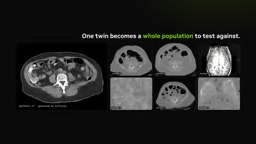
In the medical context, a digital twin refers to an individualized 3D anatomical model reconstructed from real patient imaging data (such as CT or MRI scans), capable of mapping real anatomical states in real time or offline. Extending a single patient digital twin into an "anatomical distribution" is essentially a data augmentation strategy: using parametric deformation, Statistical Shape Models, or generative models to synthesize virtual individuals covering different body types, organ positions, and pathological variations from the original scan data. This is critical for validating the robustness of robot policies — a policy trained only on a single anatomical form is likely to fail when encountering real patients with significant physical differences. Simulation testing across a broad anatomical distribution allows systematic exposure of policy edge cases in the pre-clinical stage, reducing post-market safety risks.
A GPU Physics Engine Running Frame by Frame
With anatomical models in place, physics simulation runs frame by frame: instruments and tissue push against each other in each frame, driven by real GPU-accelerated mechanics calculations. Today, these interactions can be driven by a human operator; tomorrow, they will be executed autonomously by a policy model.
Every interaction simultaneously generates perception data. Whether the robot "sees" X-ray, ultrasound, or camera images, all are rendered frame by frame from the same simulation state. This means every image is precisely paired with the true state that produced it — exactly the kind of perfect ground truth that is most valuable for training perception models, yet nearly impossible to obtain in reality.
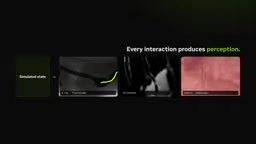
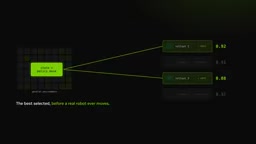
Because it runs on GPU, simulation is no longer a single experiment — it becomes a process that can be massively parallelized. A single simulation can branch into thousands of parallel environments, covering variant scenarios you could never assemble in the real world, pushing experimental scale to an entirely new level.
Within these parallel environments, policies each try different actions, and every rollout is scored within the simulation. The best-performing ones are kept; the rest are discarded — the robot learns which direction to move before any real instrument ever moves.
The "perfect ground truth" mentioned here corresponds directly to the ground truth problem in machine learning. In real surgical environments, it is nearly impossible to simultaneously and precisely record the 3D pose of instruments, the stress state of tissue, and other parameters corresponding to camera or ultrasound images — this is one of the fundamental reasons why training data for medical perception models is so scarce. The unique value of simulation lies in the fact that the simulation state itself is the annotation: any rendered frame precisely corresponds to known instrument poses, tissue deformation, and contact forces, with no manual annotation pipeline needed and no sensor error or annotator subjectivity. This "free perfect ground truth" enables perception models to be pre-trained on massive simulation data and then fine-tuned with a small amount of real data (Sim-to-Real Transfer), dramatically reducing dependence on scarce clinical data.
Classical Physics and Generative World Models: A Two-Engine Drive
What's described above represents the "classical half": directly solving physics equations. The other half is the generative approach — a world model that learns physical laws from data.
NVIDIA's Cosmos world foundation models take the current viewpoint and the robot's next action, then directly generate what will happen next — distilled to support real-time operation. Classical solving ensures physical accuracy, while the generative model delivers speed and generalization. The two complement each other to form a complete simulation loop.
Cosmos is a series of World Foundation Models released by NVIDIA in early 2025, designed specifically for physical AI applications. Its core idea is to compress large amounts of real-world and simulated video data into an implicit representation of physical laws, enabling the model to autoregressively predict the visual content of future frames given a current state and action condition. Unlike traditional physics solvers, Cosmos does not explicitly construct differential equations — instead, it learns "how the world works" through a data-driven approach, giving it a natural advantage when handling complex phenomena that are difficult to model precisely, such as soft tissue deformation and fluid flow. "Distilled to support real-time operation" refers to transferring knowledge from large foundation models into smaller, lightweight networks whose inference latency is low enough to be embedded in a robot control loop. In medical scenarios, Cosmos can provide fast, generalizable visual predictions for interactions that are difficult to model precisely with classical physics — such as an ultrasound probe compressing soft tissue or a catheter advancing through a blood vessel.
One Framework, Multiple Surgical Scenarios
This framework is not limited to a single procedure type. Surgical robots, endoscopy, vascular intervention, robotic ultrasound — wherever a robot needs to interact with human anatomy, there is a physical process that can be simulated.
Putting these elements together, the platform forms a closed loop: anatomy, physics, perception, and policy — four components driving each other in progression. The entire system is open to build on and runs entirely on NVIDIA accelerated computing.
Simulation Doesn't Replace the Path to the Clinic — It Shortens It
One point worth emphasizing: simulation does not replace the complete validation process required for medical robots to reach the clinic — it significantly shortens that path. By completing large amounts of trial and error, policy selection, and perception training in virtual environments, the cost and time required for real-world validation are dramatically compressed.
For a field long constrained by scarce data and slow prototype iteration, GPU-native medical physics simulation offers a scalable new pathway. It moves "learning from experience" away from expensive real-world trial and error and into a simulation world where infinite parallelization and precise annotation are always available.
Related articles
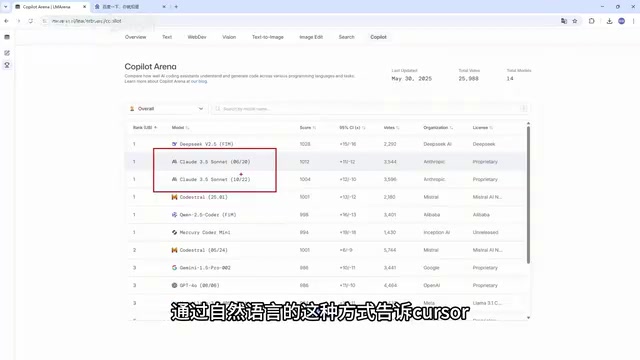
What Is Cursor? Core Differences Between This AI Coding Tool and Traditional IDEs
What is Cursor? This guide explains the AI-native code editor built on VS Code, how it compares to traditional IDEs, and its integration with Claude, DeepSeek, and Gemini.

Coze 3.0 Beginner's Guide: A Complete Overview of Agents and AI Applications
A beginner's guide to Coze 3.0: covering agents, AI applications, workflows, and plugins on ByteDance's AI platform, plus a comparison with Dify.
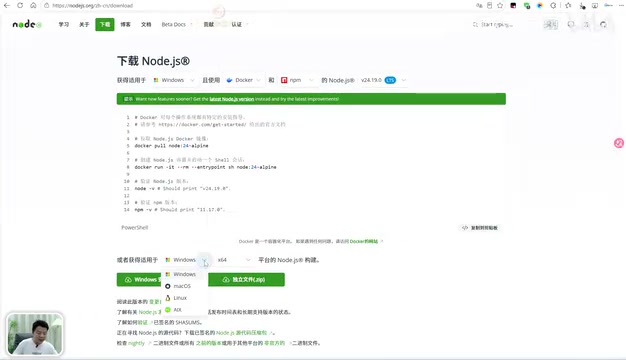
Setting Up the DeepSeek Harness Environment: A Complete Guide to Node.js Installation and Configuration
A beginner-friendly guide to setting up the DeepSeek Harness environment: Node.js installation, Add to PATH, redirecting npm global and cache directories, and configuring system environment variables.