NVIDIA Nemotron 3.5 Super VL: A 120-Billion-Parameter Visual AI Agent

NVIDIA releases Nemotron 3.5 Super VL, with 12B active parameters rivaling Ultra-class and optimized for visual Agents.
NVIDIA released Nemotron 3.5 Super VL, an Ultra-class vision-language model with 120B total parameters and 12B active parameters that can be deployed on a single DGX. It compresses Nemotron 3 family capabilities through distillation, is optimized for Agent workflows, and emphasizes low latency and high throughput. In the official demo, an Agent autonomously reads dashboard screenshots and scanned price lists, identifies a surge in thinking token consumption as the main cause of bill increases, then writes a Python routing script and generates a proposal to save $100,000 per month for human approval, demonstrating a full loop of visual reading, reasoning, code generation, and tool calling. Its core value is eliminating structured data preprocessing and using screenshots and scans directly as input, lowering the integration barrier for internal systems.
Ultra-Level Performance, Single-Machine Deployment
NVIDIA has released Nemotron 3.5 Super VL, a vision-language model positioned as "Ultra-class." It has only 120 billion total parameters and 12 billion active parameters, yet it claims performance that matches or even exceeds Nemotron 3 Ultra. More importantly, it can fit into a single DGX system and is specifically optimized for Agent workflows.
According to NVIDIA's official YouTube channel, the VL in Super VL stands for vision-language capability, which can directly parse complex documents, scans, and screenshots. The case shown in the video is an Agent that can independently investigate an AI usage dashboard—by reading images, reading scans, writing code, and producing proposals, it completed a full cost audit task.

Christ gives a core positioning at the beginning of the video: Nemotron 3.5 Super VL is an "Ultra-class model," meaning its capabilities are comparable to or even better than Nemotron 3 Ultra, but its parameter scale has been greatly compressed—120 billion total parameters and only 12 billion active parameters.
The idea here is model distillation. NVIDIA compresses the capabilities accumulated during training of the Nemotron 3 family (including Ultra) into a model that can be carried by a single DGX. For Agent scenarios, this solves two practical problems: first, inference latency must be low and tokens must be generated quickly so the Agent loop can keep running; second, the model cannot be too large, otherwise deployment cost and response speed become unacceptable.
Super VL's trade-off is clear: it does not pursue being "large" in parameter scale, but rather "sufficient and fast," with visual understanding and tool-calling capabilities as its core selling points.
Active parameters and MoE architecture: Super VL's 12 billion active parameters refer to the subset of parameters that actually participate in computation during each forward inference when using a mixture-of-experts (MoE) architecture. The 120 billion total parameters indicate that the model's overall capacity is very large, but each token is routed to only about one-tenth of the expert networks, so the amount of computation and memory bandwidth usage is closer to that of a dense model with 12 billion parameters. This is precisely the key to its ability to be deployed on a single DGX with relatively low latency—the model's knowledge capacity is supported by total parameters, while inference cost is determined by active parameters.
Distillation: The article mentions that NVIDIA compresses the capabilities accumulated during training of the Nemotron 3 family into Super VL, which is a form of knowledge distillation. A common approach is to use the output distribution, intermediate features, or chain-of-thought data from a large model (teacher) to train a small model (student), so that the student approaches the teacher's performance on specific tasks. For Agent scenarios, the goal of distillation is not to replicate general conversational ability, but to transfer key skills such as visual reading, reasoning, and tool calling, trading a smaller parameter scale for acceptable performance.
A Complete Cost Investigation Loop for an Agent
The Agent case demonstrated by Chachi in the video shows Super VL's performance in a real task pipeline. The background is: the team switched its AI help desk to a cheaper model, but the AI bill instead rose by 30%.
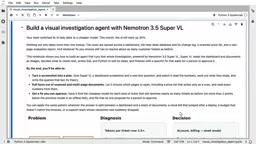
The Agent's execution steps include:
- Reading a dashboard screenshot: Extract values directly from the screenshot—spending rose 30%, while ticket volume rose only 3%. The two are disproportionate, indicating the problem is not usage.
- Reading a scanned price list: Open a price list in scanned image format and read out the price of each model line by line. This step tests text recognition and understanding of unstructured images.
- Locating the source of cost: Discover that after the team switched to a certain thinking model, daily consumption of thinking tokens exceeded the previous level by more than 100 times—this was the real reason for the bill surge.
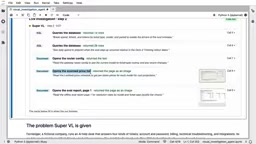
- Writing Python code to make routing decisions: The Agent wrote a Python script itself to choose the cheapest model for each ticket type while meeting a quality threshold.
- Generating a proposal and waiting for human approval: The final output is a routing plan that does not directly change any configuration, but is submitted for human review. The plan claims it can save about $100,000 per month while maintaining quality standards.
The entire process had no step-by-step human guidance—starting from screenshot input, the Agent independently completed the full loop of "observe → analyze → write code → produce proposal." This is also the combination of capabilities the official presentation wants to emphasize: visual reading + reasoning + code generation + tool calling.
Agent loop and thinking tokens: An Agent workflow is usually a loop of "observe—reason—act," in which the model needs to repeatedly read environmental feedback and decide which tool to call next. Super VL is optimized to support this kind of fast loop, emphasizing low latency and high token throughput. The thinking tokens mentioned in the case refer to the internal reasoning or chain-of-thought tokens generated by the model before giving a final answer. These tokens are not directly shown to users, but they consume a large amount of computation and cost. When the team switched to a certain thinking model, daily thinking token consumption surged by more than 100 times, which was the root cause of the bill spike—this also explains why routing strategies need to distinguish between ordinary replies and requests requiring deep thinking.
From Demo to Deployment: Super VL's Positioning
The value of this demo is not in the number "$100,000" itself, but in the Agent form it demonstrates: an analytical Agent that does not need structured data input and can work directly by looking at images and scans.
In traditional approaches, such tasks require first exporting dashboard data to CSV and organizing the price list into a structured table before the Agent can process it. Super VL eliminates this step—screenshots and scans are the input format. For many enterprise internal systems, this greatly lowers the barrier to integration, because a large amount of key information originally exists only in screenshots and PDF scans.
Of course, the demo is a presentation under ideal conditions. In actual deployment, factors such as image clarity, layout complexity, and mixed-language formatting will all affect recognition accuracy. NVIDIA says it has released a full technical report, cookbook, end-to-end recipe, and the data and environment used for training, all of which are worth further verification.

Vision-language model (VLM): The VL in Super VL stands for vision-language capability, meaning the model can process both images and text simultaneously. Unlike a cascaded approach that first uses OCR to extract text and then processes it with a language model, a VLM jointly understands image layout, table structure, and textual semantics within a unified framework, making it better suited for parsing complex documents, scans, and screenshots. Its value in an Agent lies in eliminating the prerequisite steps of exporting dashboard screenshots to CSV and manually organizing scanned price lists into tables, allowing unstructured visual input to enter the reasoning pipeline directly and lowering the integration barrier for enterprise internal systems.
Points Worth Watching
Based on the official video information, Nemotron 3.5 Super VL's differentiation lies in three points: Ultra-class performance that can run on a single machine, native vision-language capability, and efficiency optimization for Agent workflows. It is not aimed at general chat scenarios, but at Agent applications that require fast loops, frequent tool calls, and direct processing of visual input.
The video also mentions that the technical details of Nemotron 3.5 Lightning will be included in the technical report, indicating that this generation of the product line has more than one model. For teams building visual Agents or document-understanding pipelines, Super VL provides an option that can be deployed locally without relying on closed-source APIs.
The officially released cookbook and end-to-end recipe are the shortest path to getting started. It is recommended to refer directly to these resources for verification rather than judging actual performance solely from the demo.
Related articles

Bilibili's Hit Dify Tutorial: A Practical Guide to Building 20+ AI Apps from Scratch
A distilled guide to Bilibili's top-rated Dify tutorial: Windows + Docker deployment, MySQL connection, five app types, model integration strategy, and publishing.

Agent Skills Beginner's Guide: From Concepts to Multi-Agent Collaboration in Practice
A comprehensive guide to Agent Skills: core concepts, components, the importance of Description, standardization, beginner learning paths, and multi-agent collaboration.

One Neuron Detects Both Cats and Cars? We Reproduced It and Found a New Explanation
The cat-car neuron reinterpreted: researcher Cammarata argues it distinguishes pointy from round, not cats from cars. We reproduced the experiment and found the new explanation holds on most inputs—but cars are the exception. The interpretability debate continues on language models.