Nvidia Officially Denies RTX 5090 Discontinuation: Production Continues, Shipping as Normal

Nvidia executive explicitly denies RTX 5090 discontinuation, confirming normal shipping will continue.
In response to recent community rumors that the RTX 5090 is discontinued, Nvidia SVP of Personal Computing Jeff Fisher formally denied it in a follow-up interview at the Taipei RTX Spark Launch Party on October 16, 2026, stating the card will continue to ship normally. The article analyzes the rumor's background: flagship models often see periodic shortages in the mid-to-late lifecycle due to capacity reallocation and new product transitions, easily misread as discontinuation. The official debunking helps stabilize expectations and curb hoarding, cooling secondary market prices. But it stresses that "not discontinued" does not mean "ample supply"; capacity allocation still depends on overall product line cadence, and retail supply stability remains to be seen. For gamers, there's no need to rush orders out of stockout fears—decide based on your own needs and budget.
Recent rumors that Nvidia's flagship RTX 5090 graphics card is about to be discontinued have sparked widespread discussion in the community, with many gamers worried that supply shortages will further drive up already tight market prices. That concern has now been officially put to rest.
Executive Responds in Person: Discontinuation Rumors Are False
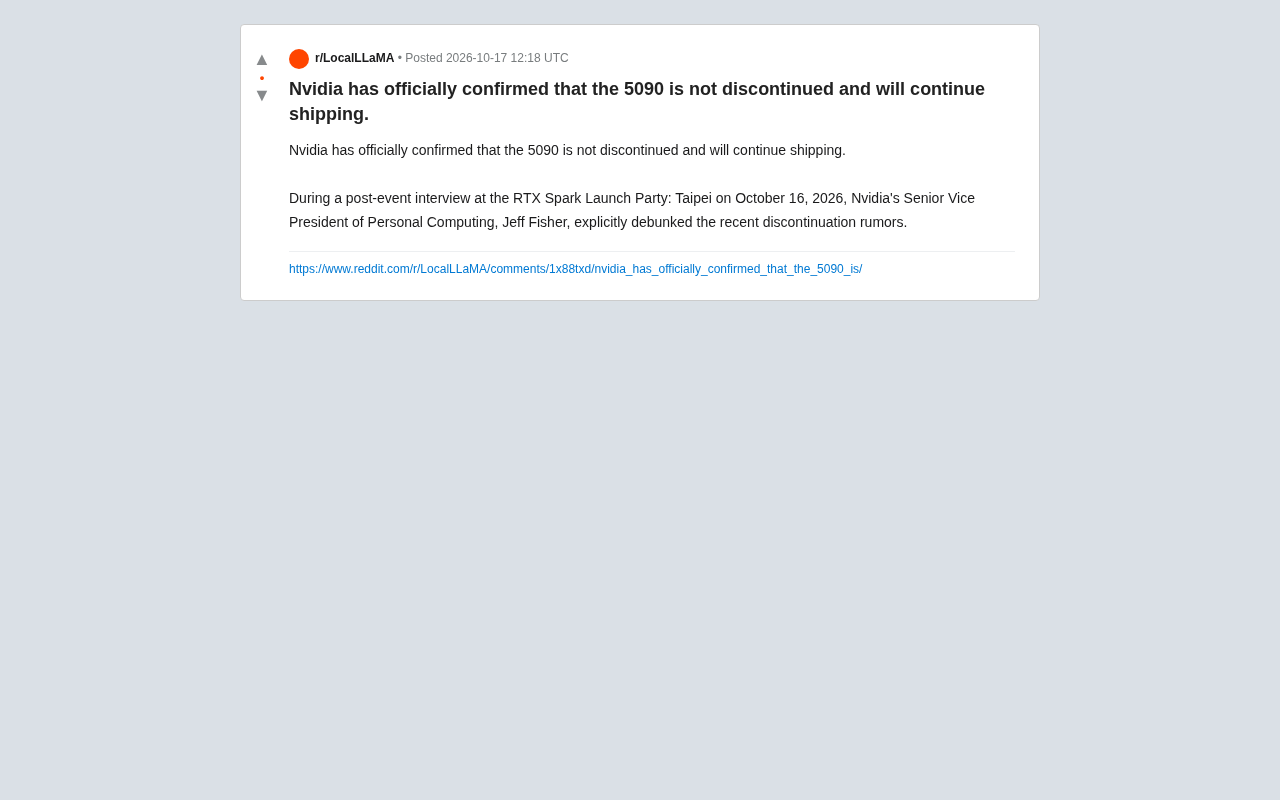
According to information circulating on the Reddit community, during a follow-up interview session at the RTX Spark Launch Party held in Taipei on October 16, 2026, Jeff Fisher, Nvidia's Senior Vice President of the Personal Computing business, explicitly denied rumors that the RTX 5090 is being discontinued and stated that the product will continue to ship as normal.
This statement comes from the executive directly responsible for Nvidia's consumer graphics card business, giving it high credibility. Fisher did not merely offer vague wording but directly addressed the specific claim of "discontinuation," indicating that the company has already formed a clear internal judgment on the rumors.
Why the Rumors Emerged
Rumors of high-end GPU discontinuation do not come out of thin air. Flagship models often experience periodic shortages in the mid-to-late stages of their lifecycle due to capacity reallocation, new product transitions, or adjustments to regional supply strategies, and the market easily interprets "temporarily unavailable" as "no longer in production." As a top-tier model, the RTX 5090 already has relatively limited supply, so any small disturbance tends to be amplified.
The official clarification helps stabilize the expectations of channel partners and consumers and prevents panic buying from creating artificial shortages.
"Supply fluctuations in the mid-to-late lifecycle" of flagship graphics cards are a common phenomenon in the GPU industry, and understanding their causes requires grasping the basic logic of wafer capacity and product mix. Nvidia's consumer GPUs are produced by foundries such as TSMC on advanced process lines, and capacity on the same lines must be allocated among data center GPUs (such as the H100/B200 series), consumer flagships, and mid-range models. When demand for AI accelerator cards is high, foundry and packaging resources (such as CoWoS) are prioritized for higher-margin data center products, and wafer starts for consumer flagships are compressed accordingly. In addition, GPUs must go through packaging, testing, board assembly, and channel distribution from wafer to finished product, and scheduling adjustments at any stage can cause supply gaps lasting weeks to months. During shortages, channel partners often reduce public quotations and switch to allocation-based distribution, and this "can't see the goods" state is easily interpreted by the community as discontinuation.
Practical Impact on the Market
In the short term, the debunking news has a certain cooling effect on secondary market prices—when the "out-of-print" expectation is broken, the incentive to hoard weakens accordingly. But what needs to be viewed rationally is that "not discontinued" does not equal "ample supply." Capacity allocation for the RTX 5090 is still affected by the overall product line cadence, and whether retail channels can maintain stable stock still depends on observing actual arrivals in the channel.
For gamers holding cash and waiting, this news means there is no need to rush orders out of fear of stockouts, and decisions can be made according to one's own needs and budget rhythm.
The price formation mechanism of the secondary market deserves separate explanation. There is a clear price gap between the retail suggested price (MSRP) of graphics cards and secondary market transaction prices, with the latter mainly driven by three aspects: immediate supply and demand, channel inventory, and information expectations. When the market widely believes that a certain model is about to be discontinued, two types of behavior emerge: first, dealers hoard goods in anticipation of price increases and reduce spot supply; second, consumers engage in panic buying. The two combine to create artificial shortages in the short term and self-reinforce expectations of price increases. This expectation-driven price fluctuation is often called a "self-fulfilling prophecy" in economics. The direct effect of the official clarification of discontinuation rumors is to break this expectation chain. However, it should be noted that clarification at the information level can only suppress speculative demand and cannot change the physical supply volume, so whether prices can fall ultimately still depends on the actual arrival cadence and the strength of overall market demand.
Variables Still Worth Watching
The official confirmation of continued shipping answers only one question: "whether it is discontinued." Price trends, regional supply differences, and subsequent driver and ecosystem support are the key factors determining the long-term experience of using this card. It is advisable to keep following arrival information from Nvidia's official channels and mainstream retailers rather than readily believing secondhand rumors in the community.
One-line Summary
An Nvidia executive explicitly denied that the RTX 5090 is discontinued and confirmed that it will continue to ship as normal.
Paragraph Summary
In response to recent community rumors that the RTX 5090 is being discontinued, Jeff Fisher, Nvidia's Senior Vice President of the Personal Computing business, formally denied it in a follow-up interview at the Taipei RTX Spark Launch Party on October 16, 2026, and stated that the graphics card will continue to ship as normal. The article analyzes the background of the rumors: flagship models often experience periodic shortages in the mid-to-late lifecycle due to capacity reallocation and new product transitions, which are easily misread as discontinuation. The official debunking helps stabilize the expectations of channel partners and consumers, curb hoarding motives, and has a cooling effect on secondary market prices. But the article emphasizes that "not discontinued" does not mean "ample supply"; capacity allocation is still affected by the overall product line cadence, and the stability of retail supply remains to be seen. For gamers, there is no need to rush orders out of fear of stockouts, and decisions can be made according to one's own needs and budget rhythm.
Related articles

Cursor AI Programming in Practice: Build a Student Management System from Scratch in 30 Minutes
A Bilibili creator demonstrates Cursor AI programming: generating a student management system in 30 minutes with natural language. Details on Agent mode, Claude selection, prompt techniques, and thresholds.

Top 20 AI Coding Tools Ranking: From Rock-Solid to Lackluster, a Scored Matrix
Bilibili creator releases top 20 AI coding tools ranking, tiered T0–T4 from rock-solid to lackluster, with Claude Code and Codex tied at T0. This article details the scoring dimensions (capability, reliability, robustness, durability, cost, domestic availability) and tool performances to help developers choose the right AI coding assistant.

Vibe Coding Systematic Tutorial: Master AI-Assisted Programming from Zero
A three-month Vibe Coding tutorial from a Bilibili creator covering Codex, ClaudeCode, and Cursor, from core logic to commercial project practice for beginners.