NVIDIA PAIR: Turn Your Idle Home Computers Into a Local AI Cluster

NVIDIA PAIR pools idle home devices into a unified local AI compute cluster with dynamic scheduling, for free.
NVIDIA's PAIR software aggregates idle compute from scattered home devices into a unified resource pool, letting local AI agents schedule and run tasks across machines. Installed on each device, PAIR dynamically routes tasks to the most available hardware — and reroutes automatically if a machine gets occupied by gaming or other workloads. It supports Windows, NVIDIA hardware, and Apple devices, accommodating mixed-brand home setups. All models and tasks run locally with no cloud uploads, and the software is completely free. Real-world performance across latency, bandwidth, and heterogeneous hardware compatibility remains to be validated beyond the initial demo.
NVIDIA has introduced a new piece of software called PAIR that aims to solve a problem many tech enthusiasts share: you have multiple computers scattered around the house, but when it comes to running AI tasks, you almost always rely on just one. PAIR's approach is to pool the idle compute from all these devices and let local AI agents schedule and run tasks across your entire home network.
What Problem Does PAIR Solve?
Many tech enthusiasts have more than one computer at home — beyond a primary machine, there might be a backup PC or even a gaming rig that's been sitting untouched for five years. Most of the time, these devices sit idle, their compute going to waste. PAIR's core value proposition is consolidating this "scattered compute" into a single usable resource pool.
A demo described a vivid scenario: you type a command on one computer and hit Enter, but the task doesn't actually run on that machine — it gets forwarded to another computer to execute. From the user's perspective, the interaction point is unified; the underlying compute routing happens behind the scenes.

Intelligent Cross-Device Scheduling
PAIR works by installing the software on all of your devices. Once installed, it evaluates the available compute on each machine and routes tasks to whichever one is best suited at that moment.
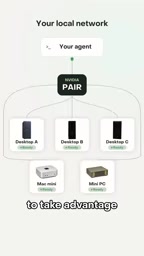
Notably, PAIR's compatibility extends beyond Windows or NVIDIA's own hardware ecosystem — Apple devices are supported as well. This means a mixed-brand, mixed-generation home setup can theoretically be folded into the same compute pool.
Dynamic Load Awareness
PAIR's scheduling isn't a static, one-time assignment. The demo highlighted a key capability: if you start gaming on one of your computers, PAIR detects that the machine's available compute is now occupied and automatically reroutes AI tasks to other idle devices.

This dynamic reallocation makes the compute pool much more practical in real-world usage. Users don't need to intervene manually, and they don't have to worry about AI tasks and everyday workloads — gaming, office work — competing for the same resources.
Local Execution and Privacy Benefits
Another key selling point PAIR emphasizes is that everything runs fully locally. Models, agents, and task execution all happen on your own devices — no data needs to be uploaded to the cloud. For users who care about privacy and want complete control over their AI agents, this is a genuinely appealing deployment model.
The software is also reportedly completely free. Combined with local privacy, this lowers the barrier for everyday users to experiment with local AI clusters — no need to buy expensive dedicated hardware; you can get started with the devices you already have.
The fundamental distinction between local AI inference and cloud inference comes down to where computation happens. Cloud-based solutions send your prompts and context data to remote servers, where the provider's GPU clusters handle the computation before returning results. Local inference downloads model weights to your own device and runs the entire forward pass on-premises — data never crosses a physical boundary. This matters especially for AI agents handling personal files, private conversations, or sensitive business information. PAIR's "fully local" promise extends this concept: even when a task is routed to another device in your home, the data stays within a LAN you control rather than flowing to a third-party data center. This aligns with the privacy philosophy of local inference frameworks like Ollama and LM Studio, with one key difference — PAIR expands the compute boundary from "a single device" to "the home network."
A Few Observations
This article is based on a single YouTube demo, and PAIR's real-world performance — cross-device task scheduling latency, model compatibility across different hardware, whether network bandwidth becomes a bottleneck — all still need hands-on testing to validate. Distributed local inference is conceptually compelling, but coordinating a pool of home devices with varying performance levels into an efficient compute cluster is a non-trivial engineering challenge.
That said, the direction is interesting: PAIR represents a trend toward freeing local AI from the ceiling of a single device, treating "all the machines in your home" as a unified resource. For users who want to break free from cloud dependency and prioritize privacy and full control, tools like this are worth watching closely.
Distributed inference faces several classic engineering challenges worth keeping in mind when evaluating PAIR. First is model sharding (tensor parallelism): splitting a large model across multiple devices for parallel computation requires frequent synchronization of intermediate tensors between machines, which is extremely sensitive to network bandwidth and latency. A home gigabit wired network is theoretically manageable, but jitter over Wi-Fi could become a noticeable bottleneck. Second is the scheduling complexity of heterogeneous hardware: different GPU architectures (NVIDIA vs. Apple Silicon) have different instruction sets, and coordinating them within a single inference task typically requires a unified intermediate representation layer (such as ONNX or llama.cpp's cross-platform backend) — otherwise, different devices can only run independent tasks rather than truly parallelizing the same model. PAIR's publicly available technical details remain limited, and how these two problems are actually solved isn't yet clear. These are the technical disclosures worth watching most closely going forward.
Related articles

Free Unlimited Claude Code Solution: Agnes AI + CC Switch Setup Guide
No paid subscription needed — pair the free AI platform Agnes AI with the open-source tool CC Switch to provide a backend for Claude Code, enabling unlimited free calls to text, image, and video models. This guide covers the full setup, test results, and usage boundaries.

A Complete Zero-Cost Guide to Getting Started with Claude Code for Beginners in China
A beginner's guide to Claude Code for users in China: two installation methods (command line and IDE plugin), full configuration steps for replacing the official API with the free domestic LongCat model, and a hands-on demo of building a small tool with natural language, plus tips.

When the NSA Gets Involved: The AI Supply Chain Crisis Behind Open-Source CVEs and API Key Hijacking
Multiple open-source projects disclosed severe CVEs in one day, PHP flaws alarmed the FBI, and Railway and OpenCode were breached with API keys stolen. This article breaks down the vulnerability window, AI-accelerated exploitation, and the AI supply chain crisis behind the API key black market, with a developer defense checklist.