Nvidia Reportedly Preparing to Fire CEO Jensen Huang
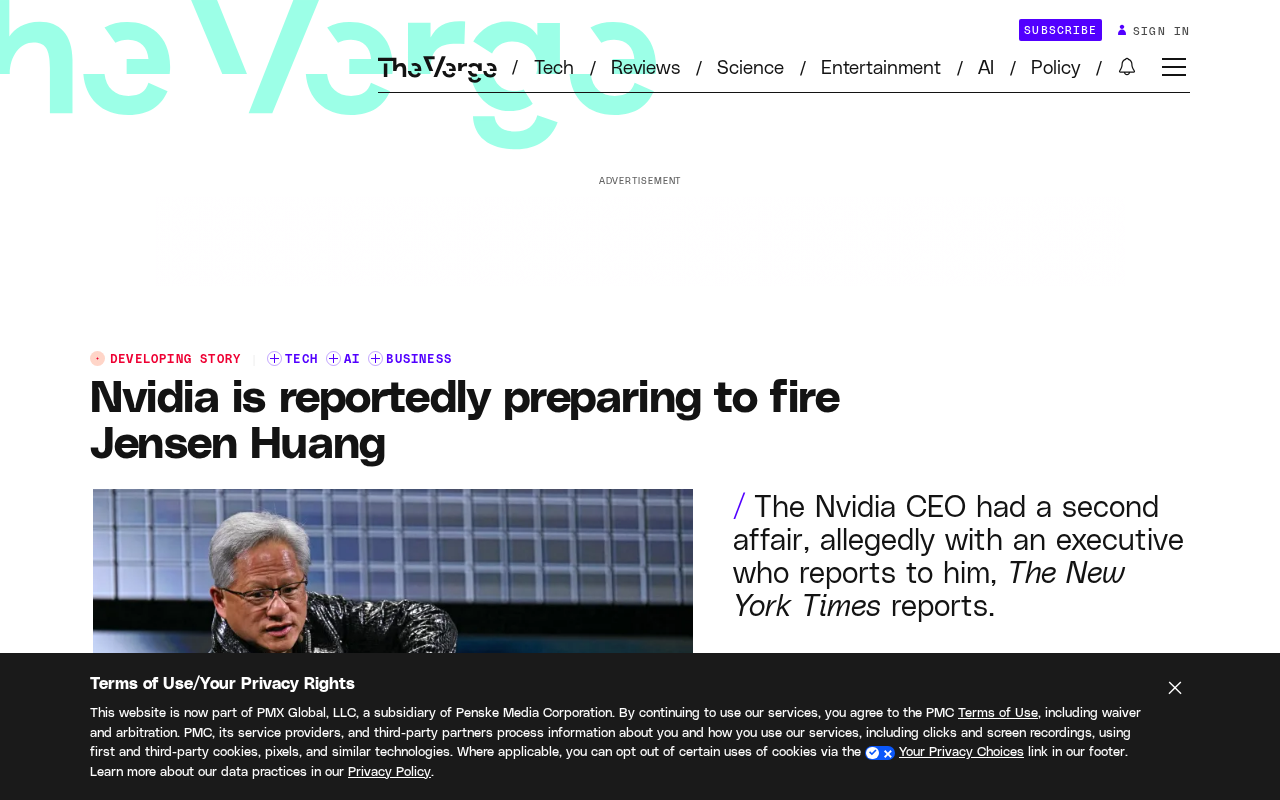
Nvidia's board reportedly prepares to fire CEO Jensen Huang amid two extramarital affair allegations.
According to The Wall Street Journal, Nvidia's board is considering firing CEO Jensen Huang. The trigger was a second extramarital affair allegation disclosed by The New York Times involving an executive; days earlier, Huang admitted another affair with a woman accused of being a Chinese spy. The board has begun termination preparations, but specifics and official responses are unclear. Nvidia's key role in the global AI chip market means a CEO change could worry investors. The story is still developing.
Nvidia Reportedly Preparing to Fire CEO Jensen Huang
According to a report by The Wall Street Journal, Nvidia's board of directors is considering firing CEO Jensen Huang. The news stems from a New York Times report alleging that Huang is involved in a second extramarital affair—just days after he admitted to another affair with a woman accused of being a Chinese spy.
Background: Two Extramarital Affair Allegations in Quick Succession
According to the original report, Nvidia's board has begun preparing to remove Huang from his role as CEO. The trigger was a New York Times disclosure of a second extramarital affair allegation involving an executive. Just days earlier, Huang had admitted to another affair, and the woman in that case was accused of being a Chinese spy.
These allegations erupted in a very short timeframe, putting enormous reputational and governance pressure on Nvidia's leadership. Although the original information provides few additional details, the fact that The Wall Street Journal is the source lends credibility to the report.
Jensen Huang is one of Nvidia's co-founders and has served as CEO since the company was founded in 1993, making him one of Silicon Valley's longest-tenured CEOs. Under his leadership, Nvidia grew from a graphics chip company into a core supplier in the global AI computing sector, with a market capitalization that at one point exceeded one trillion dollars. Because of this, his personal reputation is closely tied to the company's governance, and any major allegation involving personal conduct could directly influence board decisions.
So-called "extramarital affair allegations" fall within the realm of executive personal conduct, but under U.S. public company governance frameworks, if such conduct involves potential extortion risk, national security review, or violations of the company's code of conduct, the board typically has the authority to launch an investigation or even initiate termination proceedings. Allegations involving a "Chinese spy" in particular could trigger scrutiny from the Committee on Foreign Investment in the United States (CFIUS) or the Department of Justice, escalating a personal matter into a corporate compliance crisis.
Board Action: Termination Process Underway
The Wall Street Journal reports that Nvidia's board is preparing to fire Huang. This means the company's governance layer has taken substantive steps rather than merely remaining at the rumor stage. As Nvidia's long-time leader, Huang's fate will directly affect the company's strategic direction and market confidence.
It remains unclear which specific provisions or procedures the board is relying on to advance the termination, and no response from Huang himself or Nvidia officially has been mentioned. However, given the severity of the two affair allegations—especially the espionage allegation involving national security—the board's reaction may stem from concerns about the company's reputation and compliance risks.
In U.S. public company governance, firing a CEO typically requires a majority vote of the board and may involve "just cause" provisions in the employment contract. If the board terminates the CEO on grounds of "personal misconduct," it must demonstrate that the conduct caused material harm to the company's reputation or operations; otherwise, it could face a breach-of-contract lawsuit from the CEO. As a Delaware-incorporated company, Nvidia's board decisions must also comply with fiduciary duties under Delaware corporate law, including the duty of care and the duty of loyalty.
In addition, Nvidia has an independent board governance committee that typically oversees compliance with the executive code of conduct. If the allegations involve national security, the board may also bring in outside legal counsel to conduct an independent investigation—a process that could last weeks or even months, during which the CEO's status is often uncertain.
Market Impact and What to Watch
Nvidia occupies a critical position in the global AI chip market, and a sudden CEO change could raise investor concerns. Although the original report provides no market reaction data, such leadership turmoil typically affects a company's stock price and partner relationships.
As a side note, the information remains at the "report" stage and has not been officially confirmed by Nvidia. How the situation develops will depend on the board's formal decision, Huang's response, and possible legal proceedings. For readers following the AI industry and corporate governance, this is an event worth tracking closely.
Key Points
- The Wall Street Journal reports that Nvidia's board is preparing to fire CEO Jensen Huang.
- The trigger is a second extramarital affair allegation disclosed by The New York Times, involving an executive.
- Days earlier, Huang had just admitted to another affair with a woman accused of being a Chinese spy.
- Nvidia has not officially responded, and the situation is still developing.
One-line Summary
Nvidia's board is reportedly preparing to fire CEO Jensen Huang following two back-to-back extramarital affair allegations.
Paragraph Summary
According to The Wall Street Journal, Nvidia's board is considering firing CEO Jensen Huang. The trigger was a second extramarital affair allegation disclosed by The New York Times, involving an executive; just days earlier, Huang had admitted to another affair with a woman accused of being a Chinese spy. The board has begun preparing termination proceedings, but the specific grounds and any official response remain unclear. Nvidia holds a critical position in the global AI chip market, and a CEO change could raise investor concerns. The information remains at the reporting stage, and developments will depend on the board's formal decision, Huang's response, and possible legal proceedings.
Related articles

How Do Cursor, Devin, TRAE, and Copilot Compare on Price? Calculate Your Credits Before You Compare Monthly Fees
Side-by-side comparison of individual and team pricing for Cursor, Devin Desktop, TRAE, and Copilot, breaking down credit rules, third-party model inclusion, overage billing, and practical methods for measuring usage before paying, setting spending caps, and choosing the right tool.
Copilot Retires Three Models: Pro Users Left With Only One Alternative
GitHub Copilot retires Claude Opus 4.8, Claude Opus 5, and GPT-5.6 Tera on Nov 16 across Chat, code completion, and Agent mode. Pro users have only GPT-6 Luna left; Legacy annual plans miss Opus 5.5; admins must enable replacements manually.

Gemini 4 Carbon Arrives: The LLM Race Enters the Era of Million-Token Context and Trillion-Parameter Open Source
Google launches Gemini 4 Carbon and multi-agent tool Swarm; Anthropic debuts million-context Fable 5.2 and Mythos 5.2; OpenAI releases security-focused GPT-6 Cyber; Mistral and Kimi open-source trillion-parameter models — the LLM race accelerates across the board.