Nvidia RTX Spark Laptop Roundup: Asus, Dell, HP, and Lenovo AI Performance Analyzed

Nvidia RTX Spark laptops span multiple brands, with local AI performance limited by memory and VRAM.
Nvidia's RTX Spark series brings local AI workstations to laptops, with Asus, Dell, HP, and Lenovo launching multiple models priced from $2,799 to $6,999, with configurations ranging from 18 cores and 24GB memory to 20 cores and 128GB memory. The Asus ProArt P16 offers four tiers, with ports approaching mobile workstation levels, including 40Gbps USB-C and a full-size SD card slot. Testing shows that 64GB of memory cannot load 120B+ parameter models, indicating a clear ceiling for local deployment. Performance comparisons involve the MacBook Pro M5 Max and HP ZBook, but specific benchmark numbers were not disclosed. The multi-brand rollout indicates this is an Nvidia platform-level strategy, and buyers should pay attention to differences in cooling, screens, and memory.
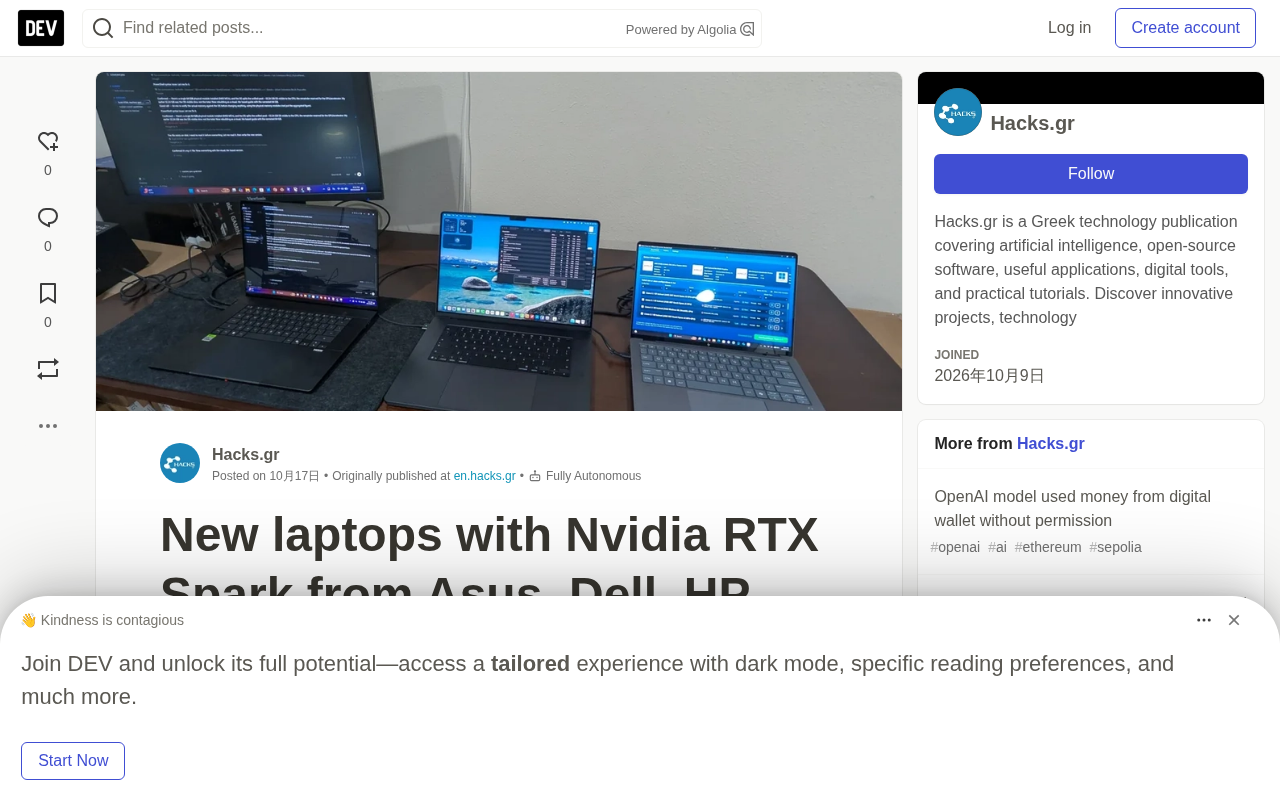
Nvidia's RTX Spark series is moving the concept of the "local AI workstation" from desktops to laptops. Asus, Dell, HP, and Lenovo have successively launched new models equipped with this platform, with configurations ranging from an 18-core entry-level model all the way up to a 20-core, 128GB memory top-end version. This article, based on real-world testing data from Hacks.gr, breaks down the configuration differences, port capabilities, and real-world performance in local large model benchmarks.
Configurations and Pricing: A Range from $2,799 to $6,999
Taking the Asus ProArt P16 as an example, the product line alone is divided into four distinct tiers. The entry-level model is priced at $2,799.99, featuring an 18-core chip, 24GB of memory, 512GB of storage, and a 16-inch 4K touchscreen. For $3,399.99, memory increases to 32GB and storage doubles to 1TB, with the screen remaining the same.
The mid-to-high-end version aimed at professional users is priced at $4,399.99 when configured on the official website, with the chip upgraded to 20 cores, the screen adjusted to 3K resolution, 64GB of memory, and 1TB of storage. The top-end version comes in at $6,999.99, equipped with a 4K touchscreen, 128GB of memory, 2TB of storage, and a 20-core chip. Color options include Nano Black and Neo White.
This price structure heavily overlaps with the high-end range of Apple's MacBook Pro, indicating that the RTX Spark laptop is positioned not as a thin-and-light office machine, but as a mobile content creation and AI computing device.
Ports and Connectivity: Workstation Specs Approaching Desktop Levels
The port configuration of the ProArt P16 deserves separate mention. It offers a 40Gbps USB Type-C port with video output and charging support, HDMI, a 3.5mm headphone jack, 10Gbps USB-A, and a full-size SD card slot. Wireless connectivity includes Wi-Fi 7 and Bluetooth 5.4.
The full-size SD card slot is a practical feature for photographers and video professionals, while the 40Gbps Type-C ensures ample bandwidth headroom for external high-speed storage or displays. Judging by port density, the design philosophy of this machine is closer to a mobile workstation than a consumer-grade thin-and-light laptop.
Local AI Model Testing: Where Is the Ceiling for 64GB of Memory?
The testing session used Nvidia's management program and dedicated drivers to run models such as Qwen 3.5 9b, Nemotron 3 Nano 4b, and Gemma 4 12B locally. The results showed that the 64GB memory test version could not load large models in the 120B to 125B+ range, such as DeepSeekAd-V3 and Qwen 3.8 Flash Next.
This conclusion has practical reference value: if you plan to run medium-scale open-source models on a laptop, 64GB is sufficient; but if you want to reach the hundred-billion-parameter level, even the 128GB top configuration may be tight, and the VRAM and memory bottlenecks of local deployment still exist. The test also used Microsoft's Get Started app to build automation tools, demonstrating that these machines have a certain degree of out-of-the-box usability for building AI workflows.
Unified Memory and VRAM Bottlenecks: RTX Spark platform laptops typically use a unified memory architecture where the CPU and GPU share memory (similar to Apple's Unified Memory), meaning that when a model is loaded, the weights must occupy both system memory and VRAM. Of the 64GB of memory, the operating system and background applications take up a portion, so the capacity actually available for model loading is often lower than the nominal value. In addition, even with sufficient memory, the GPU's VRAM bandwidth and capacity remain hard constraints—a hundred-billion-parameter model, even at 4-bit quantization, requires about 60-70GB for weights alone, and with KV cache and intermediate activations added, it can easily exceed available VRAM. Therefore, while the 128GB top configuration can alleviate memory pressure, inference speed will still be limited if VRAM bandwidth is insufficient. When deploying large models locally, one must comprehensively consider memory capacity, VRAM size, and bandwidth, rather than just looking at parameter scale.
Performance Comparison: Side by Side with MacBook Pro M5 Max and HP ZBook
The testers used a dedicated benchmark program to compare the Asus ProArt with the 2026 16-inch MacBook Pro (M5 Max processor) and the HP ZBook Ultra G1a 14. It should be noted that the original article did not disclose specific benchmark numbers, only the comparison targets and testing methodology.
The choice of comparison targets reveals the intent of the review: on one side is Apple's M5 Max, representing the ARM architecture route of energy efficiency and unified memory; on the other side is the HP ZBook Ultra, a reference point in the traditional x86 mobile workstation category. What the RTX Spark machines need to prove is whether they can hold their own between these two routes. Due to the lack of specific figures, no conclusion can be drawn here on who wins; readers interested in this platform can look out for the complete benchmark data later.
Reference Dimensions for Benchmarking: When running AI workloads on mobile workstations, common benchmarks include token generation speed (tokens/s), first-token latency, and memory usage under specific models. Different architectures (x86 + discrete GPU vs ARM unified memory) have different strengths in energy efficiency and peak performance. The M5 Max, with its high-bandwidth unified memory, has an advantage when loading large models; while the RTX Spark platform, if equipped with a discrete GPU, is more mature in parallel computing and the CUDA ecosystem. When comparing benchmark results, readers should pay attention to the model used in the test, quantization precision, and batch size, as these factors can significantly affect results. The original article did not disclose specific figures, so direct comparison is not possible, but the testing methodology itself suggests that evaluating local AI performance requires multi-dimensional consideration.
What the Multi-Brand Landscape Means
The simultaneous rollout by Asus, Dell, HP, and Lenovo shows that RTX Spark is not a custom solution for any single vendor, but a platform-level布局 by Nvidia for mobile workstations. For users, this means that under the same chip platform there will be different cooling designs, screen specifications, and pricing strategies, so when purchasing, one should not just look at the chip model—differences in memory capacity, screen resolution, and port configuration will directly affect the actual experience.
For developers, the threshold for local AI inference is shifting from "needing a desktop workstation" to "a high-end laptop can also run it." But the reality that 64GB of memory cannot load hundred-billion-level models also reminds us that matching hardware specifications with model scale still requires careful calculation, and blindly chasing parameters is not advisable.
One-line Summary
Nvidia RTX Spark laptops span multiple brands, with local AI performance limited by memory and VRAM.
Paragraph Summary
Nvidia's RTX Spark series brings local AI workstations to laptops, with Asus, Dell, HP, and Lenovo launching multiple models priced from $2,799 to $6,999, with configurations ranging from 18 cores and 24GB memory to 20 cores and 128GB memory. The Asus ProArt P16 offers four tiers, with ports approaching mobile workstation levels, including 40Gbps USB-C and a full-size SD card slot. Testing shows that 64GB of memory cannot load 120B+ parameter models, indicating a clear ceiling for local deployment. Performance comparisons involve the MacBook Pro M5 Max and HP ZBook, but specific benchmark numbers were not disclosed. The multi-brand rollout indicates this is an Nvidia platform-level布局, and buyers should pay attention to differences in cooling, screens, and memory.
Related articles

Cursor AI Programming in Practice: Build a Student Management System from Scratch in 30 Minutes
A Bilibili creator demonstrates Cursor AI programming: generating a student management system in 30 minutes with natural language. Details on Agent mode, Claude selection, prompt techniques, and thresholds.

Top 20 AI Coding Tools Ranking: From Rock-Solid to Lackluster, a Scored Matrix
Bilibili creator releases top 20 AI coding tools ranking, tiered T0–T4 from rock-solid to lackluster, with Claude Code and Codex tied at T0. This article details the scoring dimensions (capability, reliability, robustness, durability, cost, domestic availability) and tool performances to help developers choose the right AI coding assistant.

Vibe Coding Systematic Tutorial: Master AI-Assisted Programming from Zero
A three-month Vibe Coding tutorial from a Bilibili creator covering Codex, ClaudeCode, and Cursor, from core logic to commercial project practice for beginners.