Nvidia RTX Spark Laptops Launch: Asus, Dell, HP, and Lenovo All Onboard, Local AI Takes Center Stage

Nvidia RTX Spark laptops hit the market, pushing local AI from cloud to edge, but high prices remain a barrier.
Asus, Dell, HP, and Lenovo have simultaneously launched laptops powered by Nvidia's RTX Spark platform, featuring local AI model execution and agent framework support, marking the migration of large model inference from the cloud to personal devices. The products come in four configuration tiers, priced from $2,799.99 to $6,999.99, with memory ranging from 24GB to 128GB. The top-tier model approaches mobile workstation pricing. Benchmarks show Apple's M5 Max still leads in text generation speed, while RTX Spark's competitiveness lies more in CUDA ecosystem compatibility and Windows platform support. On-device AI is moving from technical demonstration to productization, but high prices remain the main obstacle to adoption.
Nvidia is bringing its RTX Spark platform to the laptop market. According to Hacks.gr, major manufacturers including Asus, Dell, HP, and Lenovo have rolled out new laptops powered by the platform, with a focus on local AI model execution and agent framework support. This signals that large model inference—previously dependent mainly on the cloud—is beginning to migrate to personal devices.
Hardware Configurations and Pricing Tiers
These laptops are divided into four configuration tiers, with a wide price range:
- Base model: 18-core Nvidia processor, 24GB RAM, 512GB storage, starting at $2,799.99
- Mid-tier: 32GB RAM, 1TB storage, priced at $3,399.99
- Test unit: 20-core processor, 64GB RAM, 1TB storage, priced at $4,399.99
- Top-tier: 128GB RAM, 2TB storage, priced at $6,999.99
The devices come in black and white color options, with the top-tier model additionally featuring a high-resolution touchscreen.
Looking at the pricing strategy, the RTX Spark laptops target professional developers and heavy AI users rather than the general consumer market. The nearly $3,000 entry price already exceeds most flagship gaming laptops. The top-tier model at close to $7,000 directly competes with mobile workstations.
Unified Memory Architecture Is Key
The memory range from 24GB to 128GB is worth noting. When running large models locally, VRAM and memory capacity are often more critical than raw compute power, because they determine how large a model can be loaded at once and how long a context can be processed. The 128GB configuration can theoretically hold the full weights of a medium-scale model without relying on quantization compression.
Unified Memory Architecture (UMA) refers to a design where the CPU and GPU share the same physical memory pool, rather than each having separate VRAM and system memory. Apple has fully adopted this design since its M-series chips. Its advantage is that the GPU can directly access the entire memory capacity, and large model weights do not need to be repeatedly copied between host memory and VRAM, thereby reducing latency and breaking through the capacity limits of traditional VRAM. Nvidia adopts a similar approach on RTX Spark, precisely to address the stringent memory capacity and bandwidth demands of local large model inference. Traditional discrete GPUs typically have 8GB to 24GB of VRAM, while unified memory can expand available capacity to 128GB—one of the prerequisites for running medium-to-large-scale models locally.
Local AI Capabilities: Running Without the Cloud
The new platform is based on RTX Spark and Grace architecture, with its core selling point being support for storing and running AI programs locally on the device. Users can load models directly through applications like LMStudio without an internet connection.
The device comes pre-installed with a dedicated tool application for managing automated tasks. For users handling sensitive data or in environments with unstable networks, the value of local inference lies in privacy and availability—data never leaves the device and is not affected by cloud service outages.
What Agent Framework Support Means
The original text mentions that these systems support agent frameworks. Compared to simple conversational AI, agents require models to autonomously call tools and execute multi-step tasks. Such workloads are more sensitive to memory bandwidth and response latency, and local execution can reduce the round-trip waiting time for each tool call.
Agent Frameworks are a class of software architecture that allows large language models to autonomously plan, call external tools, and execute multi-step tasks. Typical examples include LangChain and AutoGPT. Unlike single-turn Q&A, agents require the model to call tools such as search, code execution, and file operations after each decision step, and feed the results back to the model for continued reasoning. This loop is extremely latency-sensitive: if each tool call requires a round trip to the cloud, the accumulated waiting time can significantly slow down task completion. Local execution can compress round-trip latency to milliseconds while preventing sensitive data from passing through third-party APIs. However, agents also place far higher demands on memory bandwidth and concurrent processing capability than ordinary conversational scenarios.
Performance Comparison: Still No Match for Apple M5 Max
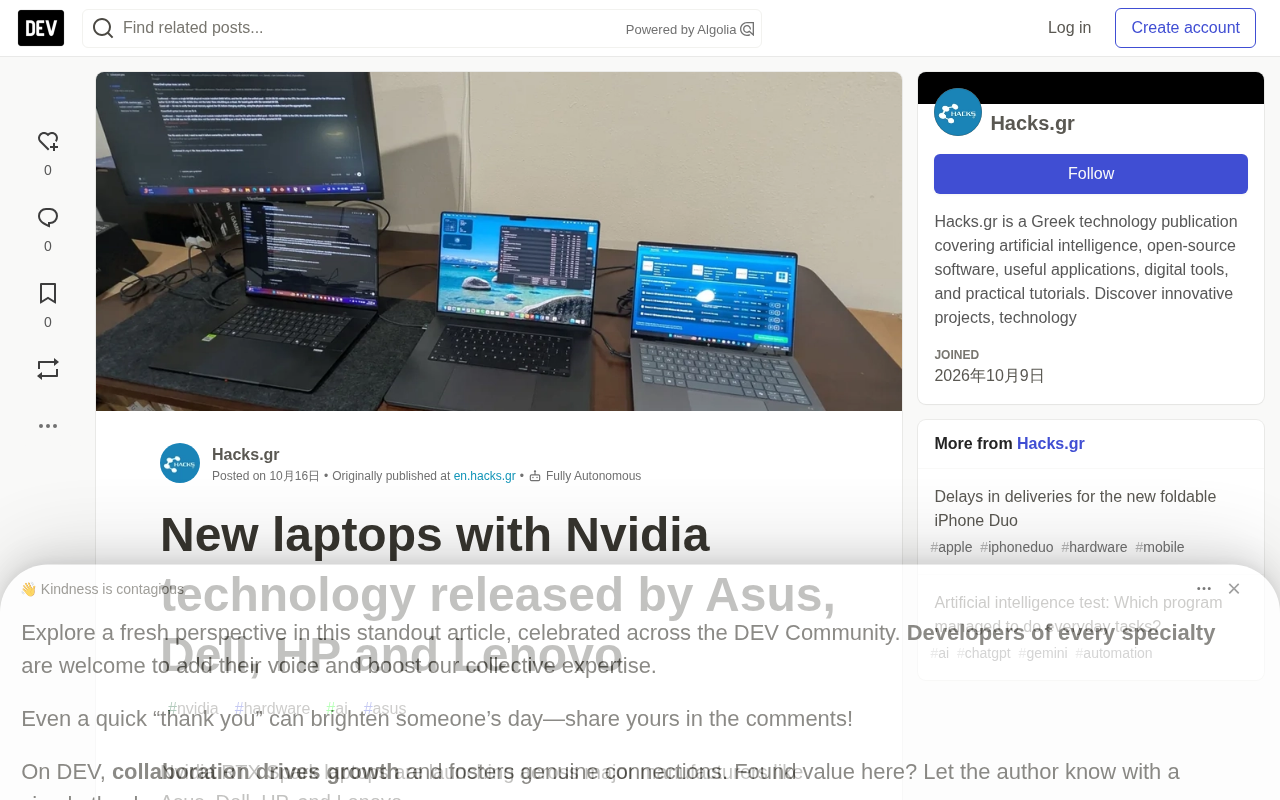
In benchmark tests, the new Asus laptop was compared with high-performance machines on the market, including devices equipped with Apple M5 Max and HP products. The results show that the Apple system maintains its lead in text generation speed.
This comparison result is not surprising. Apple's custom chips have long maintained an advantage in specific AI workloads thanks to unified memory architecture and tight hardware-software integration. The differentiated competitiveness of RTX Spark laptops is more likely to be reflected in VRAM specifications, CUDA ecosystem compatibility, and full support for the Windows platform AI toolchain.
CUDA is Nvidia's parallel computing platform and programming interface, and has become the de facto industry standard in deep learning training and inference. The vast majority of mainstream AI frameworks (PyTorch, TensorFlow, etc.) and optimization libraries (cuDNN, TensorRT) prioritize CUDA support, and developers often need to rewrite or adapt large amounts of code when migrating to other hardware platforms. This ecosystem barrier is a key factor behind Nvidia's long-standing dominance in the data center GPU market. If RTX Spark laptops can fully inherit the CUDA toolchain in the Windows environment, it will greatly lower the barrier for developers migrating from server-side to edge-side applications—a potential advantage over Apple chips in professional AI development scenarios.
Market Significance: Another Push for On-Device AI
The simultaneous launch of RTX Spark laptops by four major manufacturers sends a clear signal: local AI is moving from technical demonstration to productization. The willingness of hardware manufacturers to invest multiple product lines in this niche market indicates that demand does indeed exist.
Currently, cloud API call costs, data compliance requirements, and offline scenario needs together constitute the practical drivers for on-device AI. By entering this track through RTX Spark, Nvidia aims to replicate the ecosystem path it once took in the data center GPU market—binding developers with a hardware platform, then letting the software ecosystem form a moat.
However, price remains the biggest obstacle to widespread adoption. When a laptop's price exceeds most users' entire budget, local AI will remain a niche demand in the short term. Whether these products can truly move the market depends on whether more mid-range configurations and lightweight models emerge later.
On-Device AI refers to running AI models directly on a user's local device rather than relying on cloud servers. Its drivers mainly come from three aspects: first, privacy compliance—industries such as finance and healthcare do not allow data to leave the country or be uploaded to third parties; second, cost—cloud APIs are billed by usage, and long-term costs in high-frequency scenarios are higher than local deployment; third, availability—AI functionality is still needed in offline or unstable network environments. However, on-device AI faces hard constraints in compute, memory, and power consumption, and typically requires compression techniques such as model quantization and distillation. RTX Spark uses high memory configurations as a selling point, precisely attempting to break through these constraints on-device, but its high price will still limit it to professional users in the short term.
Related articles

The Other Side of the Agricultural Revolution: How Disease Helped Farmers Defeat Hunter-Gatherers
Historian Kyle Harper explains how agricultural societies defeated hunter-gatherers: not only through population growth from superior energy extraction per unit of land, but also through pathogens bred by settled life that caused extra mortality during expansion—a dual replacement mechanism.

Why Is AI-Generated Language So Hard to Understand?
Why is AI-generated language fluent yet hard to understand? Based on a Hacker News discussion, this article analyzes the cognitive load of AI text from three angles—imbalanced semantic density, lack of common ground, and side effects of alignment training—and offers practical advice for getting along with AI language.

Progressive Disclosure Makes Agents 2.3x Faster: A New Approach to Context Engineering
A Hacker News discussion proposes using progressive disclosure to optimize AI agent context, achieving a 2.3x speedup. This article analyzes the three performance costs of context bloat and introduces practical approaches such as layered tool catalogs, on-demand retrieval, and history compression, along with implementation considerations.