Nvidia's China AI Chip Share Falls to 34% as Huawei Closes In
Nvidia's China AI chip share fell to 34%, Huawei closed in at 28%, and non-GPU accelerator shipments surpassed GPUs for the first time.
IDC's latest report shows that in H1 2026, Nvidia's share of China's data center AI chip market fell to 34%, with shipments down 44% year-on-year to 678,000 units, while Huawei shipped 572,000 units for a 28% share, narrowing the gap to 6 points. This shift was driven by U.S. export controls and China's self-sufficiency strategy, with 9 of 11 Chinese suppliers growing shipments. More critically, total AI accelerator shipments reached 2.008 million units, but GPU shipments fell 26%, while non-GPU inference accelerators surged nearly 80% and overtook GPUs in total volume for the first time. The article argues this signals that Chinese buyers are designing AI infrastructure around domestic specialized chips, and Nvidia's CUDA moat is being eroded by inference optimization and open-source models.
For more than a decade, Nvidia's dominance in the AI accelerator market was virtually unassailable. Its CUDA software stack, rapid hardware iteration cadence, and grip on hyperscaler budgets made it the default choice for training and inference of large models. But data from the latest IDC report cited by Reuters shows that in China—once seen as a promising growth market—Nvidia's dominance is crumbling faster than expected.
Nvidia's China Share Falls to 34%, Huawei Narrows Gap to Just 6 Points
The IDC report shows that in the first half of 2026, Nvidia's share of China's data center AI chip market fell to 34%. Between January and June, it shipped 678,000 AI accelerators in mainland China, down 44% year-on-year. Meanwhile, Huawei shipped 572,000 accelerators, nearly double the roughly 300,000 units from the same period last year, capturing a 28% market share and narrowing the gap with Nvidia to just 6 percentage points.
These figures reflect two market forces at work simultaneously. On one hand, Washington's escalating export controls have progressively cut off channels for Nvidia's most advanced data center GPUs to enter the Chinese market; on the other, Beijing's aggressive push for semiconductor self-sufficiency has transformed domestic AI chips from laboratory projects into commercially viable alternatives.
Export Controls Force Domestic Substitution as Huawei Leads a Broad Push
Huawei is the biggest beneficiary of this substitution wave. The company has released more than a dozen new chipset lines covering AI accelerators, processors, and interconnect components, with product lines aimed squarely at the infrastructure territory long held by Nvidia, AMD, and Intel. Huawei is also pushing at the software ecosystem level, working with partners to launch CUDA alternatives.
The challengers extend well beyond Huawei. Of the 11 Chinese semiconductor suppliers tracked by IDC, 9 achieved year-on-year shipment growth. Alibaba's chip design unit T-Head holds 7% market share, followed by Cambricon at 5%, Baidu's Kunlunxin at 4%, and Hygon at 3%. This is a broad collective ramp-up of domestic products, not the breakthrough of a single company.
CUDA and the Software Ecosystem Moat: CUDA (Compute Unified Device Architecture) is the parallel computing platform and programming model Nvidia has built since 2006, enabling developers to use a relatively unified interface to run general-purpose computing on GPUs. Over more than a decade, a vast array of libraries and framework integrations—cuDNN, TensorRT, NCCL, and others—have accumulated around CUDA, and the vast majority of AI papers and open-source models worldwide are validated on CUDA by default. This compound lock-in of "hardware + compiler + libraries + community" means that when customers migrate to other chips, they must not only rewrite low-level operators but also re-tune performance. Therefore, for domestic vendors to truly replace Nvidia, producing a chip with comparable compute power is far from enough—they must also provide a software stack capable of supporting mainstream frameworks such as PyTorch. Huawei's launch of a CUDA alternative with partners is essentially an effort to dismantle this ecosystem moat, and its difficulty and strategic significance are no less than the hardware itself.
GPU Shipments Fall 26%, Non-GPU Accelerators Overtake for the First Time
Perhaps the most noteworthy finding in the IDC data is the deformation occurring in the market structure itself. In the first half of 2026, total AI accelerator shipments in China reached 2.008 million units, with the overall market still growing rapidly; IDC expects full-year shipments to grow 19%.
But the structure of that growth has changed. GPU shipments actually fell 26% to 991,000 units, while non-GPU AI accelerators—chips designed specifically for inference and particular model workloads—surged nearly 80% to 1.016 million units. Non-GPU accelerators surpassed GPUs in total shipment volume in the Chinese market for the first time. This crossing point is highly significant: it indicates that Chinese buyers are designing AI infrastructure around domestic specialized chips rather than trying to find substitutes for Nvidia GPUs.
IDC did not specify which Nvidia products were included in the 34% share, nor whether the data includes restricted chips such as the B200 and B300 that reportedly enter China through smuggling channels. Nvidia did not respond to a request for comment on the report.
Non-GPU AI Accelerators and Inference Workloads: Non-GPU AI accelerators generally refer to ASICs, FPGAs, or custom chips designed for specific neural network operators, rather than general-purpose parallel processors like GPUs. In the large-model training phase, GPUs remain the mainstay thanks to their high-bandwidth memory and flexible programmability; but in the inference phase, compute patterns are more fixed and more sensitive to latency and energy efficiency, and specialized chips can often complete tasks with lower power consumption and cost. As Chinese large-model applications shift from training to large-scale inference deployment, and as open-weight models allow deep tuning for specific hardware, the commercial appeal of the non-GPU route has risen markedly. This is precisely the structural reason its shipments could overtake GPUs for the first time—not that GPUs are being universally replaced, but that the center of gravity of compute demand is migrating from "general-purpose training" to "specialized inference."
Threefold Impact on the Global AI Chip Landscape
The implications of this data extend far beyond a single national market.
Export controls are producing the result Beijing wanted: forced acceleration of domestic chip development. Each round of restrictions reinforces the commercial logic of Chinese vendors, and the shipment data shows this policy is indeed working—just not necessarily in the direction Washington envisioned.
China's AI compute buildout has not slowed. Combined capital expenditures by Alibaba, ByteDance, and Tencent have doubled to roughly 700 billion yuan (about $104 billion), and there are reports that Chinese companies bought more than a million Nvidia gaming and workstation chips this year to fill the compute gap. Demand is strong; it is supply that is being redirected.
The software moat is being tested. Nvidia's ecosystem advantage has traditionally lain in CUDA, but the rise of inference-optimized accelerators and open-weight models increasingly tuned for domestic hardware are eroding what once seemed like permanent lock-in.
The Policy Logic of Export Controls and Technological Decoupling: Since 2022, the United States has gradually tightened export controls on advanced chips to China, with thresholds evolving from initial compute density and interconnect bandwidth into a compound list covering manufacturing equipment, EDA tools, and high-bandwidth memory. The goal is to slow China's access to compute usable for military and frontier AI. But the economic "substitution effect" often runs counter to the intent of controls: when external supply is cut off, domestic demand quickly shifts to domestic suppliers, providing them with trial-and-error space and order scale that would otherwise be hard to obtain. The biggest dilemma for Chinese vendors previously was that "no customer was willing to use them, so they could not iterate," and the controls conveniently forced this market into existence. The shipment growth of 9 domestic suppliers in the IDC data is precisely a manifestation of this policy reflexivity.
Three Key Things to Watch in the Second Half
The second half of 2026 will answer three questions: Will Nvidia's share continue to slide, or will it stabilize as compliant products ship? Can Huawei erase the remaining 6-percentage-point gap, or even overtake Nvidia in its home market? Can non-GPU accelerators widen their shipment lead over GPUs, thereby confirming a structural shift in how AI compute is built?
One thing is already clear: the era in which Nvidia treated China as its own turf is over. A market that was once borderless for American AI chips has now become a fiercely contested frontier—and domestic challengers have proven with shipment data for the first time that they deserve a seat at the table.
The Gray Zone of Compliant Products: To respond to controls, Nvidia previously launched "compliant" models such as the H20 with reduced specifications for the Chinese market, but such products have been substantially cut back in compute, their cost-performance and appeal continue to decline, and the policy boundary may tighten at any time. At the same time, reports say some restricted high-end chips (such as the B200 and B300) flow into China through informal channels, and it remains unclear whether these shipments are included in IDC's 34% share. If the gray-channel volume is substantial, official statistics may underestimate Nvidia's actual presence; conversely, if compliant chips sell poorly due to insufficient performance, the downward trend in its share will be even harder to reverse. This gray zone is one of the variables that most needs clarification when judging the trend in the second half.
One-line Summary
Nvidia's China AI chip share fell to 34%, Huawei closed in at 28%, and non-GPU accelerator shipments surpassed GPUs for the first time.
Paragraph Summary
The latest IDC report shows that in the first half of 2026, Nvidia's share of China's data center AI chip market fell to 34%, with shipments down 44% year-on-year to 678,000 units, while Huawei shipped 572,000 units for a 28% share, narrowing the gap to 6 percentage points. This shift is driven by both U.S. export controls and China's self-sufficiency strategy, with 9 of 11 Chinese suppliers posting year-on-year shipment growth. More critically, the market structure is changing: total AI accelerator shipments in China reached 2.008 million units, but GPU shipments fell 26%, while non-GPU inference-specialized accelerators surged nearly 80% and surpassed GPUs in total volume for the first time. The article argues this means Chinese buyers are designing AI infrastructure around domestic specialized chips, and Nvidia's CUDA software moat is being eroded by inference optimization and open-source models.
Related articles

OpenAI's New Model Bel Leaked: 10 Trillion Parameters, Potentially the Foundation for AGI
A Reddit leak claims OpenAI's new model Bel is coming, with over 10 trillion total parameters, possibly serving as the foundation model after GPT-6 or even the base for the AGI threshold. This article breaks down the key claims and assesses their credibility.
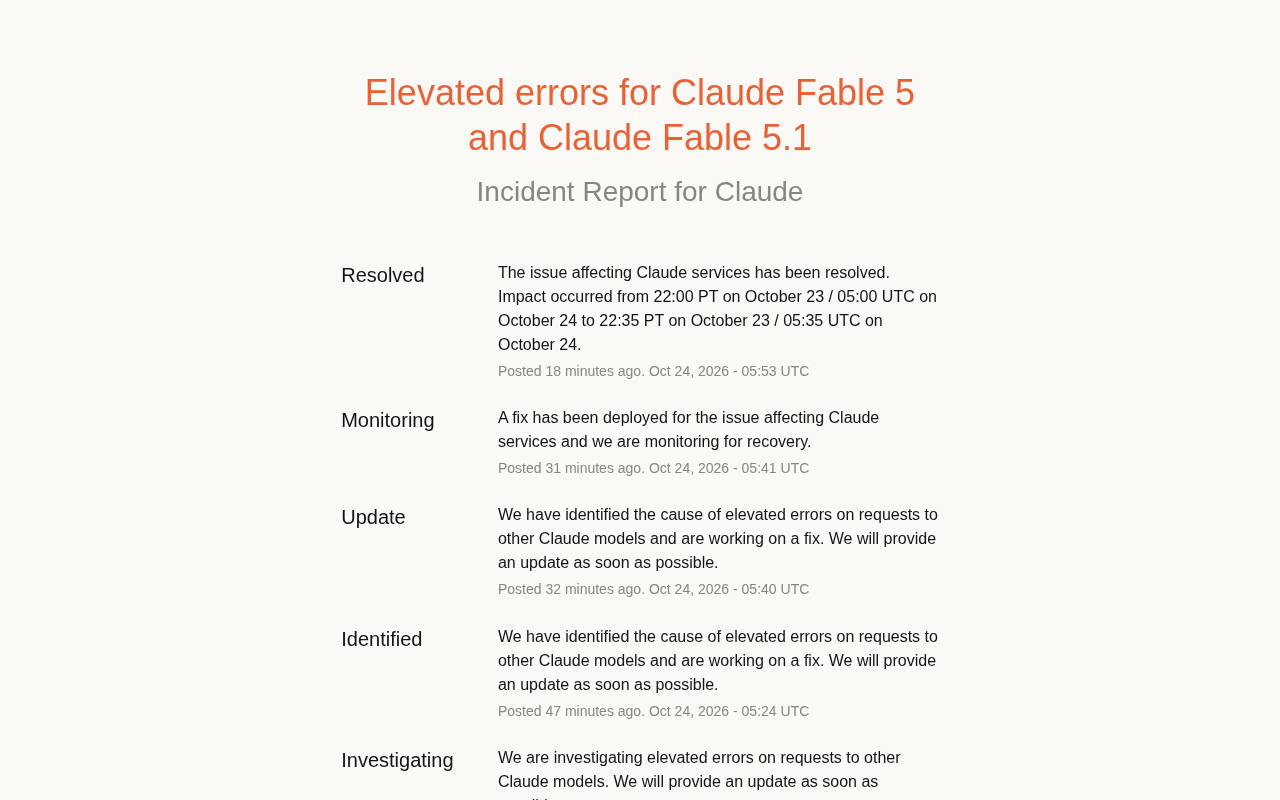
Claude Fable 5/5.1 Outage: A 30-Minute Postmortem
Claude Fable 5 and Fable 5.1 saw elevated error rates for about 35 minutes, per the official status page—from Investigating to Resolved in 37 minutes. This post reconstructs the timeline, analyzes impact on other Claude models, and offers developer guidance on retries, multi-model routing, and monitoring alerts.
Kimi K3.1 Open-Weight Model Hands-On: 3 Trillion Parameters Take On Closed-Source Giants
Kimi K3.1 open-weight model hands-on: 3T-parameter MoE, 1M-token context, stunning 3D rendering but weak spatial reasoning and factual accuracy. Benchmarks near Opus 5.5 at $2.11/task.