NYC ROS Developers Meetup: Talks from Four Robotics Companies
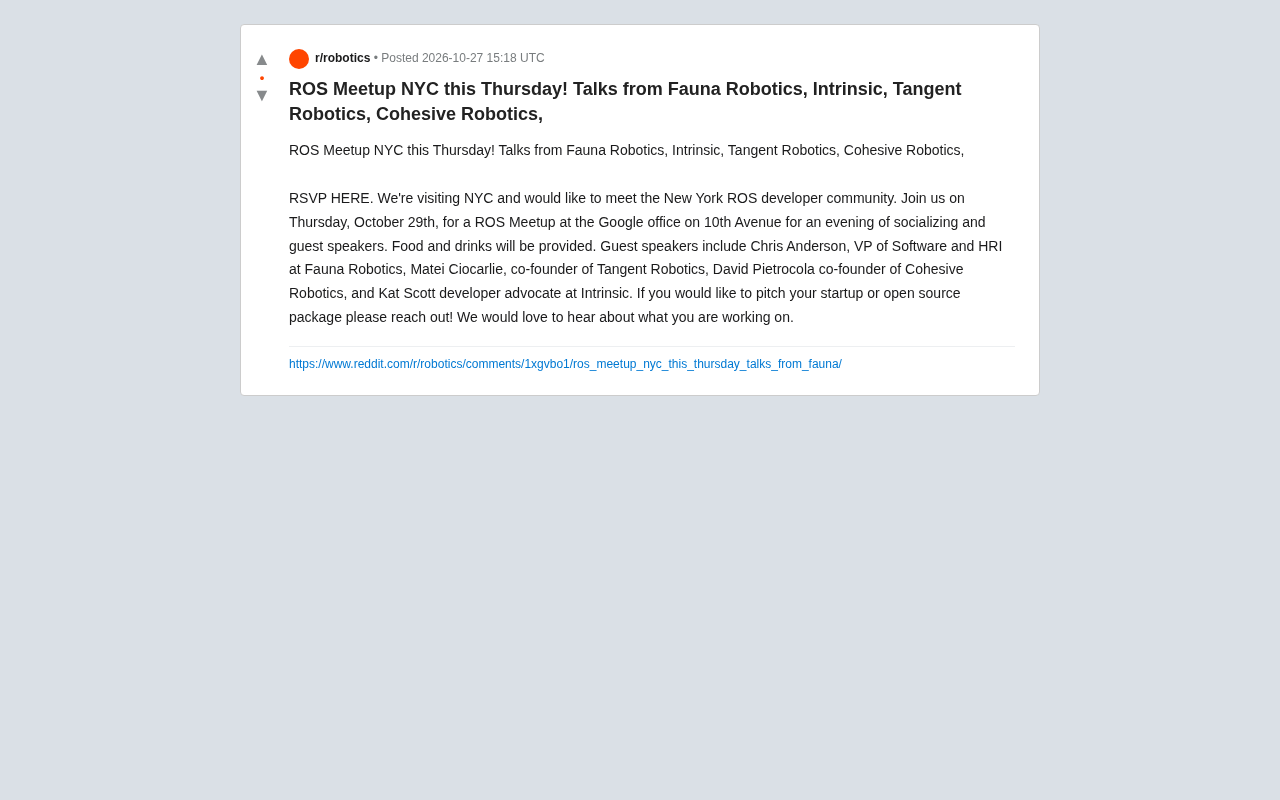
ROS NYC offline meetup on Thursday at Google's office, with four company talks and an open call for speakers.
This article reports on the ROS developer community meetup taking place Thursday (October 29) at Google's office in New York. Organized by community organizers to connect local ROS developers, the free event provides food and requires RSVP via a link. Speakers include Chris Anderson (Fauna Robotics), Matei Ciocarlie (Tangent Robotics), David Pietrocola (Cohesive Robotics), and Kat Scott (Intrinsic), covering humanoid robots, startups, and developer tools. An open call for speakers invites developers to present startups or open-source packages. The original announcement did not disclose specific talk topics or mention streaming or recordings. The article closes with observations on the ROS ecosystem, noting humanoid robots, industrial automation, and developer tools as current areas of interest.
The ROS (Robot Operating System) developer community meetup will be held this Thursday at Google's office in New York.
According to an announcement posted on Reddit, the event is organized by community organizers to connect ROS developers in the New York area. The announcement states that the organizers are visiting New York and want to meet and exchange ideas with local developers. The event takes place on Thursday (October 29) at the Google office on 10th Avenue, with food provided on-site.
Speaker Lineup: Covering Humanoid Robots, Industrial Software, and the Startup Ecosystem
The event features four speakers from different robotics companies, with backgrounds spanning humanoid robots, industrial robot software, and startups.
Fauna Robotics: Software and Human-Robot Interaction
Chris Anderson is the Vice President of Software and Human-Robot Interaction (HRI) at Fauna Robotics. The humanoid robot sector relies heavily on ROS, and the software stack and interaction design are key to bringing such products to market.
ROS (Robot Operating System) is not an operating system in the traditional sense, but rather a middleware framework and toolset for robot software development. It was initially launched by Willow Garage around 2007 and is now maintained by Open Robotics. It provides capabilities such as inter-process communication (a publish/subscribe model based on topics, services, and actions), hardware abstraction, device drivers, visualization tools (such as RViz), and simulation environments (Gazebo), enabling developers to assemble perception, planning, and control components in a modular fashion. ROS 1 reached end-of-life in 2025, and the community is fully migrating to ROS 2, which is built on the DDS communication layer. ROS 2 offers significant improvements in real-time performance, security, and multi-robot distributed deployment, which is an important reason why humanoid robot and industrial robot projects currently adopt ROS 2 universally.
Human-Robot Interaction (HRI) is an interdisciplinary field that studies how information is exchanged and collaboration occurs between humans and robots, integrating robotics, cognitive science, human factors engineering, and interaction design. In humanoid robot products, HRI focuses on natural language and voice interaction, gesture and gaze cues, social norms in motion planning (such as maintaining safe distances and avoiding pedestrians), and conveying the robot's internal state through channels such as expressions or lights to build trust. In terms of engineering implementation, HRI modules typically need to be tightly coupled with perception pipelines, motion control, and safety monitoring nodes in ROS, so this direction relies heavily on the ROS software stack.
Tangent Robotics: Co-Founder with an Academic Background
Matei Ciocarlie is a co-founder of Tangent Robotics. The announcement did not disclose his specific talk topic, but given his role as co-founder, the content may involve the company's technical roadmap or robot manipulation-related directions.
Cohesive Robotics: A Startup Perspective
David Pietrocola is a co-founder of Cohesive Robotics. The announcement provided no further details about the company, and the talk may focus on how startup teams use ROS to rapidly build products.
Intrinsic: Developer Relations
Kat Scott is a developer advocate at Intrinsic. As a participant in the robotics software platform space, Intrinsic's talk may focus on developer tools and ecosystem building.
It should be noted that the original announcement only listed the speakers' names and titles and did not disclose the specific topics of each talk. The above judgments about direction are based on each company's public positioning, not on the announcement content.
Developer Advocate is a role that connects technology platforms with developer communities. Responsibilities include writing tutorials and sample code, giving technical talks at conferences and meetups, collecting developer feedback, and driving product improvements. Unlike purely marketing roles, developer advocates usually have hands-on engineering backgrounds and need to be able to directly demonstrate how to use SDKs or APIs. In the robotics software field, such roles often work around the adoption of open-source frameworks, for example helping developers migrate existing ROS packages to new platforms or toolchains.
Registration and Open Call for Speakers
The announcement invites interested parties to RSVP via a link, with the specific registration link available in the original post. The event also has an open call for speakers, and the organizers say they welcome participants to contact them to introduce their startups or open-source packages in development.
Such offline meetups typically combine both social and technical sharing aspects. For ROS developers in the New York area, it is an opportunity to connect with local peers and learn about other teams' technical practices.
Observations on the ROS Ecosystem
Judging from the speaker lineup, this event brings together developers from commercial companies, startups, and platform companies in one setting. As an open-source middleware widely adopted in the robotics field, ROS community events often reflect the industry's technical focus—humanoid robots, industrial automation, and developer tools are currently areas of interest.
For developers unable to attend, the original announcement did not mention whether online streaming or recordings will be provided. Readers interested in future event information can follow relevant ROS community channels.
Robot Middleware and the Platformization Trend: In recent years, the ROS ecosystem has shown a trend of evolving from a "framework" to a "platform," with typical examples including cloud-hosted services from Open Robotics and no-code/low-code robotics application development platforms from companies such as Intrinsic. Such platforms attempt to lower the barrier to using ROS by packaging common capabilities such as perception and grasp planning into reusable components while preserving interoperability with the ROS 2 ecosystem. At the same time, industrial robot manufacturers (for example, through the ros2_control framework) are gradually accepting ROS 2 as an upper-layer orchestration layer, reflecting that the boundary between open-source middleware and commercial products is becoming blurred.
One-line Summary
ROS NYC offline meetup takes place Thursday at Google's office, with talks from four companies and an open call for speakers.
Paragraph Summary
This article reports on the ROS developer community offline meetup to be held on Thursday (October 29) at Google's office in New York. Organized by community organizers, the event aims to connect ROS developers in the New York area, provides food on-site, and requires RSVP via a link. The speaker lineup includes Chris Anderson, VP of Software and Human-Robot Interaction at Fauna Robotics; Matei Ciocarlie, co-founder of Tangent Robotics; David Pietrocola, co-founder of Cohesive Robotics; and Kat Scott, developer advocate at Intrinsic, covering humanoid robots, startups, and developer tools. The event also has an open call for speakers, welcoming developers to introduce their startups or open-source packages. The original announcement did not disclose specific talk topics or mention online streaming or recordings. The article concludes with observations on the ROS ecosystem based on the speaker lineup, noting that humanoid robots, industrial automation, and developer tools are currently areas of technical interest.
Related articles
Gmod TTT in Horror Mode: Vampires and Werewolves New Roles Tested
Yogscast Halloween Gmod TTT special: Vampire conversion, Werewolf silver-bullet weakness, Frenchman wall-penetrating baguette kills, and role draft strategy shifts—plus balance feedback from the match.
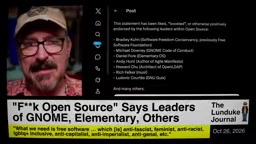
Open Source Leaders Declare "F**k Open Source": The Ideological Schism in the Free Software Movement
Leaders from GNOME, elementary OS, and the Software Freedom Conservancy endorse a "F**k Open Source" statement advocating anti-capitalist, anti-meritocratic free software. This article examines the statement, endorsers, governance controversies, and profanity rhetoric, analyzing the ideological schism's practical impact on project selection.
Professional Designers Test AI-Cloned CAD: How Far Are Fusion/SolidWorks Alternatives Really?
LTT professional designers test AI-cloned Fusion and SolidWorks alternatives SolidCraft and PuraMetric. Interfaces are similar, but shortcuts fail, constraints are missing, and interactions are inconsistent—how far are they from replacing professional CAD tools?