O'Hare Airport Unearths a 50-Ton Boulder, Igniting a Wave of Creative Naming Ideas Online
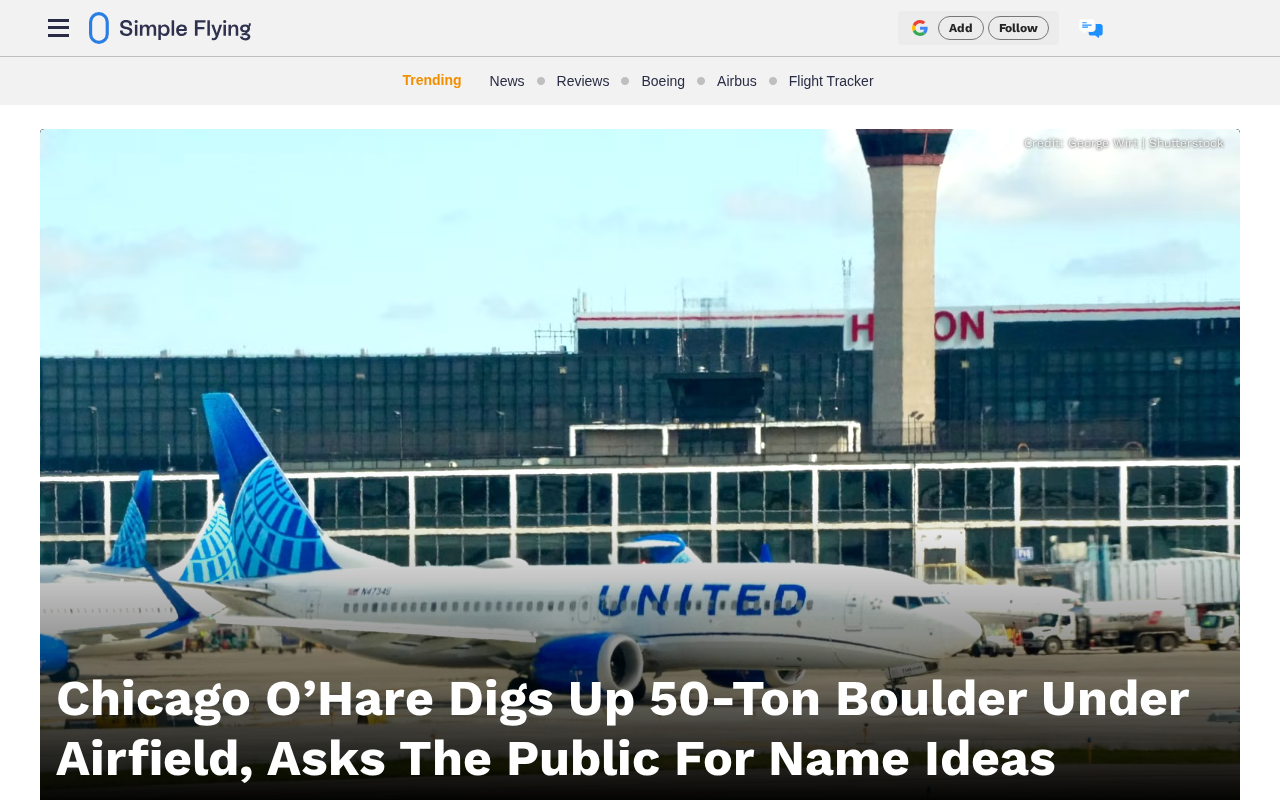
O'Hare Airport kept a 50-ton glacial erratic dug up beneath the runway and publicly solicited names, turning a construction obstacle into a public narrative asset.
While expanding its apron, Chicago O'Hare International Airport dug up a glacial erratic weighing 50 tons from beneath the runway. Instead of crushing and hauling it away, the airport decided to publicly solicit names, making the boulder a new landmark. The article notes that this decision reflects the approach in public space operations of turning construction obstacles into narrative assets, and that the naming campaign is essentially low-cost PR. At the same time, Hacker News comments also remind us that keeping the boulder means additional transportation, landscape, and foundation costs, and that open naming carries the risk of becoming entertainment-oriented, with serious proposals potentially losing to internet memes. Whether an accidental landmark can truly be established depends on subsequent placement and display plans; the name is only the first step.
Chicago O'Hare International Airport, while expanding its apron, dug up a giant glacial erratic weighing 50 tons from underground. Instead of quietly crushing it and hauling it away, airport management decided to solicit name suggestions from the public, turning this boulder that had lain dormant underground into a new airport landmark.
An Uninvited Guest Beneath the Airport
According to reports cited in a Hacker News discussion thread, the boulder was discovered by construction machinery in the soil layer beneath the airport runway. At 50 tons, it weighs roughly the same as 10 adult African elephants, or a fully loaded concrete mixer truck. For flights taking off and landing every day, it was originally just an unknown presence beneath the foundation.
Geologists typically call such boulders "glacial erratics"—they were transported by ancient glaciers from rock formations hundreds of kilometers away and left behind beneath the plains after the ice age ended. The Midwest region of the United States, where Chicago is located, was an area of frequent glacial activity, so giant erratics buried underground are not uncommon—but finding a rock of this size beneath an airport runway is still rare.
A glacial erratic is a core concept in glacial geology. During the Pleistocene ice ages, the North American continental ice sheet advanced from Canada into the U.S. Midwest, and the base of the ice froze and entrained large quantities of rock blocks. When the glacier melted or retreated, these rock blocks were released in place, accumulating in areas completely different from their original bedrock sources. The region where Chicago is located was covered by the Laurentide Ice Sheet during the Wisconsin glaciation about 20,000 years ago, and the southernmost edge of the ice sheet reached what is now central Illinois. By comparing the rock types of erratics with the surrounding bedrock, geologists can infer their places of origin and thereby reconstruct the flow paths of ancient glaciers. For example, if copper-bearing rock blocks from near Lake Superior appear underground hundreds of kilometers away in Chicago, that is direct evidence of the ice sheet transporting them from north to south. Therefore, such erratics are not just construction obstacles but also physical archives for interpreting regional geological history.
Why Not Crush It? The Public Value of a Stone
From an engineering perspective, the simplest way to deal with this boulder would be to blast it and haul it away. But the airport chose to keep it and publicly solicit names. Behind this decision is a public space operation approach worth pondering: turning a construction obstacle into a narrative asset.
The discussion in the Hacker News comment section offers another perspective. Some commenters pointed out that the cost of moving and installing a 50-ton boulder could be considerable, and keeping it would mean additional investment in subsequent landscape design, transportation, and foundation treatment. Others believed that this kind of "naming a stone" operation is essentially low-cost PR—trading a naming campaign for media exposure is far more cost-effective than buying advertising.
The two views are not contradictory. When public institutions deal with unexpected discoveries, they often need to find a balance between engineering efficiency and public participation. The real value of a naming campaign lies not in how clever the name itself is, but in turning a construction event into a topic that citizens can participate in.
The concept of "narrative asset" in public space operations refers to transforming infrastructure or construction byproducts that originally have no narrative value into story carriers that can be spread and participated in through cultural processing. The corresponding common approach is the "engineering-first" path: crushing and hauling away according to the lowest-cost principle, leaving no trace after the project is completed. Choosing to keep it and solicit names means the institution voluntarily bears additional costs (transportation, installation, landscape design) in exchange for public attention and social capital. This strategy is increasingly common in museums, transportation hubs, and urban planning. Its success depends on whether the subsequent presentation quality can support public expectations; if the display plan is crude, the narrative asset will quickly depreciate and may even trigger negative evaluations of "wasting public funds."
Online Naming: Creativity and Controversy Coexist
After the naming announcement spread through communities such as Hacker News, the comment section quickly turned into a naming contest venue. The fun of such activities lies in the fact that participants' naming logic is often completely different: some start from geology and suggest glacial terminology; some approach it from airport culture and propose aviation terms; and others simply pursue puns and humorous effects.
The risks of this kind of open naming are equally obvious. Public voting mechanisms tend to let the most entertaining names win rather than the names that best fit the site's character. Similar situations have occurred in many previous landmark naming campaigns in cities—serious proposals lost to internet memes. It is currently unclear whether the airport has set up a screening mechanism.
From the perspective of communication impact, the naming campaign has already achieved its goal. A geological discovery that originally existed only in engineering reports has now become discussion material on social media. For the airport, this is perhaps more efficient than any publicity budget.
Open naming campaigns usually face a "voting paradox": the more participants and the lower the threshold, the more the voting results tend toward entertainment and meme culture. This is an incentive misalignment in mechanism design—professional proposers have little motivation to submit serious names, while participants seeking communication impact will concentrate their votes on humorous options. Possible mitigation mechanisms include weighting by an expert review panel, separate tracks for public voting and professional review, or hard screening criteria for how well a name fits the site. In practice, the "Boaty McBoatface" incident at the UK's Natural History Museum is a typical negative example: the entertaining name selected by public vote was ultimately rejected by the institution and replaced with a professional name, while the name was retained as a codename for a subproject to partially satisfy the public's sense of participation. Whether O'Hare Airport adopts a similar compromise will determine the final direction of the naming campaign.
From Boulder to Landmark: The Contingency of Public Art
This boulder at O'Hare Airport brings to mind a broader phenomenon: many urban landmarks are not products of planning but byproducts of accidental discovery. Rock layers dug up during construction, components retained during demolition, and even abandoned industrial facilities may all be redefined as landscapes after public participation.
Whether such "accidental landmarks" succeed depends on how they are subsequently presented. If an untreated boulder is simply placed by the roadside, it will be difficult to generate sustained appeal; but with interpretive signs, geological background introductions, and appropriate design intervention, it can become a node with both educational and ornamental value. The airport has currently only announced the naming plan, and specific placement and display plans have not yet been disclosed.
For O'Hare Airport, which handles hundreds of thousands of passengers every day, whether this 50-ton stone can become an object that travelers are willing to stop and photograph depends on where it is ultimately placed and how its story is told. The name is only the first step.
One-line Summary
O'Hare Airport kept a 50-ton glacial erratic dug up beneath the runway and publicly solicited names, turning a construction obstacle into a public narrative asset.
Paragraph Summary
While expanding its apron, Chicago O'Hare International Airport dug up a glacial erratic weighing 50 tons from beneath the runway. Instead of crushing and hauling it away, the airport decided to publicly solicit names, making the boulder a new landmark. The article notes that this decision reflects the approach in public space operations of turning construction obstacles into narrative assets, and that the naming campaign is essentially low-cost PR. At the same time, Hacker News comments also remind us that keeping the boulder means additional transportation, landscape, and foundation costs, and that open naming carries the risk of becoming entertainment-oriented, with serious proposals potentially losing to internet memes. Whether an accidental landmark can truly be established depends on subsequent placement and display plans; the name is only the first step.
Related articles

LLaMA-Factory in Practice: A Complete No-Code Guide to Fine-Tuning Large Models
An introduction to LLaMA-Factory, the open-source fine-tuning tool: its 60.1K-star background, supported models and algorithms, local vs. cloud deployment, and CUDA setup steps.

Zeng Ming's Deep Retrospective: Why OpenAI May Not Be the Ultimate Winner — and Why the Corporate System Will Disappear
Zeng Ming's deep retrospective on the AI endgame: model companies are just infrastructure, OpenAI and Anthropic won't be the final winners; the next battle is the Agent entry point standard; the corporate system will disappear as AI restructures collaboration, and only mission-driven companies can survive the cycle.

OpenHands v1.28.0: OpenCode and PI Added as Built-in Agents, API Keys Requestable In-Conversation
OpenHands ships 5 releases in 21 days: v1.27.0 adds OpenCode and PI as built-in agents, v1.28.0 enables in-chat key requests. ACP integration, credential reuse, model list changes, and upgrade advice.