Oats: A Fully Open-Source, Locally-Run, Free AI Meeting Notetaker
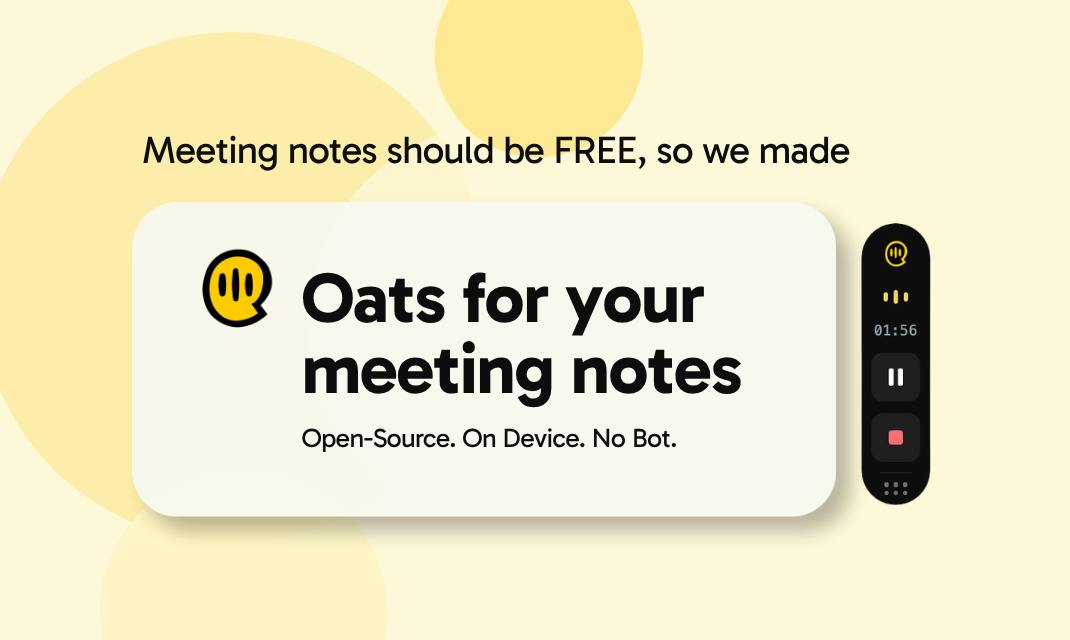
Oats is a free, open-source AI meeting notetaker that runs entirely on-device with no bots and no cloud uploads.
Oats is an AI meeting notetaker built for users who care about privacy and data sovereignty. Fully open-source and free, it runs on macOS and Windows, processing audio and transcripts locally via an on-device LLM — no cloud uploads, no bot accounts joining your calls. It uses a tiered model: free local processing as the base, with optional ariso.ai cloud integration for enhanced transcription, speaker identification, multilingual support, and coaching analytics. Earning 252 upvotes and ranking #6 on Product Hunt, Oats represents a meaningful shift toward user-controlled AI tooling, though local LLM hardware requirements and real-world transcription quality still warrant further validation.
An AI Notetaker That Won't Disrupt Your Meetings
In an era where remote work and online meetings have become the norm, AI meeting note-taking tools are nothing new. But the vast majority of similar products rely on cloud-based processing, require injecting a "bot" participant into your calls, and charge monthly subscription fees. Oats takes a different approach: fully open-source, locally run, and completely free.
This product launched on Product Hunt, earning 252 upvotes and ranking #6 for the day. Its core philosophy is simple: "don't disrupt your meetings" — no bot joins your call, and no subscription is required when running locally. It supports both macOS and Windows.
The Privacy Value of Local-First Design
The most noteworthy design choice in Oats is its on-device LLM — running a large language model locally on your device to process meeting content. This means audio and transcripts never need to be uploaded to third-party servers; your meeting data stays on your own machine.
For teams handling sensitive business discussions, legal communications, or customer privacy information, this is a genuinely meaningful differentiator. Cloud-based meeting tools may be feature-rich, but "where does the data go?" remains a persistent concern for enterprise compliance teams. Oats sidesteps this question entirely by keeping everything local.
Local execution also means zero marginal cost — no cloud compute fees, and therefore no subscription barrier. This stands in sharp contrast to commercial products that charge by meeting duration or per seat.
On-device LLM implementations typically rely on Whisper (OpenAI's open-source speech recognition model) for transcription, and locally deployable small-parameter models like Llama or Mistral for summarization and analysis. These models can run on standard consumer hardware after quantization compression, though they still require adequate RAM and CPU/GPU performance — at least 8GB of memory is generally recommended, with 16GB or more for a better experience. Local inference also introduces higher latency compared to cloud APIs, meaning post-meeting processing may take longer than cloud-based alternatives. This is a real trade-off users should weigh alongside the privacy benefits of local-first design.
A Dual-Track Model: Free Local + Optional Cloud
Oats takes a pragmatic product strategy: the core local note-taking functionality is completely free and open-source, while more advanced capabilities are offered through the ariso.ai cloud backend.
According to official documentation, the cloud backend unlocks a range of enhanced features, including:
- Enhanced transcription: Higher-accuracy speech-to-text
- Multilingual support: Handling meetings across different languages
- Speaker identification: Distinguishing between different speakers in a meeting
- Assessment and coaching: Analytical feedback on communication content
- Automatic follow-up tracking: Auto-organized action items and follow-ups after meetings
This tiered design — free local as the foundation, paid cloud for advanced features — serves both privacy-conscious individual users and teams that need deeper collaboration and analysis capabilities. Users can freely choose their own balance between privacy and functionality based on their needs.
What the Open-Source Route Means
Oats is categorized under tags like Open Source, Meetings, Artificial Intelligence, and GitHub — a clear signal of its positioning as a developer-friendly, auditable, and self-hostable tool.
For AI tools with open-source credentials, public code means the community can verify whether the promise of "runs locally, doesn't upload data" is genuine — rather than relying solely on vendor claims. This kind of transparency is especially important in a privacy-sensitive tool category. Open-source also leaves room for custom development and integration into internal workflows.
Judging by the discussion activity across 64 comments on Product Hunt, local-first AI applications are attracting a growing cohort of users with clear data sovereignty requirements.
Self-hosting is a critical extended use case for open-source privacy tools: organizations can deploy Oats on internal servers to provide a unified meeting note-taking service for their teams, ensuring all data flows entirely within their own infrastructure without passing through any third-party network. This is especially important for industries under strict data compliance regulations — such as finance, healthcare, and legal — where regulations like the EU's GDPR or China's Data Security Law impose explicit restrictions on cross-border transfer of personal and sensitive data. Code auditability also means security teams can independently review network call behavior, rather than relying on vendor privacy policy statements.
Things Worth Watching — But Still to Be Verified
As a newly launched product, Oats' real-world experience still needs more long-term user feedback to validate. Running an LLM locally places certain demands on device performance, and transcription quality, real-time responsiveness, and compatibility with different conferencing software are all factors that potential users will need to test themselves.
Additionally, how the feature boundary between the free local version and the ariso.ai cloud version is drawn — and the pricing strategy for cloud services — will directly affect how well it can be adopted in team settings.
That said, Oats represents an important direction for AI meeting tools: putting the choice back in the hands of users. In a market where it's often "go full cloud or go without," a genuinely open-source, local-first, freely available option has inherent value in its own right.
Related articles
Free Open-Source Tool Rejected: The Community Controversy Sparked by r/DnD's AI Ban
A free open-source DnD campaign tool was rejected by r/DnD's AI ban — yet the same tool was approved a year ago. The case highlights the blurry line between AI tools and AI-generated content.
What LLMs Can You Run with 1.9TB of RAM? Exploring the Ceiling of Local AI Deployment
A Reddit user with 1.9TB of RAM sparked debate about local LLM deployment. We break down what massive RAM enables, where CPU inference falls short, and the real bottlenecks.
Researchers Use Claude to Hack OpenAI Systems: A New Wake-Up Call for AI Security
Security researchers used Anthropic's Claude to breach OpenAI systems, taking over employee accounts and accessing internal repos. What this means for AI security.