OBB-Annotated Human Detection Datasets: Current State, Challenges, and Solutions
Exploring why OBB human detection datasets are scarce and four practical solutions to bridge the gap.
This article examines the gap in OBB (Oriented Bounding Box) annotated human detection datasets. It explains why OBB annotations are valuable for aerial, fall detection, and crowded scenes, and why current OBB datasets focus on remote sensing. Four solutions are presented: extracting human classes from aerial datasets, auto-converting keypoint/segmentation data to OBB, using YOLOv8-OBB frameworks, and generating synthetic data.
Starting from a Real-World Need
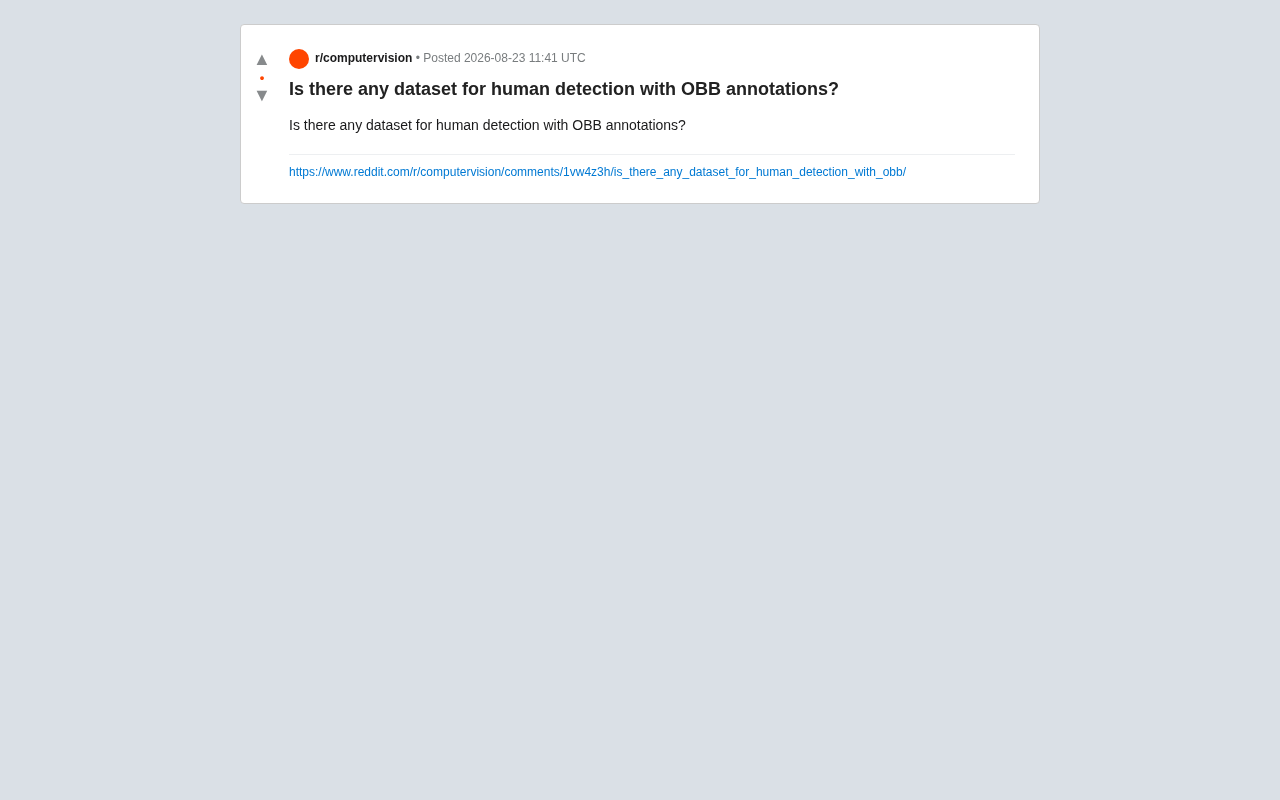
In the computer vision community, a seemingly simple question has revealed a gap in the current object detection dataset ecosystem: Are there any human detection datasets with OBB (Oriented Bounding Box) annotations?
This question originated from a discussion on the Reddit community. The poster needed OBB annotations to train a human detection model but found that virtually all mainstream datasets exclusively use traditional Horizontal Bounding Boxes (HBB). While this need may seem niche, it reflects a long-overlooked technical direction in the field of object detection.
What Is OBB Annotation, and Why Does It Matter for Human Detection
The Core Difference Between HBB and OBB
Traditional object detection uses Horizontal Bounding Boxes (HBB) — axis-aligned rectangles that enclose the target. An HBB is defined by four parameters: the top-left corner coordinates (x, y), width (w), and height (h), with its edges always parallel to the image axes. This representation was widely adopted in early computer vision because it's computationally simple and enables efficient post-processing algorithms like Non-Maximum Suppression (NMS). It remains the standard approach in classic datasets like COCO and Pascal VOC.
However, horizontal boxes have an inherent limitation: when a target is tilted, rotated, or not axis-aligned, the bounding box inevitably includes a significant amount of irrelevant background. Oriented Bounding Boxes (OBB) address this by adding a rotation angle parameter, allowing the bounding box to align with the target's actual orientation and significantly reducing redundant area. An OBB requires five parameters: center coordinates (cx, cy), width (w), height (h), and rotation angle (θ). An alternative representation uses four corner-point coordinates, totaling 8 values. OBBs allow the bounding box to rotate at any angle around its center, fitting the target's actual contour much more tightly. Mathematically, this is a special case of affine transformation — it adds rotational freedom compared to HBB, but also significantly increases the computational complexity of IoU (Intersection over Union) calculations, NMS, and other algorithms.
Typical Use Cases of OBB in Human Detection
For human detection tasks, OBB annotations are particularly valuable in the following scenarios:
- Aerial and drone perspectives: When shooting from above, human bodies can appear at any angle, and horizontal boxes severely overestimate the space they occupy.
- Fall detection: After a fall, the body assumes a horizontal or tilted posture, and OBBs can describe the posture change much more precisely.
- Crowded scenes: In dense crowds, OBBs reduce overlap between adjacent detection boxes, improving instance separation.
- Motion analysis: In sports, dance, and similar scenarios where body postures change dramatically, oriented boxes better capture the true body orientation.
Current State Analysis: Why OBB Human Detection Datasets Are Lacking
OBB Annotation Primarily Serves the Remote Sensing Domain
Currently, the vast majority of OBB-annotated datasets are concentrated in the remote sensing and aerial imagery domain. Representative datasets include:
- DOTA dataset: A large-scale aerial image object detection dataset covering categories like aircraft, ships, and vehicles — the benchmark for OBB-based rotated object detection research. DOTA was released in 2018 by institutions including Wuhan University and was specifically designed for remote sensing object detection. The dataset contains 2,806 high-resolution images with over 180,000 annotated instances across 15 categories (plane, ship, storage tank, baseball diamond, tennis court, basketball court, ground track field, harbor, bridge, large vehicle, small vehicle, helicopter, roundabout, soccer ball field, and swimming pool). What makes DOTA unique is that its images are extremely large (800×800 to 4000×4000 pixels), requiring patch-based processing; targets span a wide range of scales from tens to thousands of pixels; and targets are densely packed with arbitrary orientations, making OBB annotation essential. DOTA has evolved to v2.0 and serves as the primary benchmark for rotated object detection algorithms.
- HRSC2016: Focused on ship detection in remote sensing images.
- DIOR-R: The rotated annotation version of the DIOR dataset.
These datasets adopt OBB because targets in remote sensing images (such as ships, vehicles, and buildings) inherently appear at arbitrary orientations. In contrast, for human detection from everyday viewpoints, the human body is mostly upright, making horizontal boxes perfectly adequate — which eliminates the motivation to create OBB annotations.
High Annotation Costs and Ecosystem Inertia
OBB annotation is more complex than HBB, requiring additional marking of rotation angles, which increases per-image annotation time and cost. Moreover, HBB datasets like COCO have built up a massive ecosystem of pre-trained models and toolchains, and this community inertia has kept OBB human body datasets in a persistent state of absence.
COCO (Common Objects in Context), released by Microsoft in 2014, contains over 200,000 images across 80 everyday object categories and is one of the most influential benchmark datasets in computer vision today. COCO provides not only bounding box annotations but also instance segmentation masks, keypoint annotations, image captions, and other multimodal data, making it the de facto standard for object detection, instance segmentation, pose estimation, and more. The ecosystem built around COCO-pretrained models is enormous: virtually all major detection frameworks provide COCO-pretrained weights; academia uses COCO mAP as the primary metric for model performance; and industry commonly uses COCO-pretrained models as starting points for transfer learning. This ecosystem inertia makes it very difficult for datasets that deviate from the COCO annotation format to receive the same level of community support and toolchain maturity.
Four Viable Solutions for OBB Human Detection Datasets
Although there are no readily available dedicated datasets, the community has accumulated several viable approaches through practice.
Solution 1: Extract Human Categories from Remote Sensing Datasets
Aerial datasets like DOTA already contain OBB annotations for "person" or "pedestrian" categories. If your application scenario involves an aerial perspective, you can directly filter and extract these category subsets for training.
Solution 2: Automatically Generate OBB from Existing Annotations
For human body datasets that already have pose estimation or segmentation annotations (such as COCO Keypoints or MPII), you can automatically compute the minimum enclosing rotated rectangle from keypoints or segmentation masks to generate OBB annotations. This approach leverages massive amounts of existing data and is one of the most cost-effective paths.
Human Pose Estimation is a classic task in computer vision that aims to detect key skeletal points on the human body (such as shoulders, elbows, wrists, hips, knees, and ankles), typically outputting 2D coordinates for 17 or more keypoints. Pose estimation data has a natural conversion relationship with OBB: given a set of keypoints, you can compute the body's principal direction using PCA (Principal Component Analysis), or directly generate an OBB using a minimum enclosing rotated rectangle algorithm. The advantage of this conversion is that it can reuse massive existing datasets such as COCO Keypoints (with 17-point annotations for over 200,000 human instances) and MPII Human Pose (25,000 images). The conversion algorithm can be implemented using OpenCV's minAreaRect function, or by computing the principal direction from the keypoint covariance matrix, dramatically reducing the cost of upgrading from HBB to OBB data.
Solution 3: Use Detection Frameworks That Support Oriented Boxes, Such as YOLOv8-OBB
YOLOv8-OBB and other next-generation detection frameworks natively support oriented bounding box training. YOLOv8, released by Ultralytics in January 2023, features several architectural improvements over its predecessors: it adopts an anchor-free design that simplifies the training pipeline; replaces C3 modules with C2f modules for enhanced feature fusion; and introduces new loss function designs, including VFL (Varifocal Loss) for classification and DFL (Distribution Focal Loss) + CIoU for bounding box regression.
YOLOv8-OBB is its dedicated oriented object detection variant. Its network structure is similar to standard YOLOv8, but with key modifications in the detection head: the output layer predicts 5 parameters (cx, cy, w, h, θ) instead of 4; Rotated IoU is used as the training objective; and post-processing employs Rotated NMS. Developers only need to prepare OBB-format annotation data (typically four corner-point coordinates) to train a custom rotated object detection model. Combined with semi-automatic annotation tools, you can quickly build small-scale datasets tailored to specific scenarios.
Solution 4: Use Synthetic Data to Compensate for Real Sample Scarcity
For scenarios like fall detection where collecting real data is difficult, you can leverage 3D human models and rendering engines to generate synthetic images with precise OBB annotations, compensating for the shortage of real data.
Synthetic Data refers to artificially generated images created through computer graphics techniques, playing an increasingly important role in computer vision training. A typical pipeline includes: creating scenes using 3D modeling software (such as Blender, Unity, or Unreal Engine); importing 3D human body models (such as SMPL or SMPL-X parametric models); configuring lighting, materials, and camera parameters; and automatically exporting annotations while rendering images. The advantages of synthetic data are that annotations are perfectly accurate at zero cost, rare scenarios can be generated on demand, and viewpoints that are difficult to capture in reality can be easily produced. The disadvantage is the domain gap — differences in texture, lighting, and physical properties between synthetic and real images. Solutions include domain randomization (randomizing scene parameters), domain adaptation (using GANs and similar techniques to narrow the domain gap), and mixed training (real data + synthetic data). For safety-related tasks like fall detection, synthetic data has been proven effective in addressing the scarcity of real-world data.
Practical Advice for Developers
This seemingly niche question actually reveals a more universal pattern: dataset ecosystems often lag behind the adoption of new technical methods. As OBB detection algorithms mature and enter mainstream frameworks, the corresponding multi-domain annotated data has yet to catch up.
For teams with OBB human detection needs, here is some pragmatic advice:
- Clarify your application perspective first — Does your standard viewpoint truly require OBB, or could HBB combined with pose estimation already meet your needs?
- Prioritize reusing existing resources — Upgrade existing HBB or keypoint data to OBB annotations through automatic conversion.
- Embrace new toolchains — Frameworks like YOLOv8-OBB have significantly lowered the barrier to deploying OBB models.
As applications in drone vision, intelligent surveillance, and behavior analysis continue to deepen, OBB datasets for human detection are expected to gradually mature. Until then, flexible data conversion and synthesis strategies remain the key to filling this gap.
Related articles

Free Unlimited Claude Code Solution: Agnes AI + CC Switch Setup Guide
No paid subscription needed — pair the free AI platform Agnes AI with the open-source tool CC Switch to provide a backend for Claude Code, enabling unlimited free calls to text, image, and video models. This guide covers the full setup, test results, and usage boundaries.

A Complete Zero-Cost Guide to Getting Started with Claude Code for Beginners in China
A beginner's guide to Claude Code for users in China: two installation methods (command line and IDE plugin), full configuration steps for replacing the official API with the free domestic LongCat model, and a hands-on demo of building a small tool with natural language, plus tips.

When the NSA Gets Involved: The AI Supply Chain Crisis Behind Open-Source CVEs and API Key Hijacking
Multiple open-source projects disclosed severe CVEs in one day, PHP flaws alarmed the FBI, and Railway and OpenCode were breached with API keys stolen. This article breaks down the vulnerability window, AI-accelerated exploitation, and the AI supply chain crisis behind the API key black market, with a developer defense checklist.