Observability of Information Flow in LLM Swarms: A New Behavioral Probe Approach

Quantifying LLM swarm information flow with behavioral probes to aid node pruning and path search.
This study addresses the issue that LLM multi-agent system optimization is long driven by task utility while internal information flow remains unobservable, proposing behavioral probes to quantify information flow patterns in swarms. The authors reuse External Context Score (ECS) and Parametric Knowledge Score (PKS) from hallucination analysis to characterize node reliance on external input versus parametric knowledge. Experiments show ECS rises with input relevance and PKS declines as informative context accumulates, consistent across controlled and real scenarios. Two controlled applications are demonstrated: probe-guided node pruning reduces redundant communication and token consumption, and probe-guided reasoning path search accelerates convergence over utility-only baselines. The authors stress probes are auxiliary to utility optimization and need further validation on large-scale complex tasks.
Multi-agent systems (LLM Swarms) have long been optimized based on task utility, but how information flows, integrates, and depends across nodes has remained a black box. A recent arXiv study proposes using "behavioral probes" to quantify information flow, offering a new auxiliary signal for optimizing swarm structure.
From Utility Optimization to Information Flow Observation
Most existing LLM swarm optimization methods focus on final task utility, implicitly handling information processing, integration, and dependencies within individual interactions. While this utility-driven perspective is effective, it struggles to explain why swarms succeed or fail.
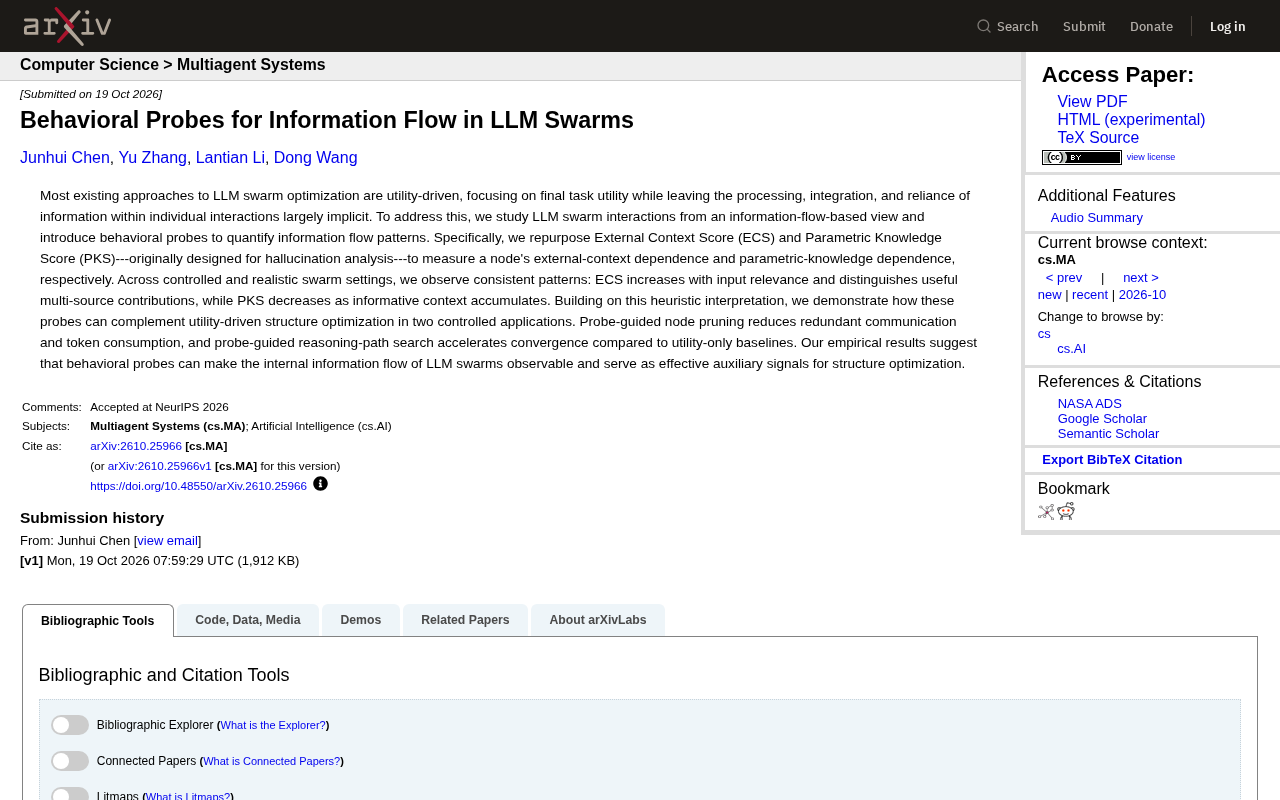
This study shifts to an information flow perspective, introducing behavioral probes to quantify information flow patterns. The core idea is straightforward: reuse two metrics originally designed for hallucination analysis—External Context Score (ECS) and Parametric Knowledge Score (PKS)—to measure a node's reliance on external context versus its reliance on model parameter knowledge, respectively.
The cleverness of this transfer lies in the fact that hallucination analysis focuses on whether a model over-relies on parametric knowledge while ignoring external evidence, whereas swarm information flow concerns precisely how nodes balance information from different sources. Both scenarios share the same underlying mechanism: where information comes from and how it is used.
ECS (External Context Score) and PKS (Parametric Knowledge Score) originally appeared in research on hallucination detection in large models. ECS measures the extent to which a model's output depends on external context provided in the prompt—a higher score indicates the model is more inclined to "speak according to the materials"; PKS measures the extent to which a model calls upon knowledge stored in its own parameters—a higher score indicates greater reliance on pre-trained memory rather than input information. Both are typically computed based on analysis of the model's internal activations or output distributions, rather than manual annotation. In hallucination research, the ideal state is for the model to lower PKS and raise ECS when it should rely on external evidence, avoiding "fabrication out of thin air"; in multi-agent swarms, the same metrics precisely characterize the trade-off between a node receiving information from upstream and downstream neighbors versus completing information from its own parameters—this is the logical basis for the study's transfer of these metrics to information flow observation.
Consistent Probe Patterns in Swarms
The study observes consistent patterns in both controlled and real-world swarm settings. ECS rises as input relevance increases and can distinguish useful multi-source contributions; PKS declines as informative context accumulates.
This pattern is intuitive: the more relevant and information-rich the external context, the more a node tends to rely on external input rather than internal parametric knowledge. Conversely, when contextual information is sparse, the node draws more on parametric knowledge to fill in gaps. The value of the probe lies in translating this intuition into a measurable signal.
According to the paper, these patterns remain consistent across both controlled and real-world scenarios, indicating that the probes possess a degree of robustness and do not depend on specific task configurations.
Two Controlled Applications: Pruning and Path Search
Based on the above heuristic interpretation, the study demonstrates how probes can complement utility-driven structural optimization, specifically through two controlled applications.
Probe-guided node pruning. By identifying nodes with low information flow contributions, pruning can reduce redundant communication and token consumption. In swarm systems, redundant communication is one of the primary sources of cost, and pure utility signals struggle to pinpoint which nodes are "idling."
Probe-guided reasoning path search. Using probe signals to guide path search can accelerate convergence compared to utility-only baselines. This means information flow signals are not only used for diagnosis but can also directly participate in search process decisions.
Together, the two applications demonstrate that probes do not replace utility optimization but serve as complementary auxiliary signals.
Node pruning in multi-agent systems refers to removing certain nodes or edges to reduce communication overhead. The token cost of LLM swarms grows approximately linearly or even super-linearly with the number of nodes and interaction rounds, making pruning a key means of reducing inference costs. Traditional approaches typically rank nodes by their marginal contribution to the final answer, but utility signals are noisy and coarse-grained, making it difficult to identify redundant nodes that "participate in many interactions yet transmit almost no useful information." Probe-guided pruning directly uses ECS/PKS to determine whether a node is genuinely integrating external information, thereby eliminating idling nodes while maintaining task performance. This aligns with the idea of structured pruning in model compression, but operates on system topology rather than network weights.
Significance and Limitations
The core contribution of this work is making the internal information flow of LLM swarms observable. For a long time, debugging and optimization of multi-agent systems have relied on external metrics, with internal mechanisms difficult to discern. Behavioral probes provide a low-cost, interpretable observation method.
That said, the study has only validated the effectiveness of probes in controlled applications; performance in larger-scale, more complex tasks remains to be tested. Moreover, as heuristic metrics, the explanatory boundaries of ECS and PKS have not been fully characterized. The authors also position them as "auxiliary signals" rather than independent optimization objectives.
For developers building multi-agent applications, this approach offers a practical insight: beyond focusing on final outcomes, it may be worth observing how information flows between nodes—this could be another path to discovering performance bottlenecks.
One-line Summary
Using behavioral probes to quantify information flow in LLM swarms, aiding node pruning and path search.
Paragraph Summary
This study addresses the problem that LLM multi-agent system optimization has long been driven by task utility while internal information flow remains unobservable, proposing behavioral probes to quantify information flow patterns within swarms. The authors reuse External Context Score (ECS) and Parametric Knowledge Score (PKS) from hallucination analysis to characterize a node's reliance on external input versus model parametric knowledge. Experiments find that ECS rises with input relevance and PKS declines as informative context accumulates, with this pattern consistent across controlled and real-world scenarios. Based on this, the study demonstrates two controlled applications: probe-guided node pruning reduces redundant communication and token consumption, and probe-guided reasoning path search accelerates convergence compared to utility-only baselines. The authors emphasize that probes are auxiliary signals to utility optimization and require further validation in large-scale complex tasks.
Related articles

Cursor AI Programming in Practice: Build a Student Management System from Scratch in 30 Minutes
A Bilibili creator demonstrates Cursor AI programming: generating a student management system in 30 minutes with natural language. Details on Agent mode, Claude selection, prompt techniques, and thresholds.

Top 20 AI Coding Tools Ranking: From Rock-Solid to Lackluster, a Scored Matrix
Bilibili creator releases top 20 AI coding tools ranking, tiered T0–T4 from rock-solid to lackluster, with Claude Code and Codex tied at T0. This article details the scoring dimensions (capability, reliability, robustness, durability, cost, domestic availability) and tool performances to help developers choose the right AI coding assistant.

Vibe Coding Systematic Tutorial: Master AI-Assisted Programming from Zero
A three-month Vibe Coding tutorial from a Bilibili creator covering Codex, ClaudeCode, and Cursor, from core logic to commercial project practice for beginners.