Ocean Monitoring Startup Quartermaster Raises Another $140M

Quartermaster raises $140M to build real-time ocean surveillance and close the sea's massive visibility gap.
Ocean monitoring startup Quartermaster has announced a new $140 million funding round, targeting what it calls "the largest blind spot on Earth." Traditional AIS systems rely on vessels actively broadcasting their location — once switched off, ships disappear entirely, enabling illegal fishing, smuggling, and sanctions evasion. Quartermaster fuses satellite imagery, RF signals, and radar data with AI to deliver real-time maritime domain awareness for defense, law enforcement, fisheries regulation, and commercial shipping. As geopolitical tensions rise and maritime security gains urgency, this sector is rapidly expanding from defense-exclusive demand into the commercial market.
The Ocean Emerges as Tech Capital's New Frontier
Ocean monitoring startup Quartermaster has announced a new $140 million funding round. According to reports, the company's technology is aimed squarely at what it calls "the largest blind spot on Earth" — the vast, near-impossible-to-monitor expanse of the world's oceans. The new capital will accelerate the commercial rollout of its maritime domain awareness technology.
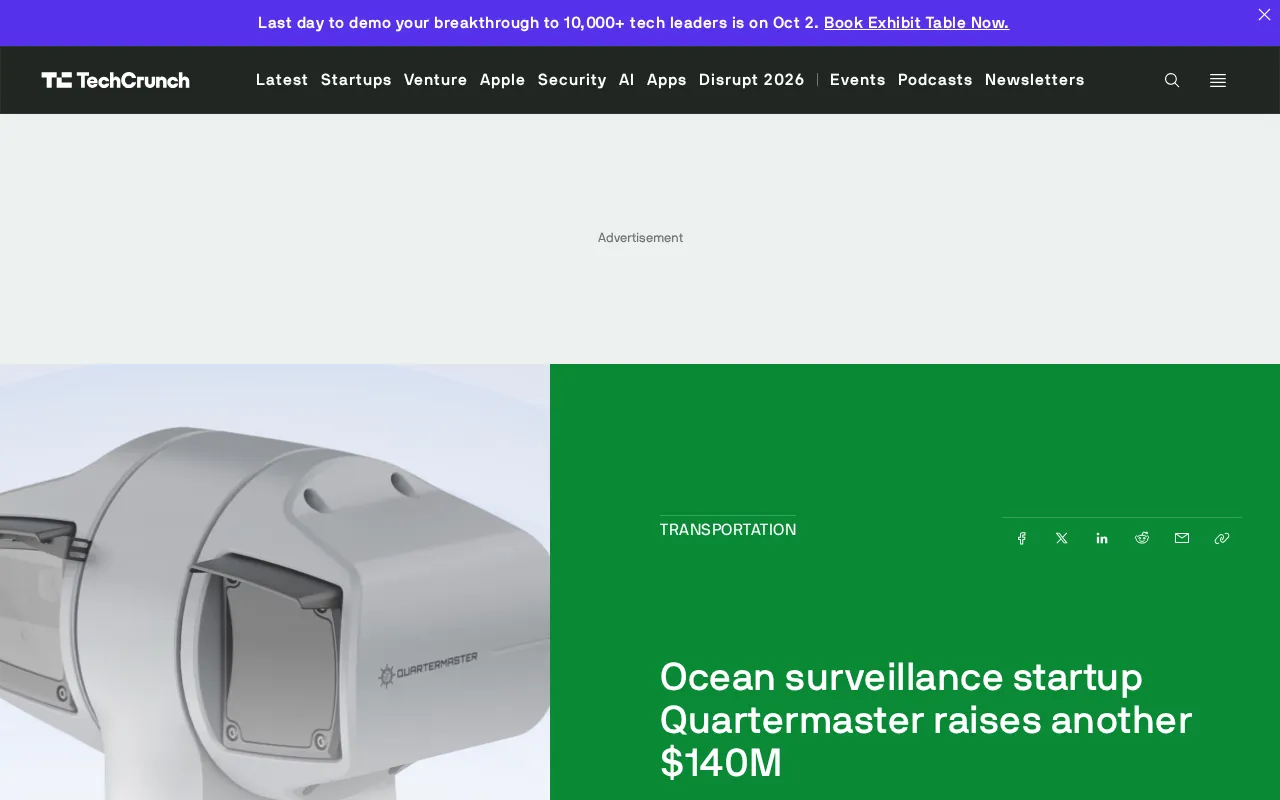
The ocean covers roughly 70% of Earth's surface, yet it has long been an information dead zone. Unlike land and airspace — already blanketed by satellites, radar, and sensor networks — ship movements, illegal fishing, smuggling, and even geopolitical incidents at sea are notoriously difficult to track in real time. Quartermaster is positioning itself to close exactly that gap.
Why the "Ocean Blind Spot" Is Worth Hundreds of Millions
Quartermaster's framing of the ocean as "the largest blind spot on Earth" cuts to the heart of the maritime monitoring market opportunity. Traditional Automatic Identification Systems (AIS) rely on vessels actively broadcasting their position signals — the moment a ship switches off its transponder, it vanishes from the picture, creating enormous room for illicit activity.
Achieving real-time awareness requires fusing data from multiple sources — satellite imagery, radio frequency signals, radar returns — and applying AI for automated identification and anomaly detection. This kind of capability has clear application value across military defense, maritime law enforcement, fisheries regulation, and commercial shipping insurance.
The $140 million funding round reflects strong investor confidence in the maritime monitoring space. Against a backdrop of rising geopolitical tensions and growing maritime security concerns, companies capable of delivering around-the-clock ocean visibility are attracting increasing attention.
AIS is the backbone of global maritime traffic management today, functioning much like a nautical version of aviation transponders: vessels periodically broadcast their position, speed, heading, and vessel identity over VHF radio frequencies, with coastal stations or satellites receiving and aggregating the data. But AIS has two structural weaknesses baked in. First, it depends on vessels voluntarily complying — a ship's captain can switch off the transmitter at any time, a common practice in illegal fishing, smuggling, or sanctions evasion. The industry calls this "AIS spoofing" or operating as a "dark vessel." Second, traditional shore-based AIS receivers have a range of roughly 40 nautical miles; coverage in open-ocean areas requires satellite AIS (S-AIS), but orbital pass intervals and coverage density introduce data latency and blind spots. These structural flaws are precisely what makes "non-cooperative target recognition" — fusing radar, optical satellites, RF detection, and other sources — the central battleground of maritime monitoring technology.
A Dual Driver: Technology and Market Demand
The core challenge in maritime monitoring is coverage combined with data processing. The ocean is simply too vast for any single sensor to form a complete picture, making it necessary to network satellite constellations, unmanned platforms, and ground receiving stations together. The ultimate value of raw data at scale depends on whether algorithms can rapidly distill it into actionable intelligence.
The "real-time" capability that Quartermaster emphasizes is the decisive competitive differentiator in this space. The shorter the latency from data collection to intelligence output, the higher the operational value in scenarios like law enforcement interception and risk early warning. This also explains why sustained capital investment is critical for companies in this sector — building a globally covering sensing network is inherently capital-intensive and a long-horizon engineering challenge.
Maritime Domain Awareness (MDA) is a concept formally defined by the U.S. Department of Homeland Security in 2005, referring to effective awareness and understanding of all maritime activity that could affect national security, economic security, or environmental security. Its technical architecture typically comprises three layers: the sensing layer (satellite constellations, unmanned surface/underwater vehicles, shore-based radar, AIS receivers), the transmission layer (data links and cloud aggregation), and the analytics layer (AI target detection, behavioral anomaly algorithms, intelligence fusion). In recent years, the dramatically falling cost of low-Earth-orbit commercial satellite constellations has shifted "persistent space-based staring" from a defense-exclusive capability to something commercially accessible — and that is exactly the technology window that startups like Quartermaster are exploiting. Competition at the analytics layer is equally fierce: how to rapidly distinguish fishing vessels, cargo ships, and potential threat targets from noisy signals, and compress results into a minute-level response, is where each company's core algorithmic moat lies.
Conclusion
Quartermaster's latest funding round is a signal for the broader ocean technology sector. As the information saturation of Earth's land and airspace approaches its ceiling, the ocean — the "last blind spot" — is becoming a new battleground for both technology and capital. That said, with limited public information currently available, the company's specific technical roadmap, product form, and customer structure remain to be further disclosed.
Related articles

Frontend to AI Agent Development: A Frontline Architect Explains Career Paths and Opportunities
A frontline AI architect explains the industry changes and practical paths for frontend developers transitioning to AI Agent development: why pure frontend jobs are disappearing, why Agent + full-stack has become mainstream in hiring, and three transformation routes—Agent development engineer, FDE, and remote contracting—along with corresponding learning strategies.

How to Choose an AI Agent Development Course: Five Pitfall-Avoidance Guidelines
A mechanical-engineering career changer's two-year pitfall-tested checklist for screening AI Agent development courses: complete delivery pipeline, resume-worthy projects, real development perspective, update frequency, and coaching feedback—with concrete judgment methods and pitfall-avoidance tips.

Coze AI Agent Building for Beginners: A Zero-Code AI Agent Development Guide
Coze, ByteDance's one-stop AI application development platform, supports zero-code drag-and-drop AI agent building. This article outlines Coze's core concepts, three advantages, differences between the domestic and international versions, and the distinction between agents and apps, helping beginners quickly get started with AI Agent development.