OCRia-nano-1: A Lightweight OCR Model for Parsing Massive PDF Documents
Lightweight OCR model OCRia-nano-1 debuts, targeting massive PDF parsing with a low deployment barrier.
The article introduces the emerging lightweight OCR model OCRia-nano-1, released on Hugging Face and invocable via the liteparse tool, positioned for batch text extraction from large-scale PDF documents. Its "nano" design lowers computational resource requirements and deployment costs, making it suitable for scenarios sensitive to speed and cost, such as academic research, enterprise document management, and historical archive digitization. The article analyzes advantages such as toolchain integration and platform ecosystem support, while noting that public technical details are limited, that lightweight models may compromise on complex layouts, low-quality scans, and handwriting recognition, and that the tweet's "trillions of pages" is more marketing rhetoric—actual capability depends on hardware and distributed strategies. It concludes with trial recommendations and emphasizes the need for empirical performance verification.
Introduction: A New Option for Large-Scale PDF Parsing
In an era of information explosion, PDF documents remain one of the primary carriers of accumulated knowledge. From academic papers to corporate reports, from scanned documents to electronic invoices, the PDF format holds vast amounts of unstructured data. Yet how to efficiently and accurately extract text information from these documents has always been a challenge for developers. Recently, a model called OCRia-nano-1 has attracted attention on social media, described as a lightweight OCR solution capable of "parsing trillions of PDF pages." This article takes an in-depth look at the model's characteristics, application scenarios, and the potential impact it may have on the document processing field.

What Is OCRia-nano-1?
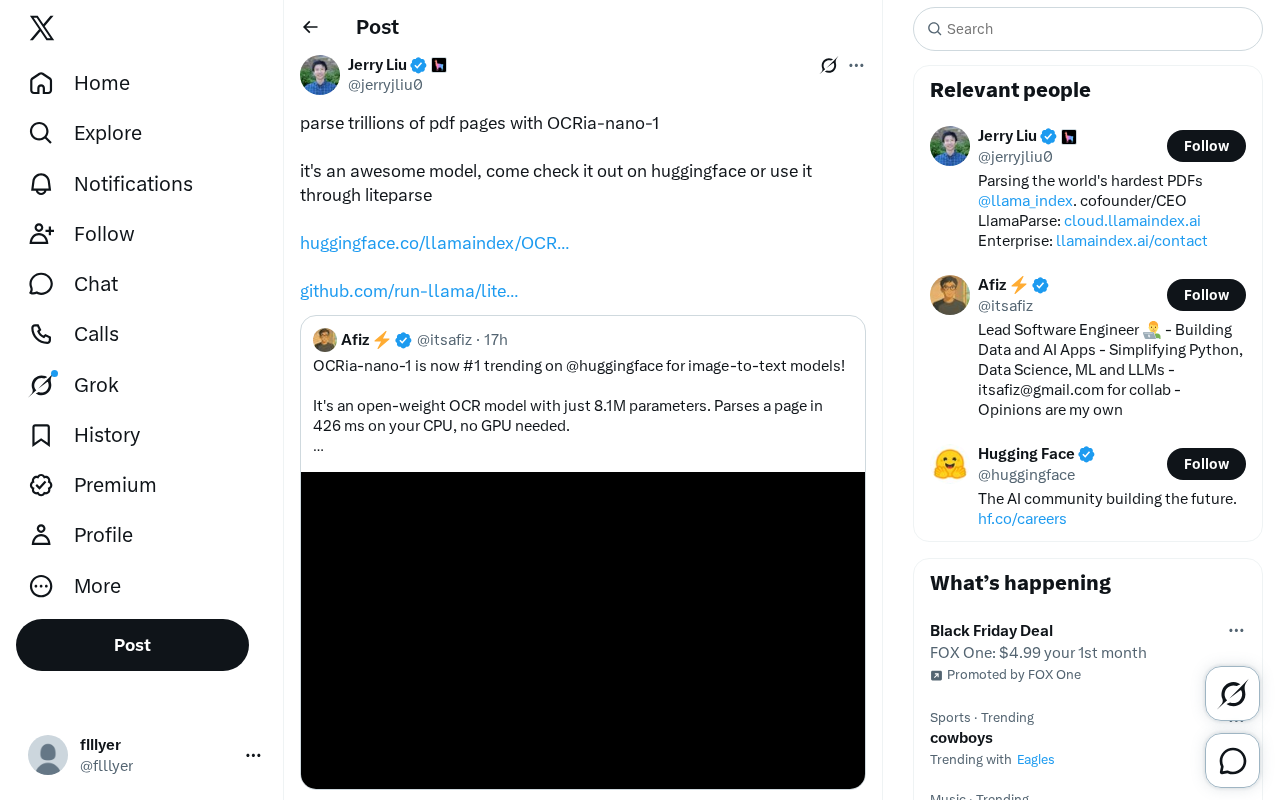
According to publicly available information, OCRia-nano-1 is a lightweight model focused on optical character recognition (OCR). The "nano" in its name hints at the model's small size, which typically means lower computational resource requirements and faster inference speed. The model is released on the Hugging Face platform, where developers can download and use it directly, or invoke it through a tool called liteparse.
Judging from its positioning, OCRia-nano-1 targets the scenario of batch parsing of large-scale PDF documents. The original tweet mentions "parse trillions of PDF pages"—while "trillions of pages" may be rhetorical exaggeration, it sufficiently reflects the model's ambition in handling massive amounts of data. For enterprises and researchers who need to extract text from large volumes of PDFs, an efficient and easily integrated OCR model holds considerable appeal.
OCR (Optical Character Recognition) is the technology that converts text in images into editable text. Modern OCR systems typically consist of two stages: text detection (locating text regions) and text recognition (converting regions into characters), implemented in the deep learning era mostly with CNN+RNN or Transformer architectures. OCR of PDF documents faces special challenges: electronic PDFs may have a text layer embedded directly (no OCR needed), while scanned PDFs are pure images that must first be rendered into bitmaps before recognition. In addition, complex layouts such as multi-column formatting, tables, formulas, and headers/footers require the model to have layout analysis capabilities. Lightweight OCR models often trade off between detection and recognition accuracy, making them suitable for batch processing scenarios that demand high speed and involve relatively regular document layouts.
Core Features and Advantages
Lightweight Design Lowers the Deployment Barrier
The "nano" suffix of OCRia-nano-1 indicates its small model size. In the OCR field, traditional models often require substantial computational resources, whereas lightweight models can run on edge devices or ordinary servers, greatly reducing deployment costs. For users who need to process massive volumes of documents, this means achieving higher throughput under limited hardware conditions.
Knowledge distillation and model pruning are two mainstream techniques for compressing deep learning models. Knowledge distillation lets a small "student model" mimic the output distribution of a large "teacher model," thereby retaining most of the accuracy while greatly reducing the number of parameters; model pruning removes redundant weights or channels to reduce computation. In addition, quantization (converting FP32 weights to INT8) can also significantly reduce model size and accelerate inference. Lightweight OCR models often employ these techniques to bring parameter counts down to the millions while maintaining acceptable accuracy, enabling real-time operation on CPUs or edge devices. However, the accuracy loss caused by compression is particularly noticeable on low-quality scans, handwriting, or complex layouts, so users need to assess applicability based on document quality.
Integration with the liteparse Tool
The tweet specifically mentions "liteparse," which is very likely a companion parsing tool or library used to simplify the process of invoking OCRia-nano-1. Combining the model with a toolchain can lower the barrier for developers, allowing users to focus more on business logic rather than low-level implementation. This "model + tool" combination pattern is becoming increasingly common in the open-source community and helps accelerate technology adoption.
Hugging Face is an AI model hosting and open-source community platform that provides a model hub, datasets, inference APIs, and core libraries such as transformers and datasets. Developers can load model weights with a single line of code via from_pretrained() and quickly run inference using the Pipeline interface. Hugging Face model cards typically include the model architecture, training data, evaluation metrics, and usage examples, making them an important source of information for understanding new models. For OCR tasks, models such as TrOCR and Donut already exist on Hugging Face, and ecosystem tools like pdf2image and PyMuPDF can be used together to complete PDF-to-image preprocessing. The platform also supports Spaces deployment demos, making it convenient for users to test model performance online.
Hugging Face Platform Support
The model's release on Hugging Face means users can conveniently obtain model weights, view documentation, and engage in community discussions. As an important hub for AI models, Hugging Face provides good exposure and ecosystem support for OCRia-nano-1. Developers can quickly load the model through libraries such as transformers for inference testing.
Application Scenarios and Potential
The positioning of OCRia-nano-1 determines that its application scenarios are mainly concentrated in fields requiring large-scale text extraction:
- Academic research: Extracting abstracts, references, and other information from massive volumes of academic paper PDFs to build knowledge graphs.
- Enterprise document management: Automating the processing of scanned invoices, contracts, reports, and more to achieve document digitization and retrieval.
- Historical archive digitization: Performing OCR on scanned images of ancient books and archives to preserve and disseminate cultural heritage.
- Content aggregation platforms: Converting PDF content into editable text for further processing and publishing.
A common characteristic of these scenarios is sensitivity to processing speed and cost, and lightweight models are well suited to meet such needs.
Technical Details and Limitations
Currently, publicly available information about the technical details of OCRia-nano-1 is limited, and we cannot know its specific network architecture, training data scale, or performance metrics. Judging from the "nano" naming convention, it may employ techniques such as distillation or pruning to compress the model, reducing the parameter count while maintaining a certain level of accuracy. But lightweight models typically make compromises on complex layouts, low-quality scans, or handwriting recognition. Therefore, in practical applications, users need to evaluate its applicability based on document quality.
In addition, the "trillions of pages" in the original tweet is more of a marketing phrase. Actual processing capability depends on hardware configuration, document complexity, and batch processing strategy. For ultra-large-scale tasks, distributed computing frameworks are usually required, which a single model cannot accomplish on its own.
How to Get Started
If you are interested in OCRia-nano-1, you can try it through the following approaches:
- Visit the Hugging Face model page to view the model card and example code.
- Install the liteparse tool (if available) and integrate it according to the documentation.
- Prepare a batch of test PDFs to evaluate the model's performance on real data.
- Adjust the preprocessing and post-processing workflows based on the results to achieve the best performance.
Since the model is still an emerging project, it is recommended to follow its community updates to obtain the latest information and best practices.
Conclusion
OCRia-nano-1 offers a lightweight option for batch OCR of PDF documents, and its pairing with the liteparse tool along with Hugging Face's open ecosystem lowers the barrier to use. Although its specific performance remains to be verified through actual testing, it is undoubtedly worth watching for developers who need to process massive volumes of documents. As the demand for document digitization continues to grow, efficient and easy-to-use OCR models like this are expected to play a role in more scenarios.
(Note: This article is written based on publicly available tweet information; please refer to the official release for the model's specific performance.)
Related articles
AI and Humans Team Up to Crack a 167-Year-Old Math Puzzle: Has the Riemann Hypothesis Been Solved?
A 167-year-old Riemann Hypothesis breakthrough? Human mathematicians provide a blueprint, AI coordinates 60 sub-agents to generate 17 million lines of proof code, then formally verified by Lean and compressed to 76,000 lines. This article analyzes the complete path and controversies of this human-AI collaboration.

AI Proves the Riemann Hypothesis? The Mathematical Revolution and Controversy Behind 170,000 Lines of Code
Anthropic mathematician uses AI to complete a machine-verified proof of the Riemann Hypothesis—17 million lines of Lean code shake the math world. A human team releases an all-human proof the same day, sparking debate over machine verification versus human understanding and AI's changing role in science.
Did AI Really Prove the Riemann Hypothesis? Mathematician Claims Cloud AI Model Cracked a 167-Year-Old Mystery
A mathematician claims a cloud AI model proved the 167-year-old Riemann Hypothesis. We explain prime distribution, what the hypothesis really says, and whether to trust the claim.